Showing posts with label jewish graphic novels. Show all posts

Sunday, 16 November 2025

An Israeli Indiana Jones


Discovering the Israeli graphic novels is like a full immersion - don´t think about mikvah, though - in a free world where words, and colours, and topics of actuality are freely flying over the nest. Not all of them are translated into English or other languages, but they can be easily used for improving your Hebrew, or just learning the language, thus, getting full access of the street language, so important for grasping the pace of the society in general.

Tunnel by Rutu Modan, children book author and illustrator and also one of the co-founder of a group of Israeli graphic artists, can be read as a local variant of Indiana Jones meeting the Israeli-Palestinian conflict. Archeology is an important discipline in Israel but it also plays an important role in the national building process as the discovery and authentification of artefacts is often instrumentalized in a process where history meets religion meets politics.

The artefact in case here is the hunt for an old tablet from the Babylonian exile raising questions about who wrote inscriptions on an old tablet. Nili, a single mother, returns to Israel and is trying to fight to save the legacy of her father, once a renowed archeologist, now took over by dementia, against the malicious efforts of the rival teacher Rafi - add academic rivality to the story. Also, Nili´s brother,m also an archeologist, is working with the rival teacher.  A hobby archeologist she is startingt o search for the famed Ark of the Convenent, but figured out that the missing tablet may be located in a Palestinian village. 

The next level concerns issues of ethics and morality in the antiquities world trade, as one person may be able to offer the key to the lost tablet, but this Abuloff is not trustworthy enough to be taken seriously.

Every single page and dialogue of this book has something to say about society and conflict, from the location of the artefact and the complexities of the archeological searches. It is not a political satire by purpose but nevertheless it shows how complex life in a conflict zone may be, without taking any specific political side.

The book was also translated into German by Reprodukt

Here is an interview with the author about the book and her creative process published by The Tel Aviv Review of Books, worth reading if interesting in finding out more about this book.

Friday, 24 December 2021

Three Graphic Novels with a Jewish Topic

I love the language of the graphic novels as suited to convene a variety of topics, including history and identity and religion. Three topics matching perfectly when it comes to Jewish identity. In the last months I´ve read a couple of graphic novels with Jewish topics that I am happy to further recommend.

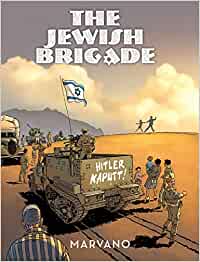
The Jewish Brigade by Marvano


This book is the second from the series created by the Belgian cartoonish Marvano. Based on true facts - Jewish soldiers hunting former Nazis in Europe at the end of the war - it recreates the ambiance of incertainty and human confusion at the end of the second World War. In few words and many inspired visual representations, there are a lot of stories told in just a couple of pages: how Jews just escaping the camps were killed by their non-Jewish neighbours, the meeting between the Russian Cold War interests and the ex-Nazis, the ways in which former Nazis escaped Europe and their punishment. Enough history and context to make you curious to find out more about it, especially if not familiar with the intricacies of those times.

Disclaimer: Book offered by the publisher in exchange for an honest review

Herzl by Camille de Toledo, illustrated by Alexander Pavlenko


Herzl written by Camille de Toledo and illustrated by Alexander Pavlenko is a story within the story, where a simple human story meets the history in the making. Ilya is a Jew who escaped the pogroms and antisemitism of Europe at a time when Herzl acknowledged the neeed for the Jews to have their own homeland. The drama of the little Ilya is the best argument in favor of such a political move. The text is elaborated and unusually rich for this genre, and the predominantly black/dark illustrations are adding the emotional dramatism to the story. I´ve read the book in the original French language. 

The duo De Toledo-Pavlenko recently published a book inspired by the stories of Isaac Babel which I hope to read it soon.

Jerusalem, Ein Familienporträt by Boaz Yakin, illustrated by Nick Bertozzi


Jerusalem. A Family Portrait - I´ve read it in the German version. Ein Familienporträt - is the result of collaboration between the screenwriter and producer Boaz Yakin and illustrator Nick Bertozzi. Its focus is the story of the Halaby family - originally from Aleppo - living in Jerusalem before and during the creation of the state. The story not only dares to explore a very delicate historical period of time, but reveals so many details that one can rarely find in a ´serious´ history book, such as the story of the Communist Party in ´Palestine´.

Those three books are not only relevant from the purely Jewish history point of view, but there are also important as a way in which historical information can be treated and transmitted through literary/visual support. 

Tuesday, 6 April 2021

Natan Sharansky, hero of a graphic novel

Once upon a time, the Jews of the Soviet Union were living under a government at least as oppressive as the Pharaon of Egypt during the Pesach story.


For the very young readers, Natan Sharansky and his fight against the enormous power of the Soviet Union may not mean too much. After all, who does remember the Soviet Union if never lived there or in its vicinity? However, in another reality, this conglomerate of nations, cultures and languages kept Jews captive either by refusing them the right to a passport and to their trip to Israel - or out of the country - or simply imprisoning those who reclaimed their identity.

Sharansky was born in the same year with the state of Israel - 1948 - in the nowadays Ukraine. A passionate chess player, he enroled in the Moscow Institute of Physics and Technology - one of the few accepting Jews in the Soviet Union. Belonging to a very secular family, as many other Jews from all over the world, he became inspired by the victory of Israel during the 6-Day War. He reclaimed his identity, by being interested to learn Hebrew and eventually become closer to religious practice. As he was employed by the Institute for Oil and Gas in Moscow, his visa was denied due to his familiarity with ´state secrets´. His wife, Avital, that he married one day before she left for Israel, was waiting for him and soon she will become his voice and supporter. Arrested in March 1977 and brought to Lefortovo KGB Prison he will spent over 400 days touring the Soviet prisons. His liberation was requested at public gatherings all over the world and was finally decided following the 1986 meeting between Gorbatchev and his American counterpart, Ronald Reagan.

In the context of the lockdown stories, Sharansky - now living in Israel and since then holding various official positions, including as the top head of Jewish Agency for Israel - shared how he was able to survive solitary confinment while imagining various chess moves. This helped him to keep his brain sharp. 

The graphic novel featuring all those stories long forgotten, Natan Sharansky. Freedom Fighter for Soviet Jews is the team work of Blake Hoena (text) and Daniele Dickmann (illustrations). The text is dense and includes a lot of useful information. I was not very impressed by the illustrations but it´s a matter of personal taste and expectations. Overall, it is an useful book, aimed to remind about a very dramatic episode in the history of contemporary Jewry. Hopefully, there will be more such works that will keep the memory alive, for a variety of readership.

Rating: 3.5 stars

Disclaimer: Book offered by the publisher in exchange for an honest review