Wednesday, 4 May 2016

'They stole our childhood'...

'When I come in Europe with my family and watched my child going to school I realized that I never had my own childhood. I haven't been to school, I haven't play with other children, I have not toys and did not know to play at all'. My friend, a child survivor, dared to tell me about her life and memories. She haven't talk about this with her own son and avoids to repeat this story in public. 
My mother haven't lived long enough to reach that moment in life when you want to get the memories out of yourself and share it with the others. When the stories are too far away to hurt. But we never understood why she never played with us, why she never had toys and childhood friends. We not even misunderstand her, but we accused her of being cold and not a good mother and not loving us enough. Disappointing us, even in her afterlife.
My big S. said today: 'I was so lucky to be born not too late for getting to know Shoah survivors'. This, coming from a teenager who is still trying to find out herself, first by completely breaking up with her traditions and family customs, tells something about the emergency of sharing over and over again the stories. 
Suffering is incomprehensible and so are the ways of life during terrible times. For my children and the memory of my mother and many other like her whose pain was too big to share it, we need to bear witness. We, the children with toys and school and childhood. 

Teaching children gratitude: Yitzi and the Giant Menorah

This is not a book about Hanukah, but about being grateful and thankful for the gifts we are given and, in general, for good things that are happening to us. Aimed for preschool and first grade children, this very beautifully illustrated work of writing tells a story taking place in the famous - for the Jewish world - village of Chelm, in Poland. This place was known for the less gifted minds of its citizens, but being intelligent does not make you automatically a better human. The - Jewish - mayor of  Lublin sent to the people of Chelm a giant menorah for Hanukah, and they were all the time thereafter trying to find solutions about what to send him in exchange. At the beginning, they are not very lucky about that: the delicious latkes made by Rivka the Cook are eaten before delivery, the giant ice is melting. Finally, they decide about something more symbolic: they all get together and lit the menorah, with all the beautiful lights reaching as far as Lublin, where the mayor was invited to watch the gratitude show from a hill. This was the most beautiful gift, worth all the material presents because it magnified the gesture creating a bigger, majestic effect. And this is the essence of the holiday of Hanukah, to be grateful for the wonderful small things that happened to us.
This book can be used as the starting point of a long discussion about gratitude and interacting with the others peers, either at home or at school. The language is simple, and the illustrations are inspiring - either colourful, with a Chagall touch, or very strong black graphics.
At the end of the book, the holiday of Hanuka is explained at length.
The author, Richard Ungar, is an artist with a lawyer background that authored and illustrated many books, including a series based in Chelm.
The book will be available on Amazon beginning of September, which makes it a great gift for the Rosh Hashana or Hanuka.
Disclaimer: Book offered by the publisher via NetGalley.com, in exchange of an honest review.

Monday, 18 April 2016

Book Review: The treasure of Mr. Isakowitz

I have met Jews from Sweden, but never read a book written by a Swedish author about Jews and Shoa. Danny Wattin's book offered me the occasion to correct this omission. 
Maybe the story as such - three Jewish men: grandfather, son and grandson are going to Poland from Sweden to find the whereabouts of a tresure hidden before the war by the grand-grandfather - I fell in love with the writing style. It is a memoir inspired by personal stories, rebuilding fragments of stories during the war, based on stories of relatives and the own research of the author. The style is succint, suple, easy, not-pathetic and (self)ironic. It is the writing of a new generation of post-Shoah writers, quite far away of the events to approach the stories from a non-engaged angle but equally interested as the previous generations to tell the stories and recover the old histories. 
It results an approach that it is not superficial, but different. It remains the interest for the truth and the revenge of memory, but the scale of the voice differs. I am really curious about discovering more authors from this generation and, who knows, maybe some more histories about Swedish Jews too. 

Saturday, 9 April 2016

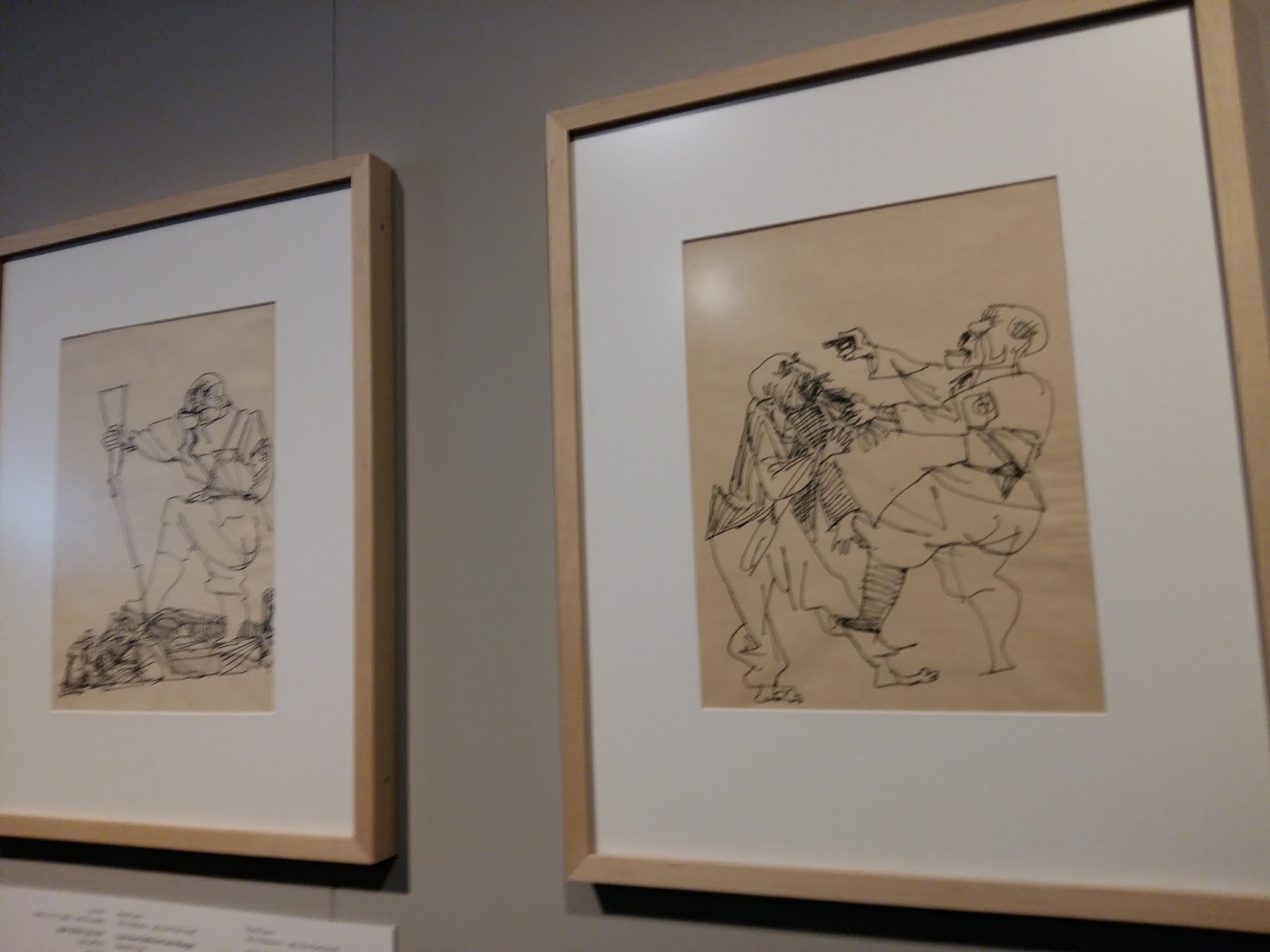
Art from the Shoah at the German History Museum

How was it possible to create, work and feel normal in a concentration camp, where misery and the sword of death was ready to cut every minute? Myself, I cannot write or do anything creative when I am not with a clear mind and clear space. Preferably beautifully adorned. The exibition at the German History Museum, organised in collaboration with Yad Vashem, offers samples of works by artists that created until the last moment, in awful conditions, sometimes trading food for any small tool that can help them work. Over 70% of them perished during Shoah, but their works were testimonies - sometimes with a legal value too, presented in international courts - of the camp life and atrocities happening there.
Alexander Bogen, who fought against the Germans as partisan, and lately settled in the state of Israel, gave me the plain answer to the question about how art was possible: drawing and fighting day and night, being creative during Shoah was a protest of the artist against what was happening. Besides graphic work, the exhibition included also some beautiful poetry where hope and desperation are part of the artistic dialogue and diary.
Besides the life in the camp, there are interesting insights about Jewish life in Europe at the time, in general. In the picture, the drawings of the Dadaist artist Marcel Janco about the attacks against religious Jews in Bucharest, Romania, 1940. A reality often denied and neglected in this country even today.
There were so many impressive works at this exhibition. From the documentation of the daily hunger, to the atemporal girls in the field by Nelly Toll or the painting Children of the ghetto made on a potato sack. Moritz Müller paints in beautiful colours and using contrasts the idyllic nature around Theresienstadt. Or the self portrait by Esther Lurie, part of a long series of such self representations in the camps. 
Noteworthy was also the high quality of the documentation, either the leaflets in German, English and Hebrew with extensive biographies or the audio guides explaining in the smallest details the history of the artwork and the particular context it was created.
An opportunity to humbly let the silence in and appreciate any moment in life while being aware that such tragedies will never happen again. 

Friday, 1 April 2016

Of Israeli life in Palo Alto: Noga Niv - Inside the Bubble

Contemporary books about the hectic Israeli expat experiences in Europe or America are not a very frequent publishing event - at least not in English, but this one succeeds to break the ice. Inside the Bubble was published in Hebrew in 2008 and comes in an English version in 2015. 
Told from the perspective of Daniella, an Israeli psychologist on the Western coast of the USA, the literary alter ego of the author, it tells the story of a couple of financially successful Israeli families living on the top of the big waves of the start-up bubble. It is hard to identify these people back in the country as they keep speaking Hebrew and their children, altough bilingual, keep a strong Israeli identity. In the country, they belong to the invisible rich people, investing in expensive penthouse they occupy for maximum two months the year, the house where they will one day return, eventually, after getting the best from the 'chutz'. In the States, they are quite easy to spot, as they do not mix very well with the local Jewish communities, except during the high holidays or some special charity events. They keep the customs and the language and the homesickness for home and the za'atar. Many of them the first generation born in Israel, their identity is made up of their common language, Army histories and the grief of their parents whose lives were dramatically torn to pieces by Shoah. 
The stories are told through the voices of the women friends, part of a group of expat women that are trying to make a life of their own while their husbands are busy making money. They are not strong women, as the stereotypical women literature expects to be, but women enjoying the discoveries of their mature years, with all the doubts and struggle involved. Human stories are never simple and I enjoyed the subtle observations and introspections of the author.  
There are stories to be told and readers to enjoy them and this book is a welcomed addition to an emerging literature. Right now, I wonder who will write a similar book about expat life in Berlin. Or maybe not. 

Monday, 14 March 2016

Jewish stories in Aleppo: Picciotto family

There were many illustrious Jewish families in the Middle East, and Picciotto remains until today a famous brand. Present in Syria, Egypt or in Beyrouth, they arrived in the area from Livorno at the end of the 18th century. In Aleppo, they settled in Khan al-Gumruk. Besides trade, members of the family were amongs the first consul in the city for the Holy Roman Empire shortly after they relocated in the region. Apparently they did a good job, as the Austrian Empire enobled them in 1806, one of the first Jews to receive such a honour.
One of the most important figure was Esdras de Picciotto, who held the position of of Austrian consul general. In this position, he presided over the Catholic services in the city, part of his obligations being also the enthronement of the Apostolic Vicar of Syria. In 1818, his brother, Eliahu, was designated as vice-consul of Denmark, while the other brother, Raffaele, was the consul of Russia. Ironically, at the time, both the Russian and Austrian Empire were strongly anti-Semitic and on their territories, life of the Jews were a cheap commodity. Other members of the family took the positions as consuls of Sweden, the Netherlands, Prussia and Spain. Moise de Picciotto, for instance, was representing 5 countries at once: Austria, Prussia, Denmark, the Netherlands and Belgium.
In time, they become very wealthy and influential, giving loans to many powerful or simple citizens of Aleppo. In the 19th centuries, they created their own bank.
Members of the family are still alive nowadays mostly in Switzerland, keeping alive their love for Aleppo and the Middle East in general.

The information from this article is mostly based on the research on Aleppo, by Philip Mansel that will be published at the end of April. The edition house house granted me the book via NetGalley.com. It is a detailed overview of the life in and history of Aleppo, but get caught in the usual stereotype about the happy harmony between Jewish and Muslim communities in the Middle East, ignoring the many 'blood labels', frequent at the end of the 19th century, and pogroms against the Syrian Jews. The book is not about Jews in Syria, after all. 

Sunday, 13 March 2016

Why the Jewish character must be the bad guy?

I wonder why? Why not the Chinese, the Indian or the Indonesian, just to give some random examples...True is that in every community there are bad guys and good guys and Jews are no exception to that but, besides this reality, the literature creates or emulates certain models and stereotypes which perpetuate certain negative stereotypes, including those with anti-Semitic flavours. 
My recent experience in this respect is the short story part of the Santa Rita Stories, by Andrew J. Rodriquez. It collects various stories based in Santa Rita, a little fishing village in Northeastern part of Cuba. Created as an initition story into life of the little Carlos by the destitute Pedro, it includes various lessons in understanding life and humans. One of them is dedicated to Carlos encounters with the family of Veronica, a girl he worshipped in secret. Everything started with the invitation to attend and accompany her to her fiesta de los quince - celebration of 15-year anniversary, an important moment in the life of a Cuban girl. 
Both Pedro and his parents are warning him that she is Jewish and thus, different traditions apply. But when he received an invitation to meet her father Benny, he has a little nightmare experience. The house is guarted by a huge dog who is ready to bit everyone that is shaking hands with any member of the family. The interior is full of kitsch expensive looking art, besides Jewish symbols. The father, Benny is not only 40 minutes late and impolite, but offers him a dirty deal: to pay him to keep his daughter away from the previous boyfriend till the famous party, which is planned as a way to invite famous local people and climb up the social ladder. He is open with his intentions: 'The pride and joy of elevating our status far beyond the common folk is all I care for'. 
Brave Carlos will not succumb the temptation and will reject the invitation to the party, while keeping a secret relationship with Veronica till her departure to Havana to her aunt for law studies. 
Again, you don't have to tag ethnicity for creating bad guy characters.