Friday, 27 March 2020

Exploring Contemporary Halachic Issues with Rabbi Ari N. Enkin

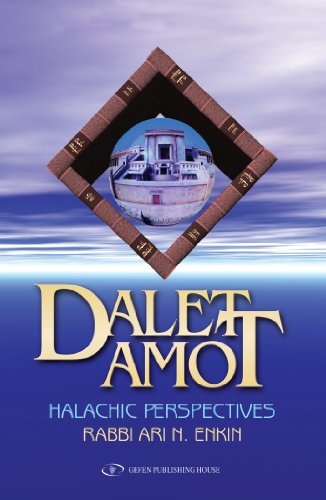
Dalet Amot: Halachic Perspectives (English Edition) von [Enkin, Ari N. ]
`Dalet amot´ literally means ´4 cubits of Halacha´ and this is what we were left with after the Temple in Jerusalem was destroyed. In over 100 articles approaching diverse topics such as women&family, medical issues or inter-personal relationships, Rabbi Ari N. Enkin offers a consistent review of more or less known issues pertaining to the everyday Jewish practice.
The level of knowledge required is basic to inter-mediate, but personally I think that every person, regardless the level of Torah education, either you are a layman, scholar or observant Jew, everyone has something new to learn and think about after reading this book. Remember the answee to the question: who is a wise man?
Despite the diversity of topics, many of them - for example, the issue of adoption - I would definitely want to study later in a more systematic and in-depth way, there is something else I highly appreciated about Dalet Amot. Halachic Perspectives by Rabbi Ari N. Enkin: the generous way in which it includes different perspectives and approaches, without taking a definite stance. After all, in the author´s own words: `If Gd is infinite, then there must be an infinite number of legitimate ways to serve Him`. It is nothing wrong in following a certain path that you´ve been observed in your home, but this does not exclude the recognition of many other similar choices and possibilities, given than the halachic matrix is respected.
The author acknowledge the fact that we must ensure that women learn halacha, and there are aspects pertaining to women practice approaches in the book, for example kol isha, modesty and mikveh - the topic of building a mikveh and the various points of view is another topic I will be very interested to approach into more technical detail one day - one may not find any dispute or controversial statements on this issue, the neutral - halachically/legal - perspective being rather followed.
Personally, I´ve found the book very useful as a refreshment of some halachic topics and for the discovery of new problems that hopefully will keep me busy in the next weeks and months.
For anyone looking for a bit of Torah learning and a larger peace of mind in confused times, Dalet Amot. Halachic Perspectives by Rabbi Ari N. Enkin may offer solace, inspiration and eventually reasons to consider an even higher level of Torah learning and halachic observance.


Tuesday, 24 March 2020

How I See It...

It´s like one day, Gd had again suddently enough of how bad humans started to behave against each other and against His work and released this time a powerful invisible virus that put the entire world on lockdown, giving the chance to humans to reestablish that genuine bond of kindness and simple humanity.

Personally, I am watching the world unfolding and I am so curious what it will bring next. Very curious...

Saturday, 14 March 2020

Exile: Portraits of the Jewish Diaspora

What makes us stay Jewish despite all the persecution and hate and forced conversions? Why people still not move en masse in Israel after the creation of the state in 1948 - although many acknowledge the safety net that it offers as the only place where eventually a Jew should be when things are getting ´really bad´ the diaspora?
Annika Hernroth-Rothstein, which defines herself as ´a Jew in the diaspora, a survivor among survivors, and a link in a vast chain that spans across the world´, a journalist and activist living in Sweden globetrotted the world to discover those links that helped us to not break in front of vicissitudes.
Her collection of accounts gathered in Exile: Portraits of the Jewish Diaspora adds up knowledge, information and introduce to the readers Jews from remote, unknown or out of reach places from around the world: Iran, Tunisia, Morocco, Uzbekistan, Cuba, Finland, Turkey, Venezuela or Siberia, among others. Obviously, many places can be openly visited, like in her local Sweden or Finland but it takes time, the good research and the proper connections to really know the people.
I really loved how the author have found the proper voice and background for each of the community stories: in some cases more history was needed, in other cases, the reader was offered a well-deserved introduction into the human network besides the institutional structures (my favorite so far are the stories from the Island of Cohanim - descendant of the High Priest in Jerusalem -, in Djerba, Tunisia and about the challenges encountered by the Jews in Venezuela). 
There are also interesting observations about the life of Jews in Iran ´one of the most elusive Jewish community in the world´, a country that used to save Jews during WWII while nowadays preaching Holocaust denial at its highest levels. According to her account based on her 2-week stay, the Jews of Iran ´are living in a gilded cage with freedoms and rights that can be taken away at the behest of their master with neither notice nor reason´. The forced isolation imposed by the life under sharia law allows the preservation of identity in the most ´Orthodox way´: inter-mariages are impossible (although conversions to Islam are a completely different story), there is plenty of kosher food available and physically aggressive anti-Semitism is absent, with no need of special protection of houses of prayers and Jewish institutions (in comparison with the situation in the liberal Sweden, for instance). 
There are also situations accounted that remind of the eternal diaspora situation, as the dispute in Uzbekistan between Askenazim (Jews of European descent) and Bukharian Jews (or Jews of the mountains as the Jews from this part of the former Soviet Union are called).
I was relatively disappointed about the part dedicated to Siberia: maybe too much discussion about the Russian/Putin connection and not too much about the diverse origin of the Jews that reached this cold remote province. Among others, there were for instance many Jews displaced by the Soviets during the WWII and the anti-Semitic persecutions from other Soviet republics like Moldova and Ukraine, known for their high-percentage of Jewish populations at the time.
My personal wish is that Annika will continue to travel the world and reveal more interesting Jewish stories. We all need to be reminded about those fine and multiple ties that connect all of us.

Rating: 4 stars

Monday, 9 March 2020

Another Testimony About Israeli Experiences in Germany

The experiences of Shahak Shapira as a Jew/Israeli in Germany adds another testimony to the hardships and challenges of Jewish life in this country. As he landed in Laucha, in Saxony a province whose far-right sympathies are finally acknowledged on a wider scale, together with his younger brother and his mother, he only had the experience of the settlement of Oranit where he grew up.
However, through his family stories he was relatively aware of what to expect: his grandfather on his father side, Amitzur Shapira, was a victim of the terrorism attack during the 1972 Olympic Games in Munich. 
With a tone full of humour and sarcasm, Shapira accounts about his encounters with the 'brown' guys. Encounters not always innocents, as his brother will get to the court against one of them. Shahak himself is attacked by antisemites in Berlin this time on 2015 New Years' Eve. 
Unfortunately this is a reality for way too long: antisemitism in schools, extreme right as a reality of the everyday life in some parts of Germany, attacks against Jews. If the situation as such cannot be changed ovenight, at least documenting it will offer a proof that not everyone stayed idle and did nothing at all.

Thursday, 20 February 2020

Book Review: The Covenant by Naomi Ragen

Esther, Leah, Maria and Ariana survived Auschwitz and made a covenant to always be ready to help each other. When the husband of Leah's granddaughter and their daughter are kidnapped by terrorists belonging to Izzedim al-Qassam terrorists in Israel, the four ladies reunite both their prayers and their connections and financial resources to save the two innocent lives.
There are many ways one can read The Covenant by Naomi Ragen, probably one of the best books I've read by this author so far: as an international thriller involving international actors; as a book about the torments of Jewish life in Israel and abroad; as a book about frienships cemented during terrible times. All reading are correct, in my opinion and it makes the book interesting and entertaining. Personally, I've read it in one sitting, curious about how the kidnapping case will evolve, as well as about the human interactions in time of crisis. 
The covenant uniting the four women, not all of them Jewish, is what separates humanity from lack of it, fear from the risk taken of never being helpless. It has to do more with human understanding and unity against evil, wherever it comes, regardless its justifications.
In the end, what kept me passionately reading this book was its obvious sparkle of humanity.

Book Review: Seven Blessings by Ruchama King

There is more than one question that those who did not marry young will ask, regardless if religious or not: what does it make it a good match? What can you do - besides being blacklisted by matchmakers - when no one is good enough for you?
The characters in Seven Blessings - allusion to the sheva brachot celebrated in the weeks after the wedding - are faced with difficult questions about love, relationships and trust, while looking for that life partner projected by the religious family model. It applies to both women and men, most of them in their late 30s, with different religious/observant backgrounds. They belong to the so-called 'Anglo' communities - English-speaking professionals that made aliya.
Being religious doesn't make the choices easier compared to the secular world and the deep questioning of the characters applies easily to the non-religious dilemma. 
The religious world itself changed tremendously and admirably Ruchama King is featuring women deeply involved in the study of the Torah, that besides a job and a busy family life are able to put aside a couple of hours for learning the holy texts. Although limited mostly to the modern communities, it is a tremendous change unheard of a couple of years ago.
The story as well as the characters has many tensioned moments which takes the book out of the relatively limited from the literary point of view - read boring, bland - of religious novels shelf for adding it to the largest range of quality literature. The search for love, the difficulties to accommodate desire with intelligence and many other complex inner monologue singles of any age are elaborating is relevant to anyone looking for a partner, regardless the geographical location and the religious denomination - or lack thereof.

Tuesday, 4 February 2020

About the Fate of Jews in Muslim Lands

Very often, one may heard that compared to the situation in Europe, Jews living in Islamic countries had a significantly better fate. The fact that they were allowed to pay a tax in exchange for their independence saved them from pogroms and forced conversions, some say.
The reality is in fact more complex and complicated than this wishful thinking. Being a Jew in diaspora rarely brought the gift of comfortable life. For those who did not have the chance to listen to stories of people that used to live in those countries, a book like The Jews of Islam by Bernard Lewis may help to have a better picture.
The book covers globally the main trends and historical events regarding the situation of Jewish communities in predominantly Muslim countries, starting from the early days of Islam. The landscape resulting is very diverse, including within the same region at different periods of time, depending on what interpretation of Islam prevail and what group - religious, tribe - was in power.
The obvious influences traded between Christians, Muslims and Jews, including in the field of religious practices are part of the co-existence. The significant influence on the Ottoman Empire Jews had in diverse fields as textile industry, arts and printing, is also noteworthy. However, these influences did not avoided pogroms or discrimination practices, especially in Shi'a dominating lands.
Although the focus is predominantly global - and I was curious about various specific cases -  The Jews of Islam offers a comprehensive picture of the ethnic landscape. Acknowledging the historical contexts is an important part in better understanding the specificities of each Jewish communities and Lewis' book can contribute to dissipating the stereotypes and ready-made interpretations about this region and the realities of religious interactions.