Showing posts with label Jewish life in Europe. Show all posts

Tuesday, 1 April 2014

History and histories

There is a lot of debate in the last weeks and months about 'truth' when it comes to events related to the Jewish life in Europe in between and after WWII. There is still a lot to be told, and the discretion of most old hasidic rabbis in getting public or writing about their experiences. Some, as many in my family, will simply refuse to disclose any details, especially about circumstances, people and locations. It was hard to understand what was going on and what was the right decision to make. Probably it was even harder to give advice to other people about what to do. It was like a night, and everyone was trying to swim against the current in that night.
After everything was gone, the constructed narrative were often based on personal accounts and not in a few situations, the escapes were miraculous. How politics, individual religious interpretations or various other reasons influenced the decisions for or against moving to Israel, there is a separate story. The Satmar, for instance, kept being against the state of Israel as usual, and their opposition didn't change. The decisive religious explanations given as an irrefutable fact about the reasons why 6 million people were killed is widely exaggerated and denies a basic right of the Jews: to never stop asking questions.
As for the decision of making aliyah, I assume it is individual and should be done when one is completely convinced it must be done. At the end of the screening process, one makes this fundamental step when fully aware of the reasons to be done: not because wants an outstanding career, or to find a mate, or to get rich, but because it is obvious that the Jews should live in their country and build their country against all odds. There is no other country for the Jews. The stories I am hearing recently of people moving back from Israel after 2-3 or even one year of aliya because disappointed of the economic situation or disillusioned about the different reality of their 'Zionist dreams' are sad. Maybe before making aliyah, people should really get in touch with the reality and their own reasons of moving in Israel.
The post-Holocaust generations, religious or not, grew up with the burden of the Shoah. Stories about what our grandfathers and parents went through were transmitted from generation to generation, not only in the shuls, but during the secular weekend afternoon. The acknowledging of the reality was equally shared to religious and non-religious children and the fear that this could any time happen again, was hunting us all. But it was this fear that made many of us powerful: strong enough to assume a religious identity that our parents couldn't have because their own parents were turned into ashes too early to learn them Shma; strong enough to assume in the front of the goyim that we are Jews; strong enough to face anti-Semites of all colours.
Despite all the small or big histories, real or not, about salvations and punishment, it is a clear historical reality: they wanted to kill us. That's obvious from all the official documents and policies of the interwar period. The Germans were helped by other smaller Amaleks, hysterically drunk with the idea of finally making real their old killers dreams, nurtured by their religions. This was the reality of Europe before and during the war: overwhelming hate against the Jews. Of course it was no clear reason to stay, but at the time, it was no state to defend us. Now we do, and it is our Army and they our our Jews, sons and grandsons of those who were killed.  
The instrumentalisation of our huge misunderstanding of the reasons why the tragedies happened for fighting one against the others is sad. Obliterating very often who our real enemies and where the serious dangers are. 

Thursday, 20 March 2014

Jewish life in Munich: Ohel Jacob Synagogue

The Synagogue 'Ohel Jacob' ('Jacob's Tent') in Munich is one of the main reference point of Jewish life in Germany and Munich. It was built between 2004-2006 and is part of a larger complex that includes also the Jewish Museum and the Jewish Center. An underground tunnel unites the synagogue to the Jewish Community Center, a memorial for the Jews killed in Munich. The official opening took place on 9 November 2006, the 68th anniversary of Kristallnacht. 
The synagogue was designed by Rena Wandel Hoefer  and Wolfgang Loich, who also designed the new synagogue in Dresden. It includes a cubic structure of travertine stone, the typical stone for many houses in Jerusalem, topped by a glass cube. The glass roof, separated by lines that form the Maghen David ('Star of David') signify the journey of Moshe Rabbeinu and the Jewish people through the desert, but can be also read as a symbol of hope for the light that conquers the darkness. The main portal, featuring in Hebrew letters the 10 Commandments, was manufactured in Budapest. 
The synagogue has a capacity of over 550 worshippers. More than 4,000 Jews were killed in Munich. After the war, many returned. Jews from the former Soviet Union that arrived in Germany after the fall of communism decided to settle in Munich too, bringing a new dynamic to the local community. The synagogue was often targeted by anti-Semitic threats.
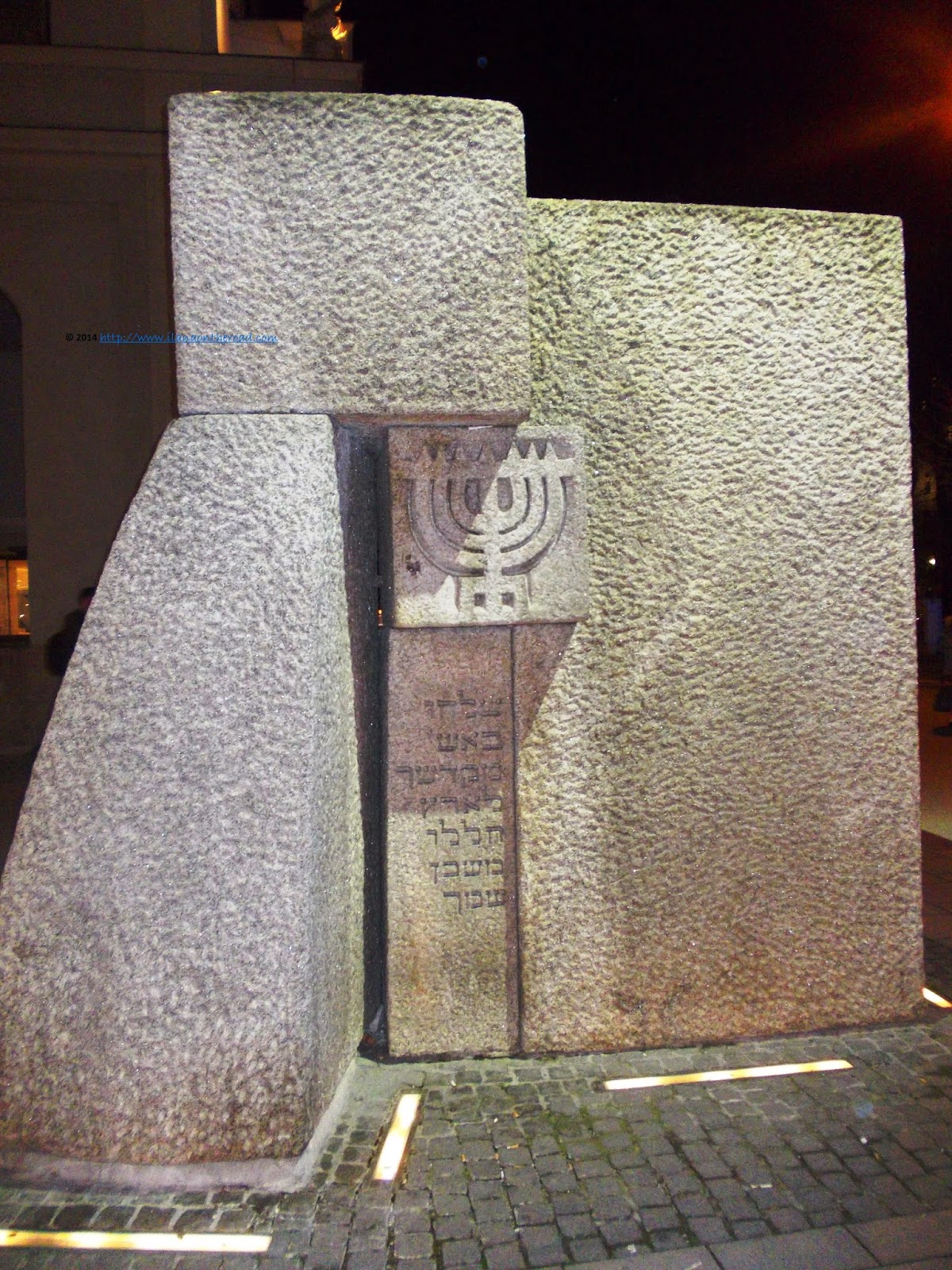
The original main synagogue in Munich was destroyed in 1938, and its ground is used nowadays as a parking area. 
The public memory reminds very often the old places of worship and former Jewish businesses, as everywhere in Germany. Old and new history meet on different sides of the time and probably a new future is still possible. 

Jewish memories: Uhlfelder Department Store in Munich

While walking the streets of Munich late in one of the last evenings, I discovered this stone inscription, on one of the walls of the buildings close to Marienplatz. It reminds about the Kaufhaus/Department store Uhlfelder, the first of this kind open in Munich in 1878. Owned by the Jewish businessman Heinrich Uhlfelder, it was a success and rapidly expanded with new stores, especially due to the low prices targeting the low income shoppers and the variety of merchandise.
The success did not suit well the local anti-Semitic establishment, and in April 1933, a demonstration took place in the front of the shop. Five years after, on Kristallnacht, the shops were vandalized and burnt, an event reminded by the stone inscription. Heinrich Uhlfelder and his son, as well as other 1,000 Jews are interned to Dachau, where many will die. Somehow, Uhlfelder is able to go out and get for him and his family a visa to India, not before being forced to give up his properties and even to pay for the damage made during the 1938 destruction. 
After the war, in 1953, he returns to Munich trying to get back his properties through more than 100 judicial files. He will be able to recover only part of it. 

Friday, 3 January 2014

Something to think about NYE's concert in Vienna

Back home after a couple of days of travel, I check my Facebook and see many of my people deeply enthusted about the gorgeous music of the classical New Year's Eve concert in Vienna. The concert consists of a first musical part continued by a dancing second part, when couples join and dance the classical Viennaise waltz. 
This year, the big Barenboim - a great musician, but as in the case of many intellectuals, with a problematic political involvement - conducted, another reason for even more people to appreciate this concert. The encores were accepted only since 1945.
As a kid growing up in a communist country, I remember how this concert used to be the main event of the year, with families setting up social gatherings around the time of the broadcast in order to enjoy some glamour in a very grey world. 
Nowadays, it is broadcast in more than 70 countries, with an audience of over 50 million.
For the sake of history, there are a 'couple of dark' episodes of this prestigious moment, that are not always mentioned and probably many more not yet known. 
The first concert took place on 31 December 1939 - the first time when it was not held on the traditional 1st of January as nowadays - in the Large Saal and was conducted by Clemens Krauss. It was approved directly by the propagandist of the IIIrd Reich, Joseph Goebbels (yimakh shemo), as part of the official policy of 'propaganda through entertainment'. The first program played exclusively Johann Strauss, who was accepted despite his Jewish family history (his grandfather was Jew from birth). As in many other cases, they realized that without Jews, there is quite difficult to have a great culture - see also Heine who authorshiped many of the German 'patriotic' poetry, or the Mendelssohn-Bartholdy who put Leipzig on the European musical maps, among others - and the program was accepted. The profits were donated for the war campaign of Germany, through the Kriegsunterhelfwerk. 
The part of the Philharmonie in the events during WWII were hidden for a long time, as the archives were closed to the public till beginning of 2000s. Even after that moment, many historians complain about the restrictive access and the problems in covering the truth of those terrible years. However, based on the available information, historians were able to establish that the Vienna Orchester gave a concert in an SS barrack and that around 47% of its members were members of the Nazi Parti. A number of 13 Jewish players were fired, out of them 7 were murdered at the orders of the attendees of the first Vienna concert. 
As for me, I never thought that this Vienna concert is really such a great cultural event. Johann Strauss and the likes are part of a middle class cultural bibliography that I would rather skip. The fact that a tradition inaugurated in those dark times is praised doesn't surprise me, as European countries are maintaining - more or less aware of the past - not a few customs and traditions with a controversial anti-Jewish history. Should we ignore this and enjoy the music. I really don't think this is the answer, especially when still there is so much hidden behind the gates of this respected Austrian institution.