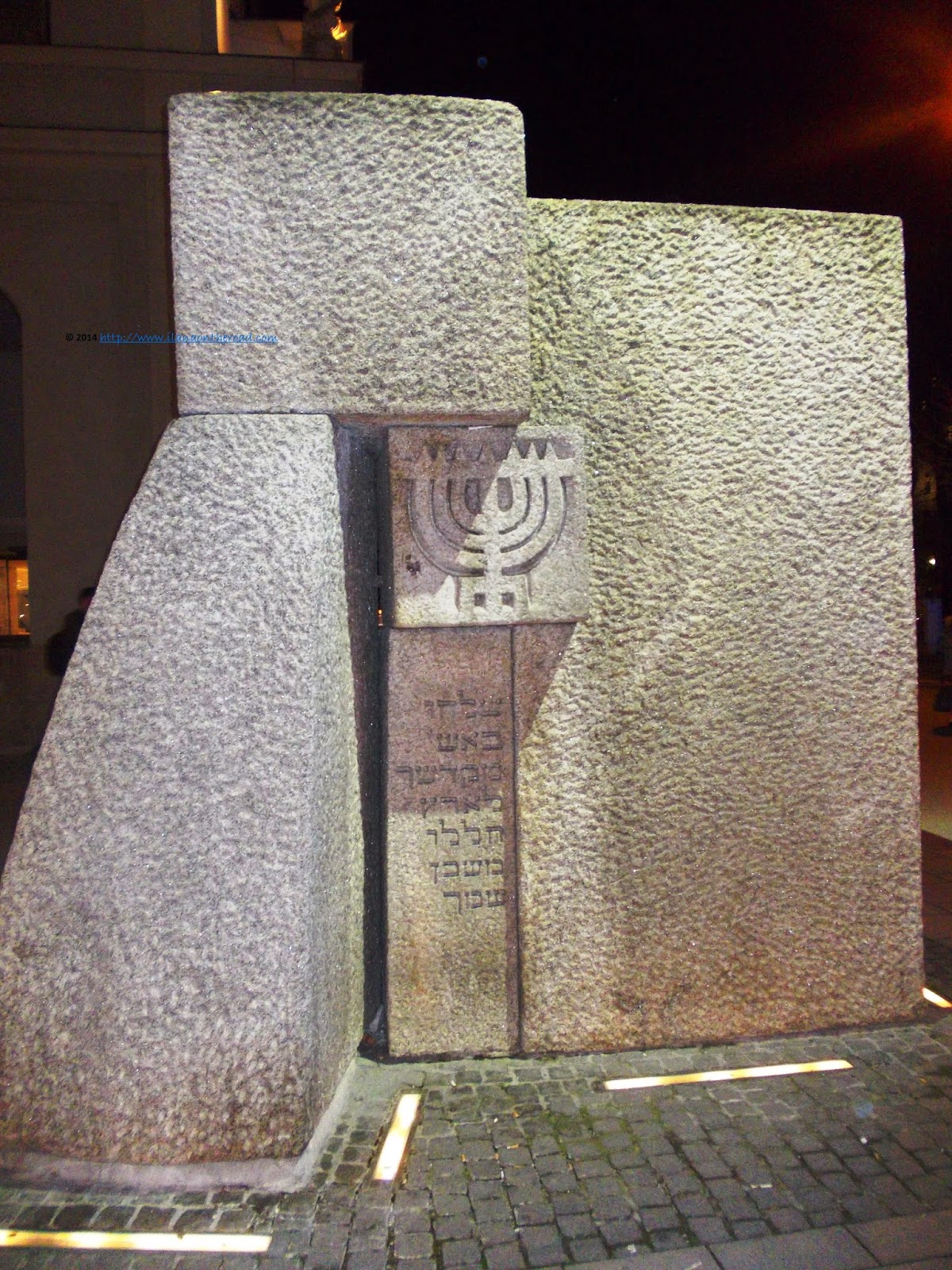
Wednesday, 16 April 2014

Book review: Rivka Guber Signal Fires of Lachish

Pesach is that time of the year when I have time to catch up with reading, and especially after a couple of busy weeks, I finally found the peace for books. Trying to follow the general topic of the holidays, stumbled upon a book by Rivka Guber, a pioneer in the domain of education and absorption policies in the newly created state of Israel.
The signal fires of Lachish is written in the journalist style, rather as a testimony than a literary account of the first years of the state. When you work hard to build a country, who does have time of literature and poetry? The style reminds me of some early Soviety/Russian feature reports, that probably Guber was used with, as she was born in Ukraine and spent some time in the country before moving to Israel. Involved in the creation of the new education system, especially the integration of new Jewish immigrants from all over the world, she mentions several times that she used the pedagogic principles of Makarenko in creating equal opportunities for the Jewish children. 
Even though the book doesn't have high literary or journalistic qualities, it is a valuable testimony of the beginning of the state and not less important, a very intimate account of the sociological and demographic changes underwent by the state of Israel. The issue of the so-called Eastern communities - North Africa, Iran, Yemen, Iraq, Kurdistan area - is presented carefully, without the usual ethnic bias, but with the generous aim to create an integrated society. The first stage of the ingathering of exiles brought together the sophisticated and less religious Askenazim with traditional families from Morocco and Yemen and the meeting wasn't a happy one. Prejudices of old generations against Eastern communities were based of a lack of understanding and contact with those fellow Jews. Some of those prejudices I try to do not hear tomorrow, but I should be thankful for living in a different stage of Jewish history, when I don't feel different of the welcoming Iraqi Jews from whom I am happy to learn every time something new. The educational state policies contributed to bring all of us at the same level of Jewish knowledge and made all of us feel as part of the same community, assuming our differences and histories. Guber's book helped me to understand  - even though I deeply disapprove - the root of the stereotypes and lack of understanding towards the 'Oriental' Jews, and to appreciate the tremendous progress achieved in only in one generation that diminished many of the misunderstandings.
I went more than one jealous of the extraordinary experiences she witnessed, the enthusiasm of building a new country, the discovery of the lost Jews and all the difficulties of the new beginnings. But still, the same difficulties persist and even though the challenges are different, the passions remain.
Especially one story at the end of the book made me think about some recent stories that maybe I will talk more about one day: a family of fresh Polish immigrants, mother and son, were expressing their dissatisfaction with the situation encountered in Israel. They were speaking only Polish and the son was photographer, a job not necessarily sought at the time. Rivka Guber suggests them to try to find out a low level job till they will be able to get a proper training for competing for the job market. They refuse to accept the reality and prefer to complain about the lack of promises in the 'promise land' and threaten with leaving the country. Sounds familiar? At least for me does...
I recommend this book for the sociological information, but also because it shows how fast we were able to move fast forward in such a short time.  

Monday, 14 April 2014

Haggadot to make you think this Pesach

There are only a couple of hours left till Pesach and after days and for many even weeks of preparations, it's time to slow down and think about the meaning of the holiday: a holiday of freedom when we recognize what are the things that really matter into our life. Reading together the Haggadah is one of the most important moment of the seder - besides the delicious food, of course. Here are some recommendations to read this year, or later. The meaning is always the same as it is never enough to start a new life.

The Ethiopian Haggadah was published a couple of years ago by Koren and reunites the fantastic stories and memories of the exodus to Israel of the Ethiopian Jews. The first time when I'd read their stories and their courage to defy death, going by foot for months till they reached Jerusalem, I was deeply impressed. Used with the comfort of booking a flight to Tel Aviv as often as we can, we forget sometimes the deep meaning of coming home. The Ethiopian stories, illustrated with pictures and detailed with documents are a testimony of am Yisroel's strength. 

Yemeni traditions are fascinating and distinguished from the Askenazi and Sephardi customs, not only when it comes to the composition of the Siddur (prayer book) but also regarding the overall setting and culinary choices of the Pesach seder

The original Algerian Haggadah has various Berber influences, and different customs, such as the one of serving the guests from the Seder plate. I was told that this is also the minhag among Morrocan Jews Special songs are also sung, with the specific Hebrew intonation. The Aleppo Haggadah  reunites commentaries of the Syrian rabbis from the 17th to the 21st century. Besides the beautiful illustrations, it has useful information about the history of the Jews from Syria and their traditions.

Vilna Gaon (GRA) Haggadah I discovered a couple of years ago and I continued its reading long time after the holiday was over. The commentaries added of his son, Rabbeinu Avraham are outlining hidden Kabbalistic interpretations and a strong message of hope for the geula (redemption). 

The Indian Haggadah, used by the Bnei Israel, Jews from Indian or 'Black Jews', was discovered three years ago by accident, during a garage sale. It is written both in Hebrew and in the local Marathi dialect, sending interesting information about a group of Jews able to keep the traditions despite being isolated from the main centers of Jewish thinking, but still keeping their traditions and names. Similarly with the fate of the Jews in Egypt, at a certain extent.

Before Rav Ovadia Yosef zt''l, Ben Ish Chai was the most important representative of Iraqi Jews during modern times. His Haggadah is not only guiding the process through the various pre-Pesach preparations, including the burning of chometz, but also reunites various commentaries and stories that can turn the seder into a learning experience. 
Considered one of the oldest Haggadot, the one from Sarajevo contains special illuminations, in the art of the Middle Ages manuscripts in Europe. It was created in Barcelona, in 1350, written on bleached calfskin with cooper and gold illuminations. 
Proof that every Haggadah tells a story of freedom is the one made by the 3rd Battalion of Palmach in 1948, fighting in the Galilee during the War of Independence. The Haggadah takes into account the victories and fragile peace and the hardships of the newly created state. 

With so much inspiration, wishing all my readers Chag Kosher v'Sameah!

Tuesday, 1 April 2014

History and histories

There is a lot of debate in the last weeks and months about 'truth' when it comes to events related to the Jewish life in Europe in between and after WWII. There is still a lot to be told, and the discretion of most old hasidic rabbis in getting public or writing about their experiences. Some, as many in my family, will simply refuse to disclose any details, especially about circumstances, people and locations. It was hard to understand what was going on and what was the right decision to make. Probably it was even harder to give advice to other people about what to do. It was like a night, and everyone was trying to swim against the current in that night.
After everything was gone, the constructed narrative were often based on personal accounts and not in a few situations, the escapes were miraculous. How politics, individual religious interpretations or various other reasons influenced the decisions for or against moving to Israel, there is a separate story. The Satmar, for instance, kept being against the state of Israel as usual, and their opposition didn't change. The decisive religious explanations given as an irrefutable fact about the reasons why 6 million people were killed is widely exaggerated and denies a basic right of the Jews: to never stop asking questions.
As for the decision of making aliyah, I assume it is individual and should be done when one is completely convinced it must be done. At the end of the screening process, one makes this fundamental step when fully aware of the reasons to be done: not because wants an outstanding career, or to find a mate, or to get rich, but because it is obvious that the Jews should live in their country and build their country against all odds. There is no other country for the Jews. The stories I am hearing recently of people moving back from Israel after 2-3 or even one year of aliya because disappointed of the economic situation or disillusioned about the different reality of their 'Zionist dreams' are sad. Maybe before making aliyah, people should really get in touch with the reality and their own reasons of moving in Israel.
The post-Holocaust generations, religious or not, grew up with the burden of the Shoah. Stories about what our grandfathers and parents went through were transmitted from generation to generation, not only in the shuls, but during the secular weekend afternoon. The acknowledging of the reality was equally shared to religious and non-religious children and the fear that this could any time happen again, was hunting us all. But it was this fear that made many of us powerful: strong enough to assume a religious identity that our parents couldn't have because their own parents were turned into ashes too early to learn them Shma; strong enough to assume in the front of the goyim that we are Jews; strong enough to face anti-Semites of all colours.
Despite all the small or big histories, real or not, about salvations and punishment, it is a clear historical reality: they wanted to kill us. That's obvious from all the official documents and policies of the interwar period. The Germans were helped by other smaller Amaleks, hysterically drunk with the idea of finally making real their old killers dreams, nurtured by their religions. This was the reality of Europe before and during the war: overwhelming hate against the Jews. Of course it was no clear reason to stay, but at the time, it was no state to defend us. Now we do, and it is our Army and they our our Jews, sons and grandsons of those who were killed.  
The instrumentalisation of our huge misunderstanding of the reasons why the tragedies happened for fighting one against the others is sad. Obliterating very often who our real enemies and where the serious dangers are. 

Monday, 31 March 2014

Jewish Berlin: Minna-Schwarz-Heim

On Brunnenstrasse 41, a glass plate reminds of what once used to be a philanthropic Jewish institution in the Eastern part of Berlin. Minna Schwarz was born in Pyritz, Poland, at the end of the 19th century, and died in 1936. In 1888, she created the first Bnai Brith Lodge for women in Berlin. Bnai Brith is the oldest Jewish service organization for social service, philanthropy and mutual aid.  
In the yard of this block of houses was created at Schwarz's initiative a kindergarten for abandoned children and a refuge for single mothers. Between 1932-1940, the 'Heim' was named after the founder, who dedicated her time and energy to help the women and children in need, although herself childless. From 1940, the building was used as a 'Judenhaus', a residence where Jews were living in a kind of ghetto. From here, many of them were sent to death.  

Tuesday, 25 March 2014

Jewish memories in Europe: The new cemetery in Leipzig

Early spring in Leipzig. On the way to the Book Fair, I spotted a Magen David and the shadows of some tombstones and decided that I am rather late to the fair than missing the opportunity of having a look at a slice of Jewish history. I go out of the tram and go back for another 5 minutes till the entrance from Delitzcher strasse. 
I first look through a big hole on the walls, through which one can enter the cemetery avoiding the main entrance that is open only between certain hours. Desecration of Jewish cemeteries happened in Leipzig too, but apparently for the moment, there are no specific threats. The entrance is not guarded and everything looked safe.
 Out of the hole, a peaceful area, with a lot of green and trees, as in all the Jewish cemeteries.
At the entrance, a quote in German: 'Only love is stronger than death', a shortened adaptation of a verse from Shir Hashirim.
Most tombstones are well preserved, erected at the beginning of the 1930s, and after the war. 
Old white stones with black spots of the new ones. The old area is almost empty. When I entered, I say 'Shalom' to two ladies exiting, that were looking a bit surprised at me. Jewish life is recorded in Leipzig since the 12th century, many Jews travelling regularly to town because of the fair trade. Officially, Jews were allowed to settle only in 1847. The first cemetery was created in 1815, till then the local Jews being buried in other places around, including Dresden. 
In 1935, there were 11, 564 Jews living in Leipzig, the city being the sixth largest community in Germany. In 1942, the deportation began, and in 1945, there were only 15 Jews left. 200 returned from Theresienstadt and other concentration camps. Eugen Gollomb was the most important post-war leader of the community, between 1967-1988. Born in Breslau and with studies at the Rabbinical seminary in Lublin, he served in the Polish army, and was prisoner in several camps, including Auschwitz Birkenau. He also was in touch with the Polish resistance. After the war, he moved to Germany, but kept considering himself more Polish than German. He never was member of the communist party, and was labelled in the documents of the intelligence service STASI as a 'dangerous Zionist'.
Torah scrolls who are damaged are no more kosher hence cannot be used any more for ritual purposes. According to the Jewish tradition, the writings cannot be destroyed or discarded, but buried according to a specific ceremonial in the genizah - a word that means hide/put away - a special repository or place either in the attic or basement of the synagogue or in the cemetery. At the Leipzig cemetery, were buried Torah scrolls stolen from Poland during the war and recovered later in the century. 
The number of Jews living in Leipzig increased especially after the end of the Cold War, when many Russians from the former Soviet Union arrived. Nowadays, there is a Jewish center and a limited kosher supervision, and since 2006, a mikvah/ritual bath, a clear message that in town are living observant families. 
As always when I go in a Jewish cemeteries, I respectfully walk near the stones. The Jewish practice does not encourage excessive visits to the cemeteries. G-d is one and we don't need intermediaries for sending our wishes and prayers. The general etiquette when visiting a Jewish cemetery is to be respectful, refrain from shouting, walking or consuming beverages or foods.
The Jews in Leipzig were usually middle class business persons, busy with trade, hence a slight investment in the outlook of the graves. Rich and poor should be buried alike though, according to the Jewish tradition, and the visual barriers between the social classes don't find their place in the cemetery. 
However, on the influence of the reform and Haskala, many Jewish cemeteries, especially in Germany - and Western part of Poland were adorned with artistic models and art nouveau decorations.
An interesting phenomenon that I noticed in Leipzig was the apparition, in the new section of the cemetery, of an area of tombs with many flowers. When I visited, during a day of full spring, a couple of women speaking Russian were there, cleaning the tombs and planting new flowers.
The planting of flowers on Jewish graves, and any adornments in general, are not part of the Jewish practice. As the flowers, the body is ephemeral and what is left is the soul, often symbolized by the small stones that we place near the burial sites in remembrance. 
Asked about the practice of bringing Jewish flowers to the grave, Rabbi Chai Elazar Shapiro of Munkacs (1871-1937) was categorically against it. Mentioning the need to avoid making any differentiation between poor and rich Jews, he also outlined that it is generally forbidden to have benefit from anything associated with the grave, thus the smell and beauty of the flowers should be avoided. The memory of the deceased is usually remembered by good deeds, tzedaka (charity), sponsoring a communal meal or learning in the memory of the dead. Excessive grave visitation can be also associated with idolatry, one of the reasons statues are not allowed for adorning the cemeteries.
In the Jewish practice, the excessive visits to the cemeteries are not encouraged. The visits are recommended on decisive moments - at the end of the shiva time, on yohrzeit. Also many go on the fast days and the first days of the months of Nissan and Elul, but not on happy occasions such as Purim, or chol hamoed of Pesach and Sukkot. 
On visitation, many recite the psalm 119.
I left the Leipzig cemetery, interested to return one day and meet some of the Jews living here. The past and future should be always connected by the present. 

Thursday, 20 March 2014

Jewish life in Munich: Ohel Jacob Synagogue

The Synagogue 'Ohel Jacob' ('Jacob's Tent') in Munich is one of the main reference point of Jewish life in Germany and Munich. It was built between 2004-2006 and is part of a larger complex that includes also the Jewish Museum and the Jewish Center. An underground tunnel unites the synagogue to the Jewish Community Center, a memorial for the Jews killed in Munich. The official opening took place on 9 November 2006, the 68th anniversary of Kristallnacht. 
The synagogue was designed by Rena Wandel Hoefer  and Wolfgang Loich, who also designed the new synagogue in Dresden. It includes a cubic structure of travertine stone, the typical stone for many houses in Jerusalem, topped by a glass cube. The glass roof, separated by lines that form the Maghen David ('Star of David') signify the journey of Moshe Rabbeinu and the Jewish people through the desert, but can be also read as a symbol of hope for the light that conquers the darkness. The main portal, featuring in Hebrew letters the 10 Commandments, was manufactured in Budapest. 
The synagogue has a capacity of over 550 worshippers. More than 4,000 Jews were killed in Munich. After the war, many returned. Jews from the former Soviet Union that arrived in Germany after the fall of communism decided to settle in Munich too, bringing a new dynamic to the local community. The synagogue was often targeted by anti-Semitic threats.
The original main synagogue in Munich was destroyed in 1938, and its ground is used nowadays as a parking area. 
The public memory reminds very often the old places of worship and former Jewish businesses, as everywhere in Germany. Old and new history meet on different sides of the time and probably a new future is still possible. 

Jewish memories: Uhlfelder Department Store in Munich

While walking the streets of Munich late in one of the last evenings, I discovered this stone inscription, on one of the walls of the buildings close to Marienplatz. It reminds about the Kaufhaus/Department store Uhlfelder, the first of this kind open in Munich in 1878. Owned by the Jewish businessman Heinrich Uhlfelder, it was a success and rapidly expanded with new stores, especially due to the low prices targeting the low income shoppers and the variety of merchandise.
The success did not suit well the local anti-Semitic establishment, and in April 1933, a demonstration took place in the front of the shop. Five years after, on Kristallnacht, the shops were vandalized and burnt, an event reminded by the stone inscription. Heinrich Uhlfelder and his son, as well as other 1,000 Jews are interned to Dachau, where many will die. Somehow, Uhlfelder is able to go out and get for him and his family a visa to India, not before being forced to give up his properties and even to pay for the damage made during the 1938 destruction. 
After the war, in 1953, he returns to Munich trying to get back his properties through more than 100 judicial files. He will be able to recover only part of it.