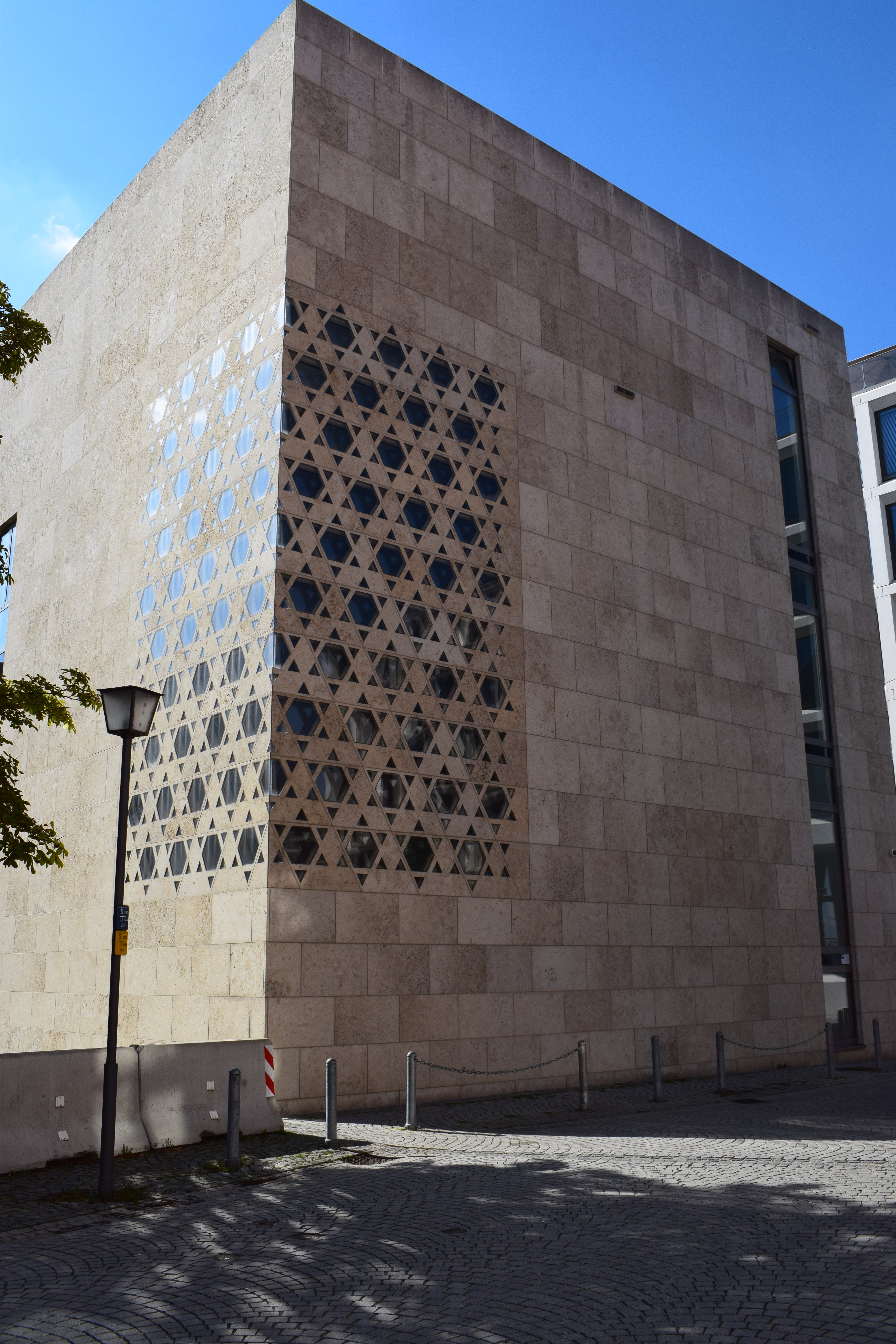
The Speyer-Worms-Mainz area - or SchUM - Sch for ש from Schpira the Jewish name of Speyer (usually, family names as Shpira, Shapira may indicate that the family is originary from here), U for ו from Warmaisa, the Jewish name of Worms, and M for ם the Mainz - was once the most important center of Jewish life in the German-speaking realm.
Since 2021 the most important remnants of Jewish life, among which the Judensand cemetery am Mombacher str.61 was included in UNESCO World Heritage, together with mikwas and cemetery in Worms and Speyer.
This summer, I spent a few days in Mainz, tracing visible signs of Jewish memories, that I am happy to share with my readers.
JUDENSAND CEMETERY
My longest exploration of Jewish memories started in the cemetery. Completely by accident, I´ve found out on Facebook that there is a free guided tour on Sunday morning and I hurried to attend. With visitors from all over Germany and even Argentina, we were kindly explained the historical context as well as the institutional steps took for getting the cemetery from Mainz into the UNESCO World Heritage.
Mainz, together with Speyer and Worms are considered the centers of European - Askenazi - Jewish life and thinking during the Middle Ages. Together with the cemetery in Mainz, synagogues and mikweh in Speyer and Worms were included as part of the heritage. The cemetery on Mombacher Street, Judensand, is situated within the original confines, although it was literally destroyed several times during pogroms and the Nazi time.
There is a certain feeling one experience while walking a Jewish cemetery in Europe. The line of stones, guarded by pristine nature exudes an overwhelming silence. As we are advancing with our group, it seemed like the sound of voices asking questions or answering the questions were completely muffled by the quietness of the place. No wonder that in Hebrew, cemetery is called Beit Haim - House of Life.
The graves available for the public viewing are in different stages of conservation. (I will not enter into halachic discussions about at what extent any kind of maintenance work is really allowed in a cemetery and under which conditions). There are tombstones as old as from the 11th century.
Not all tombstones can be viewed as for now, many older ones are located in a special protection area. According to the local plans, a visitor center is supposed to be built few meters away from the cemetery area where visitors will be introduced to details related to the local history and halacha regarding burial.
From the second half of the 10th century, the Jewish community of Mainz used to be one of the most florishing in the German lands. Jewish families from Italy and France immigrated here, among which Gershom ben Yehuda, who moved here from Metz. Surnamed Me´or ha-Golah, the light of exile, he introduced important halachic interpretations regarding the get - Jewish divorce - and also about the privacy of correspondence, which played an important role in developing the practice for Jewish trademen. He was burried in Mainz, in the Judensand cemetery.
Inspired by the Crusades, the pogrom between 27th and 29th of May 1096 pushed the Jews to refugiate to Speyer, but some also were forced to convert to Christianism. The event is remembered as Gezorot Tatnu 4856 - the Edict of the Jewish year 4856, or the Rheineland massacres.
In 1097, Jews returned to Mainz and were able to freely live here until 1438, when a conflict for power between guilts brought the Jews as scapegoats for the local economic problems and an edict for their expulsion was signed. The cemetery was desecrated and the stones were used for construction. After 18 years though, the Jews were called back, to save the difficult economic situation of the city, but expulsed again in 1471. Meanwhile, the presence of Jews here, although many were no more practising open their religion, was continous, which means that the cemetery was used, and so were the mikweh.
The community grew from the 16th until the 19th century and onwards, until 1933. The style of some tombstone may reflect different ages, but there are no significant switches, like for instance, for the time of the Enlightment, when in many other parts of Germany and Europe, Jewish tombstones were looking very similar to those of wellbeing families from Christian middle class.
Some tombstones may do go through some reparation process, as it is shown by the red and white band attached to it.
All the tombstones are inventoried. Tombstoned used as construction material in 1438 were discovered during construction work, reassembled and moved here in 1926.
For example, the tombstone of Jehuda ben Schne´or, considered the oldest tombstone in Europe so far, was found in 1922, and currently is exposed at the local museum - Landesmuseum. Ben Schne´or founded a Talmud academy in Mainz.
Another Jewish personality whose life influenced the fate of Jews in Mainz was Meshullam ben Kalonymus from the French Kalonymus family. Some of his works were discovered in the Cairo Geniza, among others, many piyyutim (liturgic poems) and a commentary of Pirkei Avot (Ethics of the Fathers). His original tombstone was lost and a new one was replaced.
As for now, the cemetery can be visited only with guided tours, either organised locally - free of charge, but donations are welcomed - or as part of private tours, with costs around 170 EUR or so. Right now, everything is work in process, and the information is only shared - generously, indeed - by people involved in the preparation and submission of the UNESCO file.
The tour I took part was in the German language, but probably options in other languages are also available. Personally, I would have wished a full immersion experience, where the local knowledge about Jewish community was connected with specific details about the tomstones, including from the perspective of the Jewish law. What does it mean, for instance, this column?
I also miss details about the artistic features of the tombstones, as well as evolution of scripts etc. Hopefully, such information will be available soon.
My plans are to visit also the other Jewish cemeteries in Worms and Speyer, therefore maybe I can make more logical connections in terms of historical and architectural similarities.
Given the many transformations and trauma those tombstones went to, no wonder that once they were reinstated, the directions are rather chaotic instead of the classical orientation - direction Jerusalem.
At the end of the tour that lasted a bit more than one hour, I made a mental note to return in the next years. Meanwhile, I got very interested in so many other details about Jewish life in this part of Germany that may require a lot of reading and reflection.
On the way out of the cemetery, the remains of the local synagogue, covered in moss, just laying disorganised just under the window of some residential blocks of houses made me think again about the many stories of destruction and renewal, always different, always unsure for how long, that do relate so much with the life of German Jews.
NEW SYNAGOGUE MAINZ
My next stop exploring Jewish life was at the
New Synagogue, at
Synagogenplatz - in some online directories, the address Hindenburgstraße 44, is also mentioned, but the street named after Paul von Hindenburg who played a great role in the ascension to power of Hitler its obviously controversial. There is a new Jewish life in Germany, and everyone used to talk about a revival, due mostly to the immigration of Jews from the former Soviet Union, the so-called ´Kontingent Jews´. The architecture of Jewish places in Germany after the fall of the Berlin Wall deserves a special study, I think, and the New Synagogue in Mainz makes no difference.
Opened 98 years after the inauguration of the original synagogue and 70 years after the destruction during the Kristallnacht, the New Synagogue was opened in 2010. It is the work of a Cologne architect,
Manuel Herz, with an interesting portfolio, being among others also the architect of the synagogue in
Babyn Yar, in Ukraine.
As a visited the place during the summer time, the strong summer lights were reflecting into the green ceramics of the facade. The architectural directions are following the five letters of the Hebrew word קרושה (Kedusha, which means holy, but also a section in several communal prayers, like the morning prayer of Amidah).
Visually speaking, the presence of the synagogue is dominating the architecture of the area, which is situated close to the institutional/governmental area.
In addition to the synagogue, the building includes a Hebrew school, an adult education center, a community center, a kosher restaurant. Tours in several languages are available
by request.
The main entrance door includes the inscription Me´or ha-Golah - Light of the diaspora, a name associated with Rabbi Gershom ben Judah.
The massive Hebrew letters do alternate in volume with the lines of the fassade, adding to the overall dynamic of construction, an orderly accumulations of volumes and lines.
I wish I had the chance to visit to see how is the proportion of light in the interior. Something to save for another day, possibly.
However, from outside, you can have a look inside, as the windows do mark as points the intricacies of the lines.
Especially during the summer times, it also receives as completion the green area of grass and trees surrounding the ground level.
On the foregrounds, the remains of the former synagogue inaugurated in 1912. Germany has a special historicist tendency in architecture, allowing the co-existence of different architectural structures, from different periods of time. In the case of the synagogue, this is more than a co-existence, but a reminder of symbolic value.
The large outdoors space, the whole square, allowed me to tour the premises several times, trying to figure out different angles and architectural choices.
Currently, in Mainz the community counts around 1,000 Jews, mostly from the Russian-speaking realm.
The time spent around the synagogue was an interesting visual exploration, and I cannot wait to check soon other new synagogues in Germany, as it may offer a lot of unique details about the Jewish identity from the architectural perspective.