Wednesday, 11 November 2020

Tehran. The Movie

I should keep restraining myself from having too many expectations from cultural productions everyone is talking about over and over again. Books, movies, theatre, music...that are such a hype, especially on social media that I generously serve those days, may not be such a great work of art, but just benefit of both a touch of actuality and a great - i.e. generous - advertising budget.


Take, for instance, Tehran, the 8-episode movie released this September, a production of Apple TV and the Israeli channel KAN. Some love it, some hate it. I´ve read furious tweets against and academic investigations into various messages and turns of the story. Indeed, movies are a great indicator of political positionings and ideological interpretations of current events, an excellent example in this respect being the Bond-series.

And when it comes to the Israeli-Iranian relations you know that nothing is neutral and innocent about it. That´s how it is for now but there is no black and white but a lot of colours in between and people belonging to a shade or another.

The story: Tamar Rabinyan, an Israeli born in Iran, is in a mission in Iran, during her military service (really, at such a green age, only because of her IT skills...) as a hacker (loud laughs...seriously, since when hackers have to travel to their target destination?) on behalf of the Mossad. She is involved in some local incidents and is getting lost - while wearing a hilarious sanitary-pad like nose covering - but find help and emotional/sexual support in the arms of another hacker that she first ´met´ across the Dark Web. There are wild parties with drugs and drinking - like in Tel Aviv - and encounters with the Revolutionary Guards and various Mossad backers on the ground. Although on a mission she contacts a lost aunt married with a Muslim policeman and a daughter actively involved with the Revolutionary Guards. Tamar enters secure institutions in Iran, on whose halls she speaks Hebrew with her bosses in Israel. 

Overall: Some parts of the movie make sense, many not, there are some good actors playing excellent roles like Shaun Toub playing the Revolutionary Guard counterintelligence Faraz Kamali, there are some smart twists of the screenwriting by Moshe Zonder (the creator of Fauda) but Tamar does not make too much sense as a Mossad agent - while the other top Mossad Iranian-born woman Kadosh does, but she is killed. Some episodes are too long, and the love story between Milad and Tamar is clumsy. There are some ideological messages with a drop of truth - the mullahs stole the land, we want to take it back and they help us - and the longing for Iran of many Iranian Jews is so real. A good point is there are some smart nuances outlined between the different centers of power and the everyday Iranian is seen in a human, even sympathetic light. 

Personally, I don´t regret watching Tehran but it´s just an entertainment before and after the war is over.

Rating: 3 stars


Tuesday, 10 November 2020

Book Review: Mischpoke! Ein Familienroman by Marcia Zuckermann

I feel guilty for not reading too many books by German Jewish authors. I am definitely guilty for being so much focused on Jewish books about life in Israel or America ignoring what it is so close from home. The home, Germany, where I live and try to define my everyday Jewish identity.


Mischpoke! (extended family) by Marcia Zuckermann covers 300-year of Jewish life in Germany (West Prussia), through the story of the Kohanim family. The result of ten years of work and research, the book is sometimes ironic, sometimes dramatic, features that define, among others, the turmoil of Jewish life in German lands.

Some of the episodes and stories are inspired by the author´s own life and family experiences. She grew up in a Jewish communist environment, with family members killed in the Shoah or part of the anti-Nazi resistance. Together with her family, she left the GDR in 1958 for Western Germany where she settled her career as a writer. 

Although the book is important from the historical point of view and as a contribution to the literary history of Jewish topics written by Jewish authors in Germany and in German language - the original language of the book I´ve read - from the literary point of view I was not necessarily happy with the story. The timeline is sometimes confusing and the story is going sometimes in too many directions without always coming back. The characters do have a strong potential that is not always fulfilled through their literary encounters and life stories. The anchor to the reality - the story of the Iranian friend the she-storyteller is trying to save - is also a weak chain of the story in my opinion because it relies on a cliché - tikkun olam (repairing the world through good deeds - which is but also doesn´t make too much sense for the rest of the story. 

However, there is a lot of quality humor in the book, created through well-crafted dialogues, and story encounters, but also many elegant allusions on inter-marriage and assimilation - or integration, German style. 

Mischpoke! is a relevant work for the Jewish voices and histories in Germany. Hopefully will open my literary curiosity for more works signed by local authors (which will help me win more small victories in my everyday encounters with the far-from-perfect German language).

Rating: 3 stars

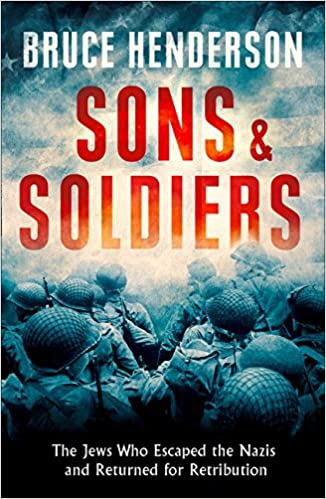
The Untold Stories of the German Jews who Returned for Retribution

The tragic fate of Jews during WWII remains an important source of historical research and inspiration. Relevant for an exhaustive coverage of the topic are the micro-stories of people that lived during those times and further participated at the historical events in the aftermath of the war.


Sons&Soldiers. The Jews who Escaped the Nazis and Returned for Retribution is an interesting book not only for the unique topic, but also for bringing back from historical facts to reality the life of German Jews that returned from America to help the Allies fight and, once the war was won, to interrogate the defeated and unrepentant Nazi officials. 
Some of those young Jews, born in Germany but forced to leave under various circumstances, left together with their families. Most of them, though, had to leave behind their parents, siblings and relatives whose whereabouts they are looking for upon return. Unfortunatelly, in the vaste majority of cases there is a dramatic reality facing them, represented by the concentration camps.
Bruce Henderson is reconstructing the stories of those German Jews, the so-called ´Richie boys´, after the name of the training camp where they got their military and intelligence education before being send back to Europe. Their big advantage was the knowledge of the language as well as the familiarity with the German culture and history. 
Besides the snapshots of Jewish life in Germany and the different biographies of the participants, new to me were the different ways in which some of the German Jews succeeded to escape. 
The mental landscape of Germany and especially the ´no remorse´ attitude of those who were close to the decision-making centers of the Nazi machinery of war are maybe not new but equally relevant as well for the generation post-war and their everyday life attitude to the responsibility - of rather lack thereof - for the crimes committed against innocent people. The lion´s share of the American isolationism at the beginning of the war is as well a painful topic that costed way too many lives.   
Once returned to America, the ´Richie boys´ preferred to build their lives mostly outside of the political turmoils of the Cold War. Sons&Soldiers does justice to their memory and outlines stories that together with many others creates a canopy full of insights and testimonies about Jewish life in Europe, particularly in Germany.
Personally, I was slightly disappointed that the book put so much weight on the pre- and during the war period of time, as I was rather curious about the period of return and, eventually, how they related to the category of ´retribution´ and the perception of Germany as the former homeland that betrayed them. Maybe will find more about this topic in another books and researches.
I had access to the book in the audio format.

Rating: 3 stars
 

Friday, 23 October 2020

´No Room for Small Dreams´

 ´In Israel, in order to be a realist, you should believe in miracles´.


No Room for Small Dreams - that I´ve had access to in audio format, read by the actor Mark Bramhall - is the book published in Peres last year of life. Half-memoir, half-inspirational book, this is just another testimony of a brave man who loved the people of Israel. A man who, together with other founding fathers like Ben Gurion, had the chutzpa to believe in their dream and set out of nothing a country. And not any country, but the country of the Jews.

A warrior, Peres also believed that peace is inevitable, and he personally worked toward it while concluding the agreement between the state of Israel and Egypt on one had, and Jordan, on the other hand. In his optimistic vein, he declares that peace is inevitable, and the current shift taking place within the Middle East is a proof that, again, he was right. 

People like Peres, or Rabin, or Ben Gurion, did have a humble dedication to the public office that unfortunatelly seems to be vanishing nowadays. Being part of the state project is a duty and they are grateful for the chance given to build The Dream. Which does not coincide with their and their family dreams of acquiring personal wealth and priviledges. Their families felt compelled to help them, from the shadows, without any expectation of public acknowledgement. They lived their religious upbringing through actions and good deeds, not by dangerously playing the card of the public piety for the sake of the cameras. Those were the days...

Peres prediction is that the future of Zionism is a two state solution, otherwise a one-state solution without Jews might happen. In an Israeli democracy, Jews and non-Jews should be equal, with the right to be different as a legacy of our own past of persecutions. Bridges would be made only through direct contact and dialogue, and this was the objective Peres had in mind when he created in 1996 Peres Center for Peace and Innovation

Shimon Peres had the moral courage to change from a hawk to a ´vocal dove´ ´on behalf of the Jewish people´. From the Hagana to the ´start-up nation´ and the creation of the nuclear resource facility in Dimona he had both the chutzpah and the vision. I am sure many of those reading him will see the difference and, as this writer, will be reminded that, indeed, miracles are such a reality of the Jewish life that one must work hard to achieve. 


Thursday, 8 October 2020

Mutual Responsibility

Some days ago, on the second day of Rosh Hashana, happened to be with my family at a religious gathering. There were plenty of people on two sides of the mechiza but except us, there were hardly more than 10 people wearing masks. 

I felt the urgency to leave and forget about the mitzvah of hearing the shofar because my precious life was at stake. 

I am working hard to keep my heart far away from evil thoughts but once I was listening some drasha about how important is positive thinking to keep you safe and healthy, I just wanted to stay away of all this. Just a couple of months ago happened to be myself in a hospital surrounded by people - me included - that I bet they were not willing to die, but just sickness happened, no matter what was in their thoughts. 

What really annoyed me was the lack of responsibility and inappropriate leadership. Many, old and young, do consider their rabbis as persons with authority, whose example is worth following. When they don´t wear of mask assuming some special divine protection they risk their lives. There are old people and young people, sick people and people with a problematic health history. All those deserve to live and they deserve to be told how risky is to avoid wearing masks and social distance. No matter what other mitzvah you want to perform, saving lives is the most important one. Where is the wisdom of the leadership when they continue to encourage dissent and disregard basic medical knowledge? How they can go to sleep at night after they heard that someone who attended the mask-free religious gatherings died and spread the virus to their family members too?

Where is the mutual responsibility?

PS: A couple of days ago, I´ve watched some videos featuring the aggressive Police intervention against the religious anti-mask dissenters in Jerusalem. What´s wrong with humans lately? 

Normalization

It´s almost a month since the Abraham Accords were signed in the US, allowing the normalization of relations between UAE and Bahrain, on one side, and the State of Israel, on the other side, and so many things are in the making. At least, this may be the only best news in this strange year and, seriously, what a great normal news it is. 

On one hand, the Accords are the recognition of a reality in the making long before the Trump administration, who was offered, though, an elegant opportunity to show off. The trust of intelligences cannot be build in four years only, and the fact that for over five years discrete bar/bat mitzvah were celebrated in a private location in Dubai, tells a lot about how far everything started. 

On the other hand, it´s clear for everyone that four decades of hate and distasteful brainwashing and propaganda haven´t helped the so-called ´Palestinian´ cause. And it will never help. By creating communication chains and personal contacts there will be more likely a chance to have an answer to a painful situation. But well, do you know under what conditions the Palestinians in Lebanon are living - no citizenship, no rights...Or in other countries from the region that keep to condemn Israel when they are going through crisis of legitimacy, even no one serious in his/her mind do really believe this circus. Hopefully voices like that of Faeze Hashemi (hopefully she is wiser than her late father) who recently recommended a recognition towards Israel as a way to defend the Palestinians are not singular, although one may only dream and dream until things will really be able to move in a different direction between Jerusalem and Tehran. 

In the last weeks, there were a couple of moves of soft power diplomacy that took place either in the UAE or Israel, not all of them equal in weight, but nothwistanding news-worthy given the many decades of dissent and the religious propaganda in the Gulf: an Arab-Israeli soccer player who plays for the Israeli national team, Diaa Saba,  signed with Dubai Al-Nasr; there were some photo joint photoshooting for undergarments with the participation of Israeli and Dubai-based models, musical collaborations between artists from the two countries (Waleed al-Jasim and Elkana Marziano, de gustibus but still something). The Harvard graduate Nuseir Yassin, known as Nas Daily, started a tour in the region which angered the BDS movement supporters - because they will feel that soon they are becoming completely redundant...

The most important of all these, though, is the meeting hosted by the German Minister of Foreign Affairs, between the top diplomats from Israel and UAE, Gabi Askenazi and Abdullah bin Zayed. The two officials who inaugurated the first ever meeting at this level in the history of the region, visited the Memorial of the Murdered Jews, near the iconic Brandenburg Gate. 

There is such a huge window of opportunities right now in the region which is stronger than a political representative or another. It has to do with the everyday life of humans who deserve better and the hopes of a generation that hate should be left way behind in the history books.


Friday, 11 September 2020

What a Loveless World...

After reading a book like Against the Loveless World by Susan Abulhawa you got the feeling that in fact, no matter what there should not be peace in the Middle East. It´s a deep feeling of despair that do not gives any chance for a future for young Palestinians other than got beaten by the ´colonizers´ and blow themselves up. It is a narrative embraced by some academics too, just another proof that sometimes academic research is not only ideologically biased and hate-fuelled but equally inadequate. But when it is ideologically biased it is clear that searching for truth it´s the last concern of the research. Instead it serves a narrative enslaved to various political plots.


Those who put their pen and intelligence - the writing of Susan Abulhawa who also wrote Mornings in Jenin is so good sometimes until you are brought back to the ideological message when one of the (Palestinian) characters is from the buttom of her heart ´destroy the Jews´ -  enjoy their victim status. And they got their credentials from insisting that the people they supposedly represent - the Palestinians - should continue to maintain this status because otherwise they will not win any popular contest of world victimization any more. It sounds so fancy to keep telling that there is the world - including the Muslim world - against the Palestinians. There should be no way out and the Palestinians themselves are against themselves as they suspect the traitors and the informers - the ´birds´ - among themselves.

The narrative of ´resistance´ carries the self-fulfilled profecy of a land where only one people live. The others, the ´colonizers´ should probably go to those countries who tried to destroy them. No answer to the question from where, historically, those Jews came from? Therefore, it is justiciable to poison the water in a settlement, and to kill other humans by individuals whose only vital energy is given by the pathetic frustration of not considering themselves worth of a better life. 

This is the message of the story of Nahr - river in Arabic - born in Kuwait, in a Palestinian family displaced from Haifa - after the European Jews stole everything, including their books...From Kuwait, where she also worked as a sex worker to support his brother´s medical dreams she lands in Amman, following the Emirate´s offensive against the Palestinians accused of collaboration with Saddam´s Iraq during the invasion of the country. As she decided to get divorced by a husband that actually was gay and in love with an Israeli soldier, she meets her brother-in-law who will lately marry her and introduce her to the ´resistance´. She ends up in solitary confinement in an Israeli prison - The Cube - but will be freed after a couple of years in a prisoners´ exchange.  

The book is indeed heavy of symbolisms and carrying an ideological message that outlines several times that there is no way out of this. But this is what a discourse of hate wants you to hear. It wants you to hate everyone because the whole world doesn´t care about you, as an individual whose destiny can develop outside the political and ideological patterns. And what a loveless world it is...