Showing posts with label Jewish life in Germany. Show all posts

Tuesday, 10 November 2020

Book Review: Mischpoke! Ein Familienroman by Marcia Zuckermann

I feel guilty for not reading too many books by German Jewish authors. I am definitely guilty for being so much focused on Jewish books about life in Israel or America ignoring what it is so close from home. The home, Germany, where I live and try to define my everyday Jewish identity.


Mischpoke! (extended family) by Marcia Zuckermann covers 300-year of Jewish life in Germany (West Prussia), through the story of the Kohanim family. The result of ten years of work and research, the book is sometimes ironic, sometimes dramatic, features that define, among others, the turmoil of Jewish life in German lands.

Some of the episodes and stories are inspired by the author´s own life and family experiences. She grew up in a Jewish communist environment, with family members killed in the Shoah or part of the anti-Nazi resistance. Together with her family, she left the GDR in 1958 for Western Germany where she settled her career as a writer. 

Although the book is important from the historical point of view and as a contribution to the literary history of Jewish topics written by Jewish authors in Germany and in German language - the original language of the book I´ve read - from the literary point of view I was not necessarily happy with the story. The timeline is sometimes confusing and the story is going sometimes in too many directions without always coming back. The characters do have a strong potential that is not always fulfilled through their literary encounters and life stories. The anchor to the reality - the story of the Iranian friend the she-storyteller is trying to save - is also a weak chain of the story in my opinion because it relies on a cliché - tikkun olam (repairing the world through good deeds - which is but also doesn´t make too much sense for the rest of the story. 

However, there is a lot of quality humor in the book, created through well-crafted dialogues, and story encounters, but also many elegant allusions on inter-marriage and assimilation - or integration, German style. 

Mischpoke! is a relevant work for the Jewish voices and histories in Germany. Hopefully will open my literary curiosity for more works signed by local authors (which will help me win more small victories in my everyday encounters with the far-from-perfect German language).

Rating: 3 stars

Thursday, 31 August 2017

Saviors of Jews in Postdam and Griebnitzsee

I am often writing here about the sad Jewish histories of WWII, especially how Jews were left alone or even helped to go on their way to the death. However, there were also exceptions and my travels are opening my mind to new information. Here is a short account of my latest discoveries while traveling to Griebnitzee - near Berlin - and Potsdam.
In Gribnitzee, on Karl-Marx Straße nr. 11, family Anemarie and Dr. Helmuth Sell hid and helped to go out of the country Ezra Ben Gershom, a young Jewish boy who previously was living on the streets for months. The German family, social-democrats and enemies of the Nazi regime, obtained forged documents for the young boy and helped him to escape. Their efforts were postumously recognized in 1981 by the Yad Vashem Memorial in Jerusalem with the prestigious title 'righteous among the nations'.

Carola Müller (born Hammer) risked her own life helping the Jewish couple Louise and Victoria Hagen, who were deprived of livelihood because of their Jewish origin. She was even detained for a couple of days by the Gestapo for her stubborness to give up in the front of the evil. Hagen family was able to leave savely the country sailing direction USA. Müller's efforts were recognized later by Yad Vashem and a public memorial mention can be seen in Potsdam, on Friedrich Ebert Straße where she lived.

Friday, 23 June 2017

Traces of Jewish life in Perleberg, Germany

My travels through Germany often bring me near traces of Jewish life. There are so many places now where Jews are no more since the end of the 1930s, but their memory is preserved and the places of memory are symbolically converted into cultural meeting points. Although there is a lot to talk about this issue too, as for now I will focus on the way in which the Jewish memory is introduced into the bigger narrative of a city without Jews.
My latest discovery was into the city of Perleberg, a former Hansa city with an interesting old town architecture.
Perleberg has the best maintained Jüdenhof in Germany. Situated on Parchimerstrasse 6a (previously Jüdenstrasse), close to the city center but on a side street, its entrance is symbolically marked by a big white arch. The Jewish history is introduced to the visitor on a big billboard in German, right at the entrance.
The Jewish community here, attracted by the opportunities of trade, went through different stages. Its first history dates back from the 14th until the 16th century, troubled times when the Jews were often the victims of unjust anti-Semitic trials and pogroms. 
The second episode of Jewish history in Perleberg starts in 1800, when a new Synagogue is built and the community is flourishing, but again, only for a short time. In 1942, all the local Jews are sent to concentration camp and killed. Nowadays, there are no signs of organised Jewish life here and most probably no Jew is living here.
The space that was used before to keep the Jews isolated from the rest of the city is used nowadays for cultural encounters and as a meeting point where topics which include Jewish history and traditions are introduced to the wider public through conferences or art and photo exhibitions. Most events are hosted in a simple modern looking rectangular building on the place of the former synagogue, neighbouring a traditional timbered house.  

Wednesday, 21 October 2015

Brit mila in Germany

If this blog was silent for a long time, there is a motivation and it has to do with the mental and physical challenges before welcoming a new baby to the world. The baby b''H arrived, a bit later than expected, but shortly after Kol Nidre. After the happiness of becoming the new boy neshama to the world, second in line were the worries about preparing him for the challenges of being a Jew.
The first step: brit mila.When you are living in Israel or in big communities, finding a right mohel, being sure that there is a synagogue where to go, inviting people in due time etc. As brits do not have a high occurence here, due to the limited number of new Jewish children born, I considered that it is very important to find a mohel with the proper medical knowledge besides the religious background. Another challenge that needed a bit of research and a lot of phone calls (if interested to find a recommended mohel in Berlin area, do not hesitate to get in touch via the blog).
According to the halacha, the brit should be done the 8th day after birth, including on Shabbat or yom tov. The problem appears when the kid had a small infection and you need to overstay in hospital and thus, to miss the deadline. Normally, the brit can be done any time after and if it was delayed once, it does not matter when it is done. However, the sooner the better, so the search continued with high intensity after being out of hospital with the baby. 
As we tried to follow both the tradition and the medical requirements, asking doctors if the child is good enough to go through the brit was normal. Less normal was to agreee with the message read on the faces of the non-Jewish doctors when explained that we are questioning the medical condition of our son because we want to make the brit: from pity to disgust. This explains the support of some German medical representatives after the 2012 court decision Cologne according to which brit was considered "a serious and irreversible interference in the integrity of the human body", not justified by the freedom of religion and the rights of parents. One prestigious chief doctor in a very respectable hospital in Berlin outlined during a short discussion that the opinions against the brit are not necessarily a German trademark. Of course, as history showed it already on several occasions, forbiding the brit is a trademark of anti-Semitism across centuries. 
The less expected answer come from a hospital that we initially considered as a possible support during our search where we were told that the brit is done there only till the 18th day and that only after 3 years. The more we asked the more we realized how pitiful we are for being away from the place when you do not have to explain why your kid does not have yet a name and why it is so important to have the brit done. A place where being Jewish is enough.

Thursday, 20 March 2014

Jewish life in Munich: Ohel Jacob Synagogue

The Synagogue 'Ohel Jacob' ('Jacob's Tent') in Munich is one of the main reference point of Jewish life in Germany and Munich. It was built between 2004-2006 and is part of a larger complex that includes also the Jewish Museum and the Jewish Center. An underground tunnel unites the synagogue to the Jewish Community Center, a memorial for the Jews killed in Munich. The official opening took place on 9 November 2006, the 68th anniversary of Kristallnacht. 
The synagogue was designed by Rena Wandel Hoefer  and Wolfgang Loich, who also designed the new synagogue in Dresden. It includes a cubic structure of travertine stone, the typical stone for many houses in Jerusalem, topped by a glass cube. The glass roof, separated by lines that form the Maghen David ('Star of David') signify the journey of Moshe Rabbeinu and the Jewish people through the desert, but can be also read as a symbol of hope for the light that conquers the darkness. The main portal, featuring in Hebrew letters the 10 Commandments, was manufactured in Budapest. 
The synagogue has a capacity of over 550 worshippers. More than 4,000 Jews were killed in Munich. After the war, many returned. Jews from the former Soviet Union that arrived in Germany after the fall of communism decided to settle in Munich too, bringing a new dynamic to the local community. The synagogue was often targeted by anti-Semitic threats.
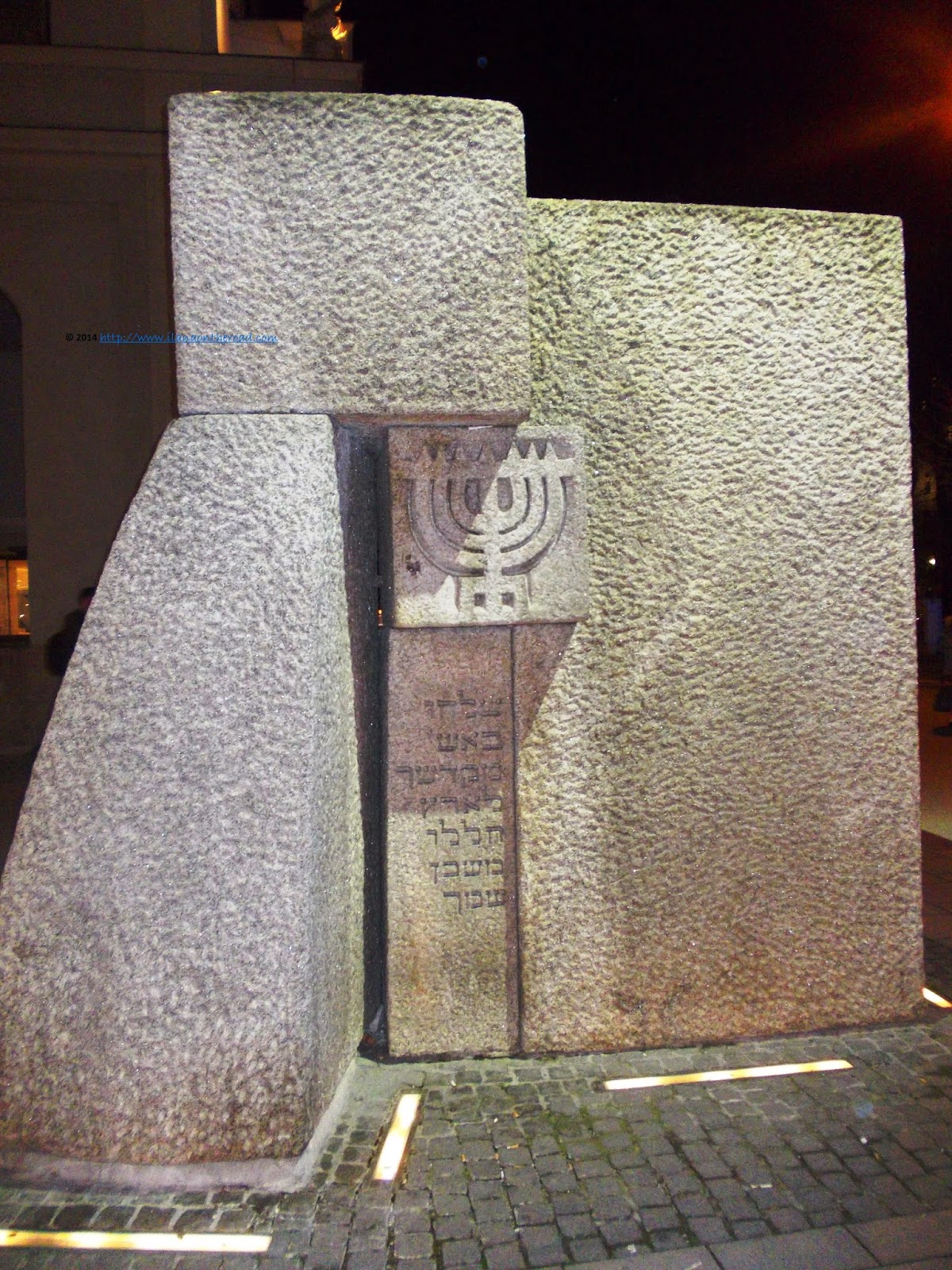
The original main synagogue in Munich was destroyed in 1938, and its ground is used nowadays as a parking area. 
The public memory reminds very often the old places of worship and former Jewish businesses, as everywhere in Germany. Old and new history meet on different sides of the time and probably a new future is still possible. 

Jewish memories: Uhlfelder Department Store in Munich

While walking the streets of Munich late in one of the last evenings, I discovered this stone inscription, on one of the walls of the buildings close to Marienplatz. It reminds about the Kaufhaus/Department store Uhlfelder, the first of this kind open in Munich in 1878. Owned by the Jewish businessman Heinrich Uhlfelder, it was a success and rapidly expanded with new stores, especially due to the low prices targeting the low income shoppers and the variety of merchandise.
The success did not suit well the local anti-Semitic establishment, and in April 1933, a demonstration took place in the front of the shop. Five years after, on Kristallnacht, the shops were vandalized and burnt, an event reminded by the stone inscription. Heinrich Uhlfelder and his son, as well as other 1,000 Jews are interned to Dachau, where many will die. Somehow, Uhlfelder is able to go out and get for him and his family a visa to India, not before being forced to give up his properties and even to pay for the damage made during the 1938 destruction. 
After the war, in 1953, he returns to Munich trying to get back his properties through more than 100 judicial files. He will be able to recover only part of it.