Showing posts with label german jews. Show all posts

Thursday, 23 April 2026

Balagan by Mirna Funk


There is a new book by Mirna Funk   and I hurried up to get to read it. As in her previous novels, there is again, an Israeli-German story, rooted in the realities of the two worlds - post 7th of October, built around a well developed plot. And there is also a lot of sex, but the author is, after all, a sex columnist as well.

The main protagonist of the story, Amira, inherited from her grandfather a very valuable art collection, that was stolen from the family during the Nazi times. The realities of becoming millionaire overnight. an upgrade from a status of a survival online journalist, put into motion an expected row of envies and confusion, but also led her to shocking personal and family discoveries, especially about her mysterious grandfather.

Funk is extensively using the experiences of the toxic post-7/10 environment in the German cultural sector to prompt a decision on Amira´s behalf. Sadly, it is a realistic and well-informed assessment, forcing a poisonous terror-oriented ideology into the field of arts that are supposed to be free - and open to contradictions. It is a toxicity going well beyond the arts and culture, hitting in general the public space. There are no nuances, no intellectual acceptance, only ´friends´ and ´enemies´ which already reminds of an old mindset. 

Dealing with current, unfolding events in literature may have a price and although I agreed with the ideas, from the literary point of view it sounded like forcing the characters to adapt to the ideas, limiting their options and character development.

Funk writes about topics no one writes in German: being Jewish, and Zionist, and fully embracing one´s Jewish (and sexual) identity. I wish I could compare with other similar novels, but there is none so far.

Monday, 17 June 2024

Jerusalem, via Berlin


The intellectual history of Israel is still to be written, but for sure it reveals as more complex than a black-and-white painting separating Zionists from anti-Zionists. As it usually happens in the case of intellectuals, the more nuances the better in order to reach a higher level of understanding.

Personally, I believe that historians should take a big distance from emotional involvement and often felt like the split between the abovementioned categories of historians is too feeling-driven. It´s like each is trying desperately to prove the other one is wrong, ignoring on the way to accomplish the researcher´s mission of finding and exposing the truth. 

Hence, I usually took very critically the works by Tom Segev, but could not resist the temptation of reading his memoirs, hoping that maybe I can have a better understanding of his background.

Born as Thomas Schwerin, in a German family, his parents fled Germany in 1935. Both of his parents were involved with the Bauhaus movement, his mother a photographer, his father an architect and toy manufacturer. Only his father was Jewish, and he grew up speaking German as mother tongue. His sister, Jutta, is based in Germany and is an architect and a politician for the Green Party.

For many years, Segev worked as a journalist, among others, for the left-wing Haarets, reporting from many parts of the world, interviewing famous local and international personalities. Maybe his love for journalism, permeated too much his everyday life, as according to his memoirs, he used at least twice his acquaintances as subjects of daily feuilletons and reporting - one was his adopted son, an Ethiopian-born Jew, another one, a drug addicted acquaintance who stalked him obsessively for years, asking for money and a warm blanket, a weird relationship between source and journalist to be honest.

What is really important to understand from his memoirs - subjective, as one may expect from this type of writing - is the many nuances and motivations of the Israeli intellectual life. Layers of personal experiences, expectations, personal choice, ideological profile. After reading this memoir, I will be most probably interested in reading his historical books as well, obviously, with that grain of salt that comes into question when reading history anyway.

Ironically, for a language buff is that the book was published by Munchen-based Siedler Edition House. ´Siedler´ translates as ´settler´, but the name of the edition house does not have anything to do with the category that people like Segev do not agree with. The name takes it from the founder, Wolf Jobst Siedler.

Tuesday, 25 October 2022

Where We Feel at Home

 ´Die Geschichte meiner Familie scheint wie ein Pendel zu sein, das langsam zurückschwingt´.

Through personal accounts and family stories, writer and journalist Maxim Leo recreated the history of his family, spread all over the world, as they escaped Nazi Germany. Wo wir zu Hause sind is a (auto)biographical account tracing his family members and their longing for the home they lost.

His parents returned to Germany after the war, in the Eastern part of Berlin, in Lichtenberg, dreaming - as many others - of building the communism. Some of his relatives were involved in building the state of Israel. Other made career and fortune in France or London. All stories are unique as sharing particular experiences. In addition to the content of the stories though, the methods used for the research can be used as an inspiration to anyone looking to remake their family tree, Jewish or not. It relates particularly to third or second generation researches, when part of the archives and testimonies were obliterated for physical and age-related reasons.

The book is rich in details about the Jewish life in Germany before and after the war and the longing of many of the German Jews for the home they were expelled from against their own will. 

Monday, 8 November 2021

Der gebrauchte Jude


Maxim Biller arrived from Czechoslovakia to Germany as an early teen. His Jewish Soviet-born family was forced to leave country after country in order to escape the anti-semitism and political pressures. 

´Ich bin Jude, weil ich keine Russe, Tschecke oder Deutsche sein will´. (I am Jewish, as I don´t want to be Russian, Czech or German - my translation). 

His story is a story of Jewish life in the 1980s, at a time when Jews - Jews coming to live in Germany particularly - were a rare occurrence. Those living there already in public positions - like the literary critic Marcel Reich-Ranicki that Biller randomly interviewed as he 24 years old - were rare and rather were introduced in a ´clean´ narrative of the post-WWII Germany. A rhetoric of the kind: You see, we don´t kill all our Jews, some of them are even allowed to return? From this perspective, there may be some Jews who accepted to be publicly used in this way.

As someone who haven´t lived in Germany those years, such an autobiographical account fills up many details about what really Jewish life meant at the time. I may not say that now it is better or things are improved, but there are different pieces of the puzzle that may come together differently. 

At the same time, the book is also a book about coming-at-age in Germany as a non-German Jew, finding your literary way and thinking at length about having - or not - a place in this complex realm. It is not a philosophical approach too, and there is a lot of Czech-alike humour that is still very useful for surviving Germany, particularly if you take your Jewish identity seriously. 

PS: On purpose I will not mention anything at all about the recent Biller-Czollek ´halachic´ debate


Monday, 21 June 2021

German Book Review: Zwischen du und ich - Between You and Me by Mirna Funk


After Winternähe, I couldn´t wait for the next novel by Mirna Funk. As a passive follower on social media, I watch her energy in approaching tabu topics related to Jewish life in Germany - not only antisemitism - and her intense journalistic activity. She is not the only one, but always feel good to live in a society where there are young resilient voices.

Zwischen Du und Ich - Between You and Me - her newest novel, was worth waiting for. The writing is refined and the plot development gained in complexity. The characters - both the main and the secondary - do have stronger, relatable personality. Lola, the character from Winternähe, is also worth a sentence and a bit in the new book. A hint that maybe she is thinking those books as episodes of German Jewish life?

As in Winternähe, there is a personal plan which naturally interferes with historical encounters, but what really matters this time is the individual story. Nike is a 35 years old German Jewess, who grew up in East Berlin in a secular family. She decided to take a job opportunity of organising a DAAD conference in Israeli while making her aliyah. There she will hook up with Noam, a rather fluid character, a journalist writing for Haaretz - we all know that Germans will rather care about such a reference, Gd forbid to write for, let´s say Jerusalem Post...until he left. 

Both characters are worth a novel but their match was not my best scenario. Honestly, I will not waste a bet on their chances. But what attracts them is a shared trauma and the plot is rather developed to prove how trauma attracts trauma, with all the gratuitous sexual and urologic symptoms and references. At to a certain point I will admit that, indeed, someone with a traumatic past will rather enjoy the company of someone with a shared grief but relationships are much more complex and less casual and with a healing effect too. Smart people with a traumatic past maybe will rather enjoy the company of someone with a less or absent generational suffering. But otherwise trauma ends by controlling us, our future, present and relationships and it´s hard to escape it. Rather, it adds up more along the journey which complicates the DNA structure even more.

But despite those references and failures and the exhibitionism, Zwischen Du und Ich reads very well, the mathematical kind of writing which pondered words and effects creating an unique story. I never read something like that before in German language, because no one had the easiness of doing so as Mirna Funk. It´s such a fresh writing and topic that the eventual misfits are in fact a good sign. A hope that soon, in one or two years, she will write another book. I can´t wait to.

Rating: 3.5 stars

Monday, 7 December 2020

A New Episode of Jewish Medical History in Germany

During an early walk in Berlin today, I´ve discover another trace of Jewish medical history: In the front of one of the entrances of Wilmersdorf City Hall, there is a small square bearing the name of Julius Morgenroth, one of the creator of chemotherapy.


Julius Morgenroth was born in a Jewish family in Bamberg, in 1871. He studied in Freiburg, Würzburg and München. Between 1906 and 1919 he was the director of the Bacteriology Department of the Pathology Institute within the Charité. Following positions involved heading the newly created Department of Chemotherapy within the Berlin Institute for Infectious Diseases - nowadays known as Robert Koch Institute in Berlin.

Morgenroth worked closely with another fellow Jewish scientist, Paul Ehrlich, Nobel Prize winner as recognition for his works in the field of immunology. He created Rivanol, a medical substance used until today, as wound desinfectant, and studied extensively the effects of quinine against infections. 

Nowadays, we refer mostly to chemotherapy as part of the anti-cancer treatments, but originally this type of method and medication referred to the substances acting specifically against pathogenic infections. Ehrlich, as well as Morgenroth contributed regularly to the development of this field of study building up the basis for the current development, which is still a work in process.

The more I discover about the Jewish contributions to the history of German medicine the more frustrated I am by the lack of systematic information in this field. Obviously, the Jewish presence into the history of medicine is a topic that deserve a better historical treatment.

Saturday, 5 December 2020

How to Desintegrate. To be Full Again

There is so much to say and write, on an intellectually critical note about how the Jewish life in Germany was set up but there are not too many intellectuals to create a critical mass against the mainstream.

On my side, I will mention one single event: it is the day when it takes place the so-called Long Night of Religions (Lange Nacht der Religionen). Once the year, usually somewhere at the end of the summer, for one night, the places of worships in Berlin are open to visitors. People come in large groups to visit various churches, mosques and synagogues. On one of those occasions, I was in the synagogue, for the end of Shabbat. Suddenly, a group entered the praying space, started to look around taking pictures (although they were told that Orthodox people on Shabbes don´t fancy such hobbies). They stayed longer for the seuda shlishit - the third required meal on Shabbat. Happy, they took another batch of people, observing how Jews are eating and singing and clapping their hands. They are alive, you see, let´s call it a day!   


Max Czollek belongs to a new generation of Berlin Jews. Born in Berlin at the end of the 1980s, he went through the full cycle of Jewish education. He doesn´t owe anything to anyone, in order to confirm his status as a Jew. He´s out of the everyday instrumentalisation of his identity for absolving the guilt of the majority. 
Desintegriert euch! is an honest account of the institutionalized game with memory on display in Germany, with Jews playing the main role according to a script which legitimizes the Leitkultur - dominant culture. It is a scenario which outlines what belongs and what not to Germany and where the Jews need to offer a ´perspective´ to the majority for excusing their historical excesses. For instance, let´s the Jews say their opinion on Luther´s antisemitism and call it a debate. 
There is a script for everything, but issued by the majority in order to push the minorities to conform. The Gedächtnis Theater - theatralisation of the commemorations - re-enacts the Shoa, among others, in a way which disconects the time slots. I´ve often heard young Germans complaining that ´enough is enough´ and it is about time to stop talking about the past, that past that ended up with the murder of 6 million people. Does AfD appear in a void? What about the neo-Nazis who are part of the everyday life for decades? My questions that owed me a dismissal.
But there is a lot more in the book and even a lot more to be said about how you are expected to think and behave as a Jew - and a non-German member of a minority group - in Germany. I am glad the circle of conformity is being broken. Itis about the time to take the floor.
I´ve had access to the book in audio format, read by the author.  

Rating: 5 stars


Friday, 20 November 2020

Max Levy-Dorn, Jewish Medical History in Germany


The role of Jewish doctors in the development of German medicine is still to be told. It is a topic which got lost on the corridors of German hospitals. As a visitor of those institutions lately - not for research reasons, unfortunatelly, I am happy to spend my time googling about Jewish personalities that created the medical science that still makes history nowadays.
A relatively least mentioned but nevertheless relevant character of the medical history from the end of the 19th century, beginning of the 20th was Max Levy-Dorn. He was a pioneer in the field of the radiation science discovered by Röntgen, a passion that finally killed him as he contracted cancer after being exposed to the irradiation. 
I couldn´t find too much information about his Jewish roots and family, and the medical information are sparse as well. He studied in Leipzig and become a surgeon, but at the end of the 19th century, he was owning his own medical practice and a Röntgen Lab, the first of this kind in Berlin. In 1906 he took over the Radiology Department at Virchow Clinic, where I´ve discovered the mention on the wall close to the main entrance. 
Levy-Dorn authored over 200 academic publications dedicated to the then-new science of radiology and had noteworthy contribution to the development of the radiation techniques and clinical procedeeings, especially in diagnosis of thorax and stomach maladies. 
He died of cancer at the age of 56, the result of high exposure to radiation. 

Tuesday, 10 November 2020

Book Review: Mischpoke! Ein Familienroman by Marcia Zuckermann

I feel guilty for not reading too many books by German Jewish authors. I am definitely guilty for being so much focused on Jewish books about life in Israel or America ignoring what it is so close from home. The home, Germany, where I live and try to define my everyday Jewish identity.


Mischpoke! (extended family) by Marcia Zuckermann covers 300-year of Jewish life in Germany (West Prussia), through the story of the Kohanim family. The result of ten years of work and research, the book is sometimes ironic, sometimes dramatic, features that define, among others, the turmoil of Jewish life in German lands.

Some of the episodes and stories are inspired by the author´s own life and family experiences. She grew up in a Jewish communist environment, with family members killed in the Shoah or part of the anti-Nazi resistance. Together with her family, she left the GDR in 1958 for Western Germany where she settled her career as a writer. 

Although the book is important from the historical point of view and as a contribution to the literary history of Jewish topics written by Jewish authors in Germany and in German language - the original language of the book I´ve read - from the literary point of view I was not necessarily happy with the story. The timeline is sometimes confusing and the story is going sometimes in too many directions without always coming back. The characters do have a strong potential that is not always fulfilled through their literary encounters and life stories. The anchor to the reality - the story of the Iranian friend the she-storyteller is trying to save - is also a weak chain of the story in my opinion because it relies on a cliché - tikkun olam (repairing the world through good deeds - which is but also doesn´t make too much sense for the rest of the story. 

However, there is a lot of quality humor in the book, created through well-crafted dialogues, and story encounters, but also many elegant allusions on inter-marriage and assimilation - or integration, German style. 

Mischpoke! is a relevant work for the Jewish voices and histories in Germany. Hopefully will open my literary curiosity for more works signed by local authors (which will help me win more small victories in my everyday encounters with the far-from-perfect German language).

Rating: 3 stars

The Untold Stories of the German Jews who Returned for Retribution

The tragic fate of Jews during WWII remains an important source of historical research and inspiration. Relevant for an exhaustive coverage of the topic are the micro-stories of people that lived during those times and further participated at the historical events in the aftermath of the war.


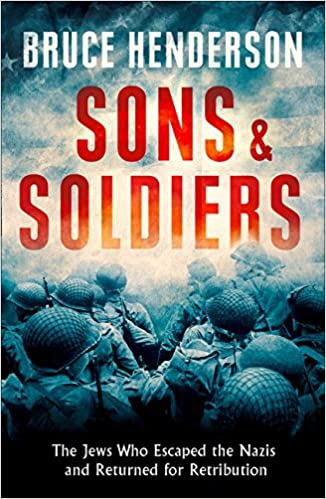
Sons&Soldiers. The Jews who Escaped the Nazis and Returned for Retribution is an interesting book not only for the unique topic, but also for bringing back from historical facts to reality the life of German Jews that returned from America to help the Allies fight and, once the war was won, to interrogate the defeated and unrepentant Nazi officials. 
Some of those young Jews, born in Germany but forced to leave under various circumstances, left together with their families. Most of them, though, had to leave behind their parents, siblings and relatives whose whereabouts they are looking for upon return. Unfortunatelly, in the vaste majority of cases there is a dramatic reality facing them, represented by the concentration camps.
Bruce Henderson is reconstructing the stories of those German Jews, the so-called ´Richie boys´, after the name of the training camp where they got their military and intelligence education before being send back to Europe. Their big advantage was the knowledge of the language as well as the familiarity with the German culture and history. 
Besides the snapshots of Jewish life in Germany and the different biographies of the participants, new to me were the different ways in which some of the German Jews succeeded to escape. 
The mental landscape of Germany and especially the ´no remorse´ attitude of those who were close to the decision-making centers of the Nazi machinery of war are maybe not new but equally relevant as well for the generation post-war and their everyday life attitude to the responsibility - of rather lack thereof - for the crimes committed against innocent people. The lion´s share of the American isolationism at the beginning of the war is as well a painful topic that costed way too many lives.   
Once returned to America, the ´Richie boys´ preferred to build their lives mostly outside of the political turmoils of the Cold War. Sons&Soldiers does justice to their memory and outlines stories that together with many others creates a canopy full of insights and testimonies about Jewish life in Europe, particularly in Germany.
Personally, I was slightly disappointed that the book put so much weight on the pre- and during the war period of time, as I was rather curious about the period of return and, eventually, how they related to the category of ´retribution´ and the perception of Germany as the former homeland that betrayed them. Maybe will find more about this topic in another books and researches.
I had access to the book in the audio format.

Rating: 3 stars