Tuesday, 25 March 2014

Jewish memories in Europe: The new cemetery in Leipzig

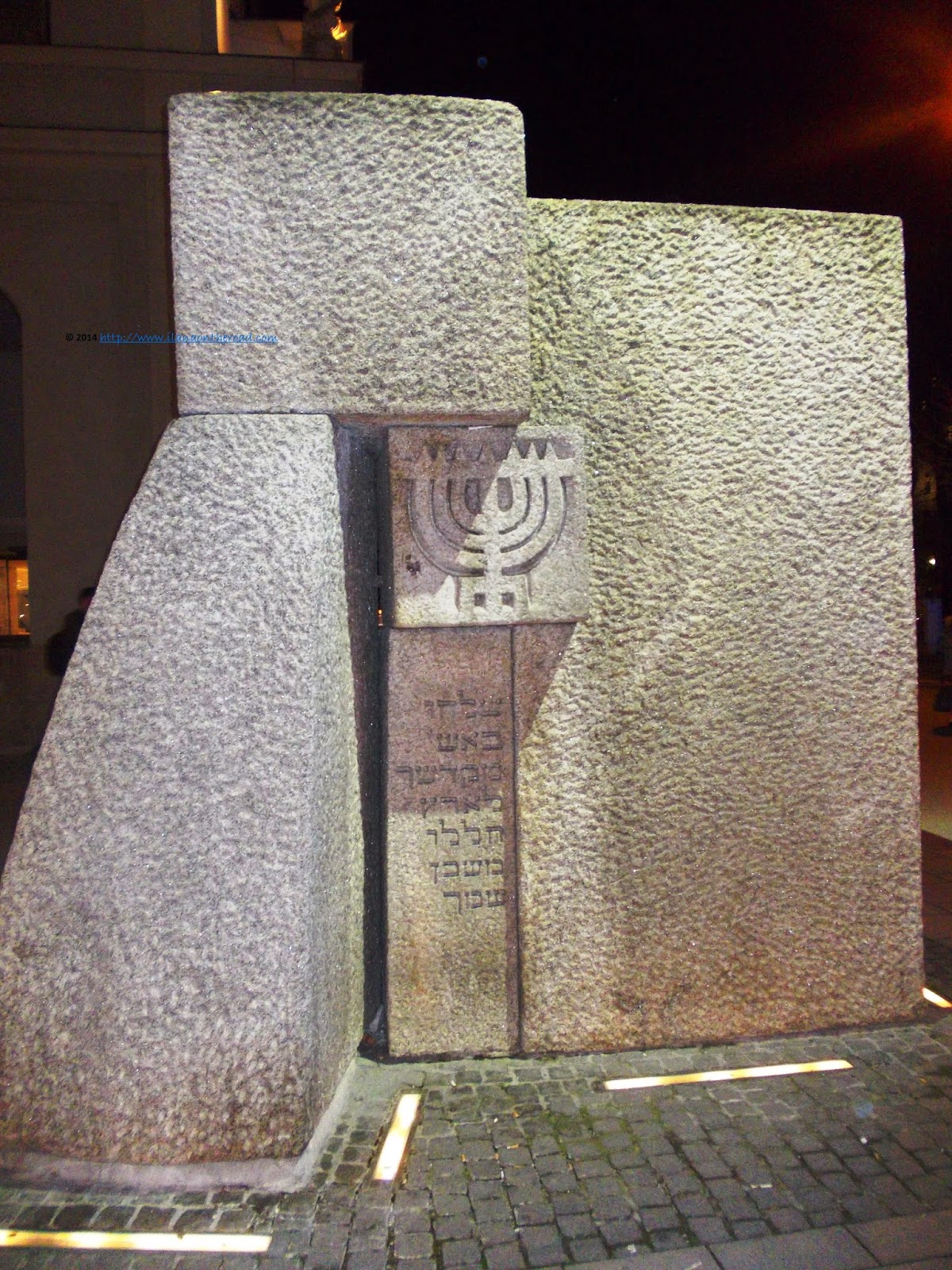
Early spring in Leipzig. On the way to the Book Fair, I spotted a Magen David and the shadows of some tombstones and decided that I am rather late to the fair than missing the opportunity of having a look at a slice of Jewish history. I go out of the tram and go back for another 5 minutes till the entrance from Delitzcher strasse. 
I first look through a big hole on the walls, through which one can enter the cemetery avoiding the main entrance that is open only between certain hours. Desecration of Jewish cemeteries happened in Leipzig too, but apparently for the moment, there are no specific threats. The entrance is not guarded and everything looked safe.
 Out of the hole, a peaceful area, with a lot of green and trees, as in all the Jewish cemeteries.
At the entrance, a quote in German: 'Only love is stronger than death', a shortened adaptation of a verse from Shir Hashirim.
Most tombstones are well preserved, erected at the beginning of the 1930s, and after the war. 
Old white stones with black spots of the new ones. The old area is almost empty. When I entered, I say 'Shalom' to two ladies exiting, that were looking a bit surprised at me. Jewish life is recorded in Leipzig since the 12th century, many Jews travelling regularly to town because of the fair trade. Officially, Jews were allowed to settle only in 1847. The first cemetery was created in 1815, till then the local Jews being buried in other places around, including Dresden. 
In 1935, there were 11, 564 Jews living in Leipzig, the city being the sixth largest community in Germany. In 1942, the deportation began, and in 1945, there were only 15 Jews left. 200 returned from Theresienstadt and other concentration camps. Eugen Gollomb was the most important post-war leader of the community, between 1967-1988. Born in Breslau and with studies at the Rabbinical seminary in Lublin, he served in the Polish army, and was prisoner in several camps, including Auschwitz Birkenau. He also was in touch with the Polish resistance. After the war, he moved to Germany, but kept considering himself more Polish than German. He never was member of the communist party, and was labelled in the documents of the intelligence service STASI as a 'dangerous Zionist'.
Torah scrolls who are damaged are no more kosher hence cannot be used any more for ritual purposes. According to the Jewish tradition, the writings cannot be destroyed or discarded, but buried according to a specific ceremonial in the genizah - a word that means hide/put away - a special repository or place either in the attic or basement of the synagogue or in the cemetery. At the Leipzig cemetery, were buried Torah scrolls stolen from Poland during the war and recovered later in the century. 
The number of Jews living in Leipzig increased especially after the end of the Cold War, when many Russians from the former Soviet Union arrived. Nowadays, there is a Jewish center and a limited kosher supervision, and since 2006, a mikvah/ritual bath, a clear message that in town are living observant families. 
As always when I go in a Jewish cemeteries, I respectfully walk near the stones. The Jewish practice does not encourage excessive visits to the cemeteries. G-d is one and we don't need intermediaries for sending our wishes and prayers. The general etiquette when visiting a Jewish cemetery is to be respectful, refrain from shouting, walking or consuming beverages or foods.
The Jews in Leipzig were usually middle class business persons, busy with trade, hence a slight investment in the outlook of the graves. Rich and poor should be buried alike though, according to the Jewish tradition, and the visual barriers between the social classes don't find their place in the cemetery. 
However, on the influence of the reform and Haskala, many Jewish cemeteries, especially in Germany - and Western part of Poland were adorned with artistic models and art nouveau decorations.
An interesting phenomenon that I noticed in Leipzig was the apparition, in the new section of the cemetery, of an area of tombs with many flowers. When I visited, during a day of full spring, a couple of women speaking Russian were there, cleaning the tombs and planting new flowers.
The planting of flowers on Jewish graves, and any adornments in general, are not part of the Jewish practice. As the flowers, the body is ephemeral and what is left is the soul, often symbolized by the small stones that we place near the burial sites in remembrance. 
Asked about the practice of bringing Jewish flowers to the grave, Rabbi Chai Elazar Shapiro of Munkacs (1871-1937) was categorically against it. Mentioning the need to avoid making any differentiation between poor and rich Jews, he also outlined that it is generally forbidden to have benefit from anything associated with the grave, thus the smell and beauty of the flowers should be avoided. The memory of the deceased is usually remembered by good deeds, tzedaka (charity), sponsoring a communal meal or learning in the memory of the dead. Excessive grave visitation can be also associated with idolatry, one of the reasons statues are not allowed for adorning the cemeteries.
In the Jewish practice, the excessive visits to the cemeteries are not encouraged. The visits are recommended on decisive moments - at the end of the shiva time, on yohrzeit. Also many go on the fast days and the first days of the months of Nissan and Elul, but not on happy occasions such as Purim, or chol hamoed of Pesach and Sukkot. 
On visitation, many recite the psalm 119.
I left the Leipzig cemetery, interested to return one day and meet some of the Jews living here. The past and future should be always connected by the present. 

Thursday, 20 March 2014

Jewish life in Munich: Ohel Jacob Synagogue

The Synagogue 'Ohel Jacob' ('Jacob's Tent') in Munich is one of the main reference point of Jewish life in Germany and Munich. It was built between 2004-2006 and is part of a larger complex that includes also the Jewish Museum and the Jewish Center. An underground tunnel unites the synagogue to the Jewish Community Center, a memorial for the Jews killed in Munich. The official opening took place on 9 November 2006, the 68th anniversary of Kristallnacht. 
The synagogue was designed by Rena Wandel Hoefer  and Wolfgang Loich, who also designed the new synagogue in Dresden. It includes a cubic structure of travertine stone, the typical stone for many houses in Jerusalem, topped by a glass cube. The glass roof, separated by lines that form the Maghen David ('Star of David') signify the journey of Moshe Rabbeinu and the Jewish people through the desert, but can be also read as a symbol of hope for the light that conquers the darkness. The main portal, featuring in Hebrew letters the 10 Commandments, was manufactured in Budapest. 
The synagogue has a capacity of over 550 worshippers. More than 4,000 Jews were killed in Munich. After the war, many returned. Jews from the former Soviet Union that arrived in Germany after the fall of communism decided to settle in Munich too, bringing a new dynamic to the local community. The synagogue was often targeted by anti-Semitic threats.
The original main synagogue in Munich was destroyed in 1938, and its ground is used nowadays as a parking area. 
The public memory reminds very often the old places of worship and former Jewish businesses, as everywhere in Germany. Old and new history meet on different sides of the time and probably a new future is still possible. 

Jewish memories: Uhlfelder Department Store in Munich

While walking the streets of Munich late in one of the last evenings, I discovered this stone inscription, on one of the walls of the buildings close to Marienplatz. It reminds about the Kaufhaus/Department store Uhlfelder, the first of this kind open in Munich in 1878. Owned by the Jewish businessman Heinrich Uhlfelder, it was a success and rapidly expanded with new stores, especially due to the low prices targeting the low income shoppers and the variety of merchandise.
The success did not suit well the local anti-Semitic establishment, and in April 1933, a demonstration took place in the front of the shop. Five years after, on Kristallnacht, the shops were vandalized and burnt, an event reminded by the stone inscription. Heinrich Uhlfelder and his son, as well as other 1,000 Jews are interned to Dachau, where many will die. Somehow, Uhlfelder is able to go out and get for him and his family a visa to India, not before being forced to give up his properties and even to pay for the damage made during the 1938 destruction. 
After the war, in 1953, he returns to Munich trying to get back his properties through more than 100 judicial files. He will be able to recover only part of it. 

Sunday, 16 March 2014

Architecture stories: Beth Shalom Synagogue, by F.L.Wright

Among the long list of nearly 1,000 projects by Frank Lloyd Wright, there is also a synagogue, the conservative Beth Shalom (the House of Peace in Hebrew) situated in Elkins Park, Pennsylvania. During the elaboration of the project that the architect accepted in 1953, he worked closely with the then rabbi, Mortimer J. Cohen. The only synagogue ever in the portfolio of the architect was ready in 1959. Cohen wrote personally to Wright, who had an Unitarian background, asking him to accept the project and during the projection and construction work the Rabbi worked closely with the architect explaining the main concepts of the Jewish faith. 
The synagogue aims to represent both the tent and the mountain as symbols of the direct commitment of the Jewish people to Torah transmitted by G-d. The plan is irregular, with the Eastern point oriented direction Jerusalem, a constant in many Conservative synagogues. It has a glass pyramidal tower on the top relying on a navy-like stone structure. The included walls of translucent fiberglass are aimed to create the image of a 'luminous Mount Sinai', closer to heaven. The artificial lightning during the night singles out the construction as a beacon of light that can be compared with the Statue of Liberty, an association that . In the front of the entrance, the place for the ritual washing of hands - 'netilas yadaim' - is represented by a fountain. 
Structured on two levels, it has 1020 places on the first floor and around 1000 on the second. The disposition of the floors aims to fulfil the basic functions, social and religious/ritual. The yellowish carpet represent the sand of the desert where the Jewish people settled till reaching the land of Israel.  

Architectural historians consider that the synagogue belongs to the Mayan Revival Style. but there are also many elements that reminds of the New York Steel Cathedral project.   
Considered as one of the most expensive places of worship, the project was delayed because of the lack of funds. 
Beth Shalom Synagogue was included since 29 March 2007 on the list of National Historic Landmarks. The building belongs to FLWright Historical Society, which means that the owners are not allowed to operate changes. For instance, they are not even allowed to change the carpet. One of the main problem arising from this restriction is the difficulty to accommodate the members in wheelchairs as the original plans did not include such facilities. The specialists also mention the various electricity  and heating problems due to the need to cope with the needs of modern society.
F.L.Wright worked out around 1,000 architectural projects - houses, office buildings, space of worships and stores, among which Price Towers, Dallas Theatre, Solomon R. Guggenheim Museum.
Guided tours are made twice the week. The conservative congregation of Beth Shalom was created in 1919 at a time when Conservative Judaism was on the raise and the idea to have a new synagogue coincided with the need to create historical benchmarks. Despite the fact that Wright was not necessarily the friendliest person to Jews and the final results that reminds a lot of non-Jewish construction, his prestige was considered good enough for being commissioned this project. 

Source of photos: online resources

Thursday, 20 February 2014

The honour of being the last Jew

In the middle of the crisis, strong personalities decide to take the challenge and continue to keep their principles. Even though the stubbornness is only of the heart, while the need for survival might send a different message, not giving up means more than claiming loudly a statement to the world. 
Suddenly today, out of nowhere, I had the realization that maybe we are living today one of the best times in the Jewish history: there are many situations when our life is in danger, but compared to the life as a Jew in the Spain during the Inquisition or the WWII Germany, we are living freely and without fear. Maybe because now we have a state to defend us?
With so much cruel reality around, I am very reluctant to read historical fiction, but Noah Gordon's Last Jew caught me faster than expected because: 1) I had for a while the unluck to be forced by circumstances to keep my Jewishness secret; 2) it offers a certain historical introduction to the later discussions about the possibility to get back the Spanish citizenship for the Jews expelled from Spain. In the second case, I also tried to think from a personal perspective: one of my grandfathers was one of them and even was speaking ladino. But how can I bring the documents from 5 centuries back, from a time when citizenship wasn't existent and not even the precious IDs or other clear archives ?
Yonah Toledano, the hero of Gordon's book, is able to keep his promise of remaining a Jew in an epoch when even the most fervent baptized Jews that were eventually accepted as part of the clergy were not considered 'pure' enough and burned at stake. Through hard work and discretion and a sense of the danger, he succeed to become a trustworthy surgeon when the Jews where not allowed to be in such positions, without being baptized or making a loud 'faith' show. What kept me awake till the end of the book was the authenticity of the story and the similarity with situations I've heard, read and was told about. More than being a work of historical fiction, the book has that pint of reality that kept me interested. 
The sad story is that such situations repeated over and over again. Even now, being a Jew in France or Hungary or in the Arab lands might present a certain level of risk. The good news is that we were able to survive and even more, to return to faith despite all the terrible things that happened to us. And there are so many true stories waiting to be told that are much better than any historical fiction. 

Saturday, 15 February 2014

Another BT story goes wrong

Just another BT story who goes wrong. From a very intricate juridical story, that is the most entertaining and suspense part of the book, my selective attention focused on the ways in which two people apparently in love fell apart due to misunderstandings around religion.
After her husband dies, Isabelle decides to make aliya after a short visit to Eilat. A couple of months after, she moves first to Ra'ana and after to Tel Aviv, while facing the local bureaucracy and trying to get used with the daily life. 
Complaining about the 'bureaucratic otherness' of Israel is a common complain in many books and statements of people moving to Israel from US or Western Europe. It may look at a completely different reality, but looking a bit into the history and recent social issues facing a relatively young country, there is obviously an explanation for the gap. Israel is not a perfect country and part of moving from a country to another is facing a different culture and reality.
After a while, Isabelle is getting married with a handsome man who's becoming more and more religious. She is not and never intended to be one and this decision, that seems unilateral according to the book, but adopted without too much discussions, it seems, will set them apart. This is the part which interests me a lot. Obviously, during the BT process, there are always problems, especially if starting from a completely secular background. The first temptation is to start being 'frum' in only a couple of hours or days, as there is a miraculous pill that will delete from your mind and behavior the whole years of non-religious life. But hopefully, there is not and the 'return' takes many years and even many more mistakes. The husband, who's somehow 'famous' in Tel Aviv for being the roller skating bearded man, started the teshuva process with Chabad - not the right moment to express now what I think about it, involving his wife through various programs for women. 
After receiving the get - she is introducing the procedure in the book, but omit to mention that compared with other countries, in Israel is easier to get it compared to, for instance, America - afraid that her soon will be forced to follow a religious education, she kidnaps the kid and pays a significant amount of money for getting the boy out of Israel. 
Five years after intensive trials, the European Court of Human Rights in Strasbourg decides that she can keep the kid. At least for now, there is the end of the story. She cannot go back to Israel unless she will face 20 years of prison, he cannot see the boy. The boys grows up in Switzerland. 
I am not sure if I understood properly that the father doesn't contribute at all financially to the education of the kid. He also had apparently some violence outbursts and was shortly married once again, before getting married a third time. 
There are a lot of gaps in the story and many questions regarding the ways in which the religious change took place. Some big or small failures on the way may explain the dramatic outcome. 

Wednesday, 5 February 2014

Movie review: Bethlehem

After lots of mental struggles and hesitations and cons, many cons, I finally watched 'Behlehem' today. And although I think that it was my right to refuse to watch it, despite the fact that I did not read any reviews or interviews and listen to opinions of friends, I think it was worth doing it.
Let's finish first with the superficial bad impression. I was afraid, but so afraid, that it is just another pathetic movie when we need to cry on the poor Palestinian's shoulders and introduce 2-3 angry leftist activists longing for peace. 
But movies, like people, should not be judged before getting to know them. 
Bethlehem explores the complicated relationship between Razi, an Israeli secret agent, and one of his Palestinian informant, Sanfur. One is looking for information that may prevent to save the life of innocent people, the other is interested in money and probably a little bit of adolescent adventures. Sanfur was recruited when he was 15, as a guarantee for his father's freedom. The conversation switches from Arabic - when it is about creating a special communication - to Hebrew, for the important, professional communication. 

But despite the working relationship, Razi is taking care of the boy, finding him a treatment place after he was shot in a bullet proof jacket part of a children's game. But blood connections are stronger and the talented Israeli operative miss an important detail about his protege: that he is bringing Hamas' money to his brother who planned an murderous attack in Jerusalem. And when he finds it out, Razi sends him to Hebron instead of using him to catch the brother.What, the Israeli secret agents do have a heart? He is even more than that, losing his life by the hands of Sanfur whom he is meeting alone, after weeks of silence following the death of his brother and his contacts with various groups, all equally dangerous and toxic. 
The documentary part of the movie, showing the dissent between various Palestinian groups is accurate and reflects a state of mind in Bethlehem and other places of people using the conflict as a way of getting rich, and avoiding to take adult's responsibilities. Confused children are driven into the example of lazy warriors cleaning their guns and playing cards before the next suicide attack. 
A strong movie for perverse times.