Showing posts with label jewish life europe. Show all posts

Thursday, 1 December 2022

One Hundred Saturdays by Michael Frank


For one hundred Saturdays, Michael Frank discussed with Holocaust survivor Stella Levi about her memories of her life in the Juderia, the Jewish quarter of Rhodes, and thereafter, following the liberation from Auschwitz. The fate and history of the Jews from Rhodes, a cosmopolite community connected to both the Middle East, the Balkans and Europe, is relatively less known and even less explored. The book by Nathan Shachar is a noticeable exception in this respect. 

The dialogues between Frank and Levi - now in her late 90s - are however more than an academic reconstruction of a time past. They add on the personal memories of Levi, now the only survivor of her family, already decimated by the Shoah. In comparison with an analytical academic approach, One Hundred Saturdays is sharing a personal, intimate account of an unique, subjective anthropological value. I had the access to the book in audiobook format, which includes some interventions of Levi herself - including singing songs in Ladino from her childhood - , therefore sharing an even more direct personal testimony.  

For us, the young readers, it is a priviledge to have access to such first hand testimonies about one of the many lost Jewish worlds. Those world will stay alive as long they are remembered. The world of the Jews from Rhodes, as well as many other Jews whose world were destroyed by war and hate are part of a bigger history of Jewish culture and memories. 

Rating: 5 stars

Saturday, 12 August 2017

Traces of Jewish Life in Görlitz, Germany

Call it the traveller's luck: You spontaneously decide to go to Görlitz and this is exactly the day when there is the open day visit of the main historical monuments in the colourful, Hollywood-loved town. This is how I had the chance to visit the Art Nouveau Synagogue on Otto-Müller Straße, that during my previous visit I've only seen from outside. 
From outside, the massive stoned synagogue looks like many others I've seen in Germany and Eastern Europe, typical constructions for the beginning of the 20th century. It looks like a temple, but it is rather a Greek one it reminds of, instead of the Temple from Jerusalem. The synagogue in Görlitz was inaugurated in March 11, 1911, being the few in Germany not damaged during WWII. I particularly loved the metal-lace intricacies near the main door, an interesting Moorish detail. 
Inside, the details are impressive and carefully chosen with golden inserts into black marble. The lightning also plays an important role in creating a special ambiance and amplifying the space. When we arrived, there were preparations for a concert, as the synagogue nowadays is used as a cultural space rather than a religious institution.
The ceiling offers a fascinating combination between the usual decorative elements of Art Nouveau and typical Biblical motives, such as the lions.
It also has a space for the choir, the typical element of a Reform synagogue, but this space can also be used as a women's section. Around me, other visitors were coming and going in a hurry, snapping pictures before heading up to the new open monument. I wanted to stay a bit more, trying to imagine how it was when the synagogue was ready to welcome the guests coming to pray for Shabbat or holidays.
This synagogue in Görlitz, a town where the presence of Jews is documented since the 13th century, is one of the many, and apparently not the most frequented, as shortly after the opening it seems that there were problems to gather the miniyan - the 10 men needed to pray. Most of the Jews living here were merchants, laywers or doctors, and traces of Jewish life still can be seen in many places around the town, including a cemetery, a mikveh - ritual bath - and houses that used to belong to Jews. 

Tuesday, 6 September 2016

A rabbi and an imam are going to Jerusalem

It may sound like the beginning of a traditional joke, but I think it sounds much better than a rabbi and a imam started a war in Jerusalem. Ramazan Demir, the imam, and Schlomo Hofmeister, the rabbi, are both young and religious and involved in the daily discussions regarding religion and tolerance, both between their religions, on one side, and in relation with the majority. 
Together, they spent a couple of days in Jerusalem, via a stop over in Istanbul, exploring their roots and the big dilemma of the 21st century. Both of them are European citizens and acknowledge the main challenges of our times, while trying to make the world a better place.
During their trip they approach issues such as extremism, radicalization, missionarism, relation with other religions, head covering for women and in general how to preserve the difference while being part of the majority. On purpose or not, they behave like well trained diplomats, avoiding as much as possible particular tensed situations and political disputes - which do exist and fuel greatly the current dissent, particularly in the Middle East - trying to assume that extremes and over politization is in fact the main reason for misunderstanding. Even when they are visiting Hebron, a place torned out between two religions, where a visit from outside cannnot be done without special supervision, particularly when it comes to going to the religious places, the two enlighted religious leaders are just mentioning that the holy places of the two religions are situated in the other religion's place. 
In my opinion, the most interesting part of the book were the discussions about the current relation of Western Europe to religion, the post-post-Enlightment years and the difficulties of accepting the religious difference. The dialogue omits to address, among others, the root causes of the current radicalization among Muslim communities in Europe, but hope the dialogue will continue and, at least in the German-speaking media, a more complex discussion will ensue.  

Wednesday, 23 December 2015

Memories of Jewish life in Lüneburg

I was just on the way to the train station heading back to Berlin, after spending some time in a big park nearby, where a lonely youngster was chilling on his own in the grass enjoying listening to loud Nazi music. I had had an intensive day of travel across this city, that was kept unharmed by the WWII bombs. Lüneburg was after the war the headquarters of the Belsen Trial, against former officials and functionaries of the Third Reich, held by the British Military Tribunal and more recently this spring, of Oskar Groening, former guard at the Auschwitz concentration camp. But the picturesque streets and joyful retired people enjoying their coffee made you ignore these troubling historical episodes.
As usual during my trips in Germany, I was looking for traces of Jewish life but there was nothing left, except this memory engraved on this bloc of stone, tucked between heavy bushes. Often the case in Germany, these memories are everything what is left from the Jewish life.
The first traces of Jewish settlement in Lüneburg, a trade city with an important salt production a commodity as valuable as the gold and other precious materials, date back in the 13th century. After the 1350 Black Death, Jews were killed and their properties took by the locals. A couple of decades later, at the end of the 14th century, Jewish life was back in the city, the local documents mentioning the existence of a mikveh and of a synagogue. But as usual, life was not easy: during the 16th century, Jews were the victims of at least 6 expulsions. They remained there though, and from 1680 they received the "protection" status. As the people were getting wealthy, a bigger synagogue, in the North German Gothic style was built at the end of the 19th century, between 1892-1894. This large synagogue was constantly desecrated between 1927-1930. This situation pushed many Jews to exile, an exile that in fact gave them the chance to survive. On 1st of October 1936, there were only 36 Jews left. The final services of the synagogue took place in 1938, the 30th of October. Shortly after the building was destroyed. 11 Jews from Lüneburg were deported and lost their lives.
Ten years ago, local newspapers published advertising of Jewish tours taking place in the city. Learning about the past is always useful and there is a lot to learn about the risks of being resilient and stay in the wrong place against all odds. 

Wednesday, 21 October 2015

Brit mila in Germany

If this blog was silent for a long time, there is a motivation and it has to do with the mental and physical challenges before welcoming a new baby to the world. The baby b''H arrived, a bit later than expected, but shortly after Kol Nidre. After the happiness of becoming the new boy neshama to the world, second in line were the worries about preparing him for the challenges of being a Jew.
The first step: brit mila.When you are living in Israel or in big communities, finding a right mohel, being sure that there is a synagogue where to go, inviting people in due time etc. As brits do not have a high occurence here, due to the limited number of new Jewish children born, I considered that it is very important to find a mohel with the proper medical knowledge besides the religious background. Another challenge that needed a bit of research and a lot of phone calls (if interested to find a recommended mohel in Berlin area, do not hesitate to get in touch via the blog).
According to the halacha, the brit should be done the 8th day after birth, including on Shabbat or yom tov. The problem appears when the kid had a small infection and you need to overstay in hospital and thus, to miss the deadline. Normally, the brit can be done any time after and if it was delayed once, it does not matter when it is done. However, the sooner the better, so the search continued with high intensity after being out of hospital with the baby. 
As we tried to follow both the tradition and the medical requirements, asking doctors if the child is good enough to go through the brit was normal. Less normal was to agreee with the message read on the faces of the non-Jewish doctors when explained that we are questioning the medical condition of our son because we want to make the brit: from pity to disgust. This explains the support of some German medical representatives after the 2012 court decision Cologne according to which brit was considered "a serious and irreversible interference in the integrity of the human body", not justified by the freedom of religion and the rights of parents. One prestigious chief doctor in a very respectable hospital in Berlin outlined during a short discussion that the opinions against the brit are not necessarily a German trademark. Of course, as history showed it already on several occasions, forbiding the brit is a trademark of anti-Semitism across centuries. 
The less expected answer come from a hospital that we initially considered as a possible support during our search where we were told that the brit is done there only till the 18th day and that only after 3 years. The more we asked the more we realized how pitiful we are for being away from the place when you do not have to explain why your kid does not have yet a name and why it is so important to have the brit done. A place where being Jewish is enough.

Thursday, 9 April 2015

'The Stuff of Jews'

What happened with the material culture of the Jews mostly living in Central and Eastern Europe, but also in the North of Afrca, during and after Shoah? What happened with their former properties, cemeteries and material memories in those places emptied on purpose of their Jewish population? After so many years, those and the children of those who survived then terrible times should consider themselves lucky to still be alive, but old memories and stories about those memories are still persistent and many questions are left unanswered, maybe for ever. These very interesting topics were discussed at the end of March at a workshop organised by the Center for Research on Antisemitism, Technical University in Berlin, sponsored by the Volkswagen Foundation: 'The Stuff of Jews: Political Economics and Jewish Material Culture, 1945-Present'.
Approaching the fact and stories from Poland, Romania, Czech Republic, Germany, Algeria and North of Africa in general, from an academic perspective, the interventions, held by academics from Europe, US and Israel outlined various aspects of the post-Shoah Jewish life. Interesting information were shared about the situation of Jewish properties in places where Jews were no more - synagogues and cemeteries, the difficult and sometimes controversial aspects of the restitution process, or the struggle to maintain Jewish memories in places where Jewish identity continues to be under threat, many years after most Jews left (such as the North of Africa). 
Each academic story brough some new fragments of history of the complicated histories of Jewish communities in these lands. Often following opportunitistic reasons and without a constant reliance of laws, the states after the end of the war made tremendous efforts, with some successes, to appropriate Jewish goods and properties, either at the community or individual level. Very often, they considered these properties as their own goods and unfortunately, many consider to keep them till today. There are many nuances, of course, and each situation should be considered individually. In some places, especially in Poland, organisations - supported by the state - were create in order to help the preservation of the Jewish heritage. Although Jews left for decades, their memories can still be included as part of the material memories. 
However, memories about these small things that may make your identity, as childhood toys or old furniture or even that chair that you loved as a kid...all these are gone for good and they may be lay somewhere in an Antique shop, after those who took over the Jewish properties did not need them any more. But what really maters is to stay alive and start writing beautiful stories about those lost toys that you left in the old country. This is also part of our destiny, probably. 

Thursday, 26 June 2014

Jewish memories in Hamburg: Brandenburger Haus

A Hansa city, with an intensive trade activity, Hamburg also used to have a very rich and sophisticated Jewish community, whose representatives contributed greatly to the well-being of the city and its citizens. The free economic status that supposedly also involved a certain free mind frame. It was not always like this, but at least, for a certain period of time, Jews living in Hamburg had a good time. They invested in the local economy and constructions, their contributions remaining as part of the history of the city. 
During a short visit to the city of Hamburg, I discovered close to the Gansemarkt, the imposing Brandenburgerhaus. It has 4 stores and bay-windows, a typical architectural element from Liverpool, in England. This 'kontorhaus' - tradesman house, usually used as offices for businesses - was built following the plans of Johannes Wald.
The house belonged to Isidor Hirschfeld that wanted to build the house for his wife, born Brandenburger. Isidor, together with his brother Benno, had before the war a successful fashion owner based in Hamburg, with offices in Hannover, Bremen and Leipzig. Isidor died in 1937, but Benno shortly before the end of the war, at Buchenwald. 

Tuesday, 10 June 2014

Memories of Jewish life in Schöneberg, Berlin

In the Western part of Berlin, Schöneberg is one of the areas where used to live many Jewish intellectuals, among which Albert Einstein, that used to live on Haberlandstrasse 8, Gisele Freund, Leo Baeck on Fritz Elsasstrasse 15 or Erich Fromm, on Bayerischer Platz 1. Marcel Reich-Ranicki, the leading literary critic of German literature also lived here for a while, and in his memory, a local school is bearing his name.
Aiming to remember the terrible times, an artistic project of Renata Stih and Frieder Schnock is aimed to raise awareness about the absurdity of the racist legislation at the time. Near the street lamps, on the main streets from the Bayerische Viertel, where Jews used to live, small billboards were placed with the texts of the interdictions the Jews were victims thereof. 
Jews were not allowed to go to school, own dogs or visit the doctors. Even though, later in the project, various mentions were added aimed to specify the context where those decisions were taken, reading all those messages on the light of the day in 2014, doesn't sound very pleasant.
The 80 signs are doubled signed: on one side there is a fragment of the German Nuremberg law and on the other side, there is a graphic description of the interdiction. 
As the signs are written in German, the target of the live exhibition is the German speaking population, but I suppose that after a while, those living around got used with the signs ending up by completely ignoring them. 
This exhibition is part of the larger project 'Places of Remembrance', aimed to outline the lost Jewish heritage of Berlin and can be considered as one of the most significant in the Western part of the city.
In the Schöneberg area used to live around 16,000 Jews, out of which 6,000 were deported from the Munchenerstrasse. At no. 37, there used to be a synagogue and Jewish school, mostly destroyed first during Kristallnacht and after by the bombings. The Orthodox synagogue was opened in 1909, answering the spiritual needs of the growing Jewish population. 
Schöneberg used to be called the 'Jewish Switzerland', but nowadays, there are only the Stolpersteine and the various memory projects that reminds about the past. This is how things are in this part of the world. 

Tuesday, 20 May 2014

Jewish Memories: Gleis 17 Berlin

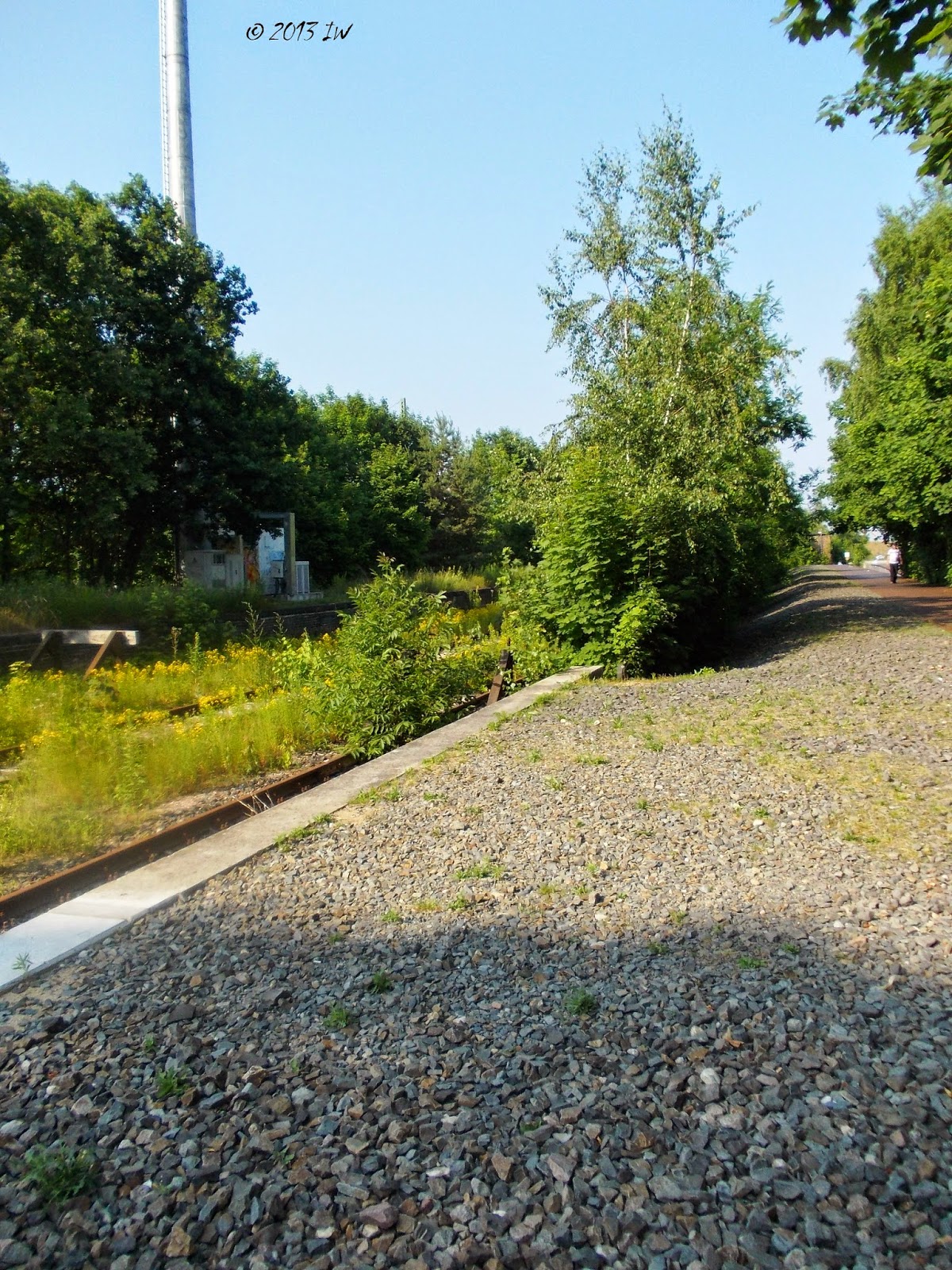
I visited the Gleis 17 from the Berlin Grunewald station the last August. It was a very sunny beautiful day and the noble houses from the area were breathing a majestic peace. The station was first opened in 1879 and bore different names till the current one. The entrance has the shape of a castle and was finished in 1899. 
Various arrows and historical references are leading the visitor to the Gleis/Platform 17, one of the many stations from the Berlin network where the trains are coming and going every 15 minutes almost. It was a certain ambiance of normality that I'm afraid to think it used to be during the terrible times too. Some were taking the train to Berlin, others to death.
From 18 October 1941 till beginning of March 1945, from this station left 183 trains with Jews deported to, first, Litzmannstadt and Warsaw and from 1942 on, to Auschwitz and Theresienstadt. The number of the victims that went through this station is of around 55,000 persons. 
Nowadays, the line is not used being changed into a memorial in the memory of the person deported with the Deutsche Reichsbahn. The inheritors of the then German rail company, Deutsche Bahn, contributed to the establishment of a memorial officially inaugurated on 27 January 1998. At this date the Auschwitz and Birkenau concentration camps were liberated. 
The platform is separated into 183 steel plates, with details of the trains that left the station. It includes the date, the destination and the number of deportees. 
Stones in the memory of the victims, according to the Jewish tradition, are set on various places near the platform. Regularly, reunions in the memory of the victims are held, and most Israeli delegations visiting Berlin include Gleis 17 as part of their program. 
Remembrance has an important role in the Jewish tradition. The victims should be remembered individually and their name kept in the book of life. 
I spent there probably more than one hour, walking slowly and quietly the platform, putting one stone in one corner. No one around, only my silent steps on the steel. There is a lot of sadness and depressive feeling about the human condition. But there is also hatikva/hope, that such atrocities are not possible nowadays as we do have our state to protect and safe us from all evils.