Showing posts with label jewish life berlin. Show all posts

Sunday, 28 August 2022

The Case for Avital Gerstetter

The recent case of the first German woman Cantor Avital Gerstetter, fired by the Judische Gemeinde after writing an article in Welt criticizing Jewish conversions, although generously spread salt on the wounds of the problematic German identity of Jewish communities, still does not deal with the system disfunctionalities that made possible this situation.

Shortly, Gerstetter, born in West Berlin to an Israeli mother and a German - Jewish convert father - mentioned, among others, how the big number of Jewish conversions, some of them Germans with a brown family past, is altering the structure and in the end, the ´Jewishness´ of the everyday practice, including the regular synagogue service itself.

There are a lot of nuances regarding the motives of conversions, that Gerstetter noticed, and there are also individuals differently changed and challenged by their new identity. There are many people who are converting for the sake of a spouse, for having Jewish children, although shortly after the conversion they may give up any trace of practice. They are many belonging to the ´contingent Jews´, those who emigrated from the Soviet Union, with a Jewish father, who may want to convert according to the Jewish Orthodoxy. Some used to celebrate their whole life Jewish holidays and are familiar with the Jewish values therefore the conversion is just an official confirmation of their belonging.

However, there are situations when, unfortunately, situations when exhaustive knowledge about Jewish practice does not help to build the community spirit that connects Jews no matter their background, orientation and level of kashrut. There are those situations when someone who knows very into depth the rules of kashrut or tzniut may make you feel like a second class Jewish citizen because displaying 1 mm more of collarbone that they learned about during the giur classes. That patronizing attitude that, ´puah, they call themselves Jews but look at them, enjoying their plate full of seafood!´/not fasting on Yom Kippur, never coming to the Shabbes service, driving on Shabbes etc.etc.

Reminding someone where is he/she coming from in terms of original religious practice may not be allowed, but what about keeping in mind that it is wrong to make distinctions between Jews, humiliate someone in public, doing lashon hara etc.?

Who are those people learning with for their giur classes? Who are the persons in charge with their giur? What about the rabbis responsible for their giur?

And what about the trauma of the persecutions and the relationship with the state of Israel as the ultimate place of refuge for a persecuted Jew? 

In some cases may be that people who went through the years of the conversion process themselves supported the new converts. Before the accused article was published leading to her abrupt redundancy, Gerstetter used to sing in the synagogue in Oranienburger Straße whose rabbi herself is a convert, born in a Protestant family. Another convert actively ´converting´ other people, whose case made less waves that the remarks by Gerstetter, Walter Homolka is accused of being part of a network of sexual abuse created by his husband. 

Some may ask why Gerstetter haven´t addressed those issues in the Jewish media that used to generously host Homolka´s achievements? Maybe some of the answers are already stated in the article for the smart and informed readers to figure out by themselves.

In the end, what was not (yet) frontally touched upon is the cause of this problem, mainly a system - not necessarily ´liberal´ or ´reform´-supported - that for very non-religious related reasons allows some conversions instead of others. It´s largely unclear how far this discussion will go, but maybe it was about time to happen, even just for the sake of the historical mentions.

(Hopefully) to be continued...

Moses Mendelssohn: ´We Dreamed of Nothing but Enlightenment´

There is a bitter irony that struck me when I visited the very well documented interactive exhibition dedicated to Moses Mendelssohn at the Jewish Museum in Berlin: Although his whole life he pledged the cause of a liberal Judaism for the sake of diminishing persecutions and antisemitism, for the cause of the integration into the mainstream German society, Nazi actually hated and demonized Moses Mendelssohn. His Jewish Enlightment process, that lead that his children even converted to Judaism being eventually burried in a Christian cemetery while bearing very heimishe names, failed from the point of view of the clear aim endeavoured: to take upon Jews the stigma of being targeted for their religion and religiosity.

The exhibition We Dreamed of Nothing but Enlightment/Wir Träumten von Nichts als Aufklärung, hosted by the Jewish Museum in Berlin, until the 11st of September is however an important journey into the intellectual roots of Mendelssohn, his life benchmarks as well as the complex context of his times (including the economic development of Prussia, requiring qualified and skillful workforce which lead to allow more Jews to be part of the larger society). This was my first visit at the museum under the new direction, and although I grasp that there is a relatively similar (liberal) orientation, at least in the case of this exhibition, it pays more attention to the historical facts and less to the ideological background.

Mendelssohn lifestory and intellectual statements can be read in many ways and mine is just one of them. Well integrated Jews are not safer from antisemitism than the visible self-aware Jews. It may offer a temporary invisibility and illusory safety but a full acknowledgment of being the ´part´ of the majority will never happen. The fate of the Jews from the Soviet Union who gave up every bit of their identity to be Soviet, but ended up being marked as Jews in their passports is another example.

But without knowledge it is impossible to make right choices and the exhibition at the Jewish Museum in Berlin offer enough food for thought for a (sad) meditation of the tragical ending of the Haskala Jews.

Disclaimer: I visited the exhibition free as a journalist but the opinions, as usual, are my own.

Thursday, 10 November 2016

Golem Exhibition at the Jewish Museum Berlin

Until the end of January 2017, the Jewish Museum in Berlin hosts a temporary exhibition dedicated to the frightening, mythical and often misunderstood figure of the Golem. Does this exhibition make justice to it, bringing more clarifications and countering the anti-Semitism associated to it?
To start with the news lead: during the wandering through the various artifacts and explanations, and some movies too, I hardly found anything that haven't been told about the Golem. In a bric-a-brac style I encountered in the case of other exhibitions hosted here, you are introduced to an enormous amount of information and objects. From Made in China plastic warriors to work of art playing with calligraphy and new-Age Kabbalistic visions and manga, the exhibition succeeded to cover almost everything.
But too much information, especially when presented in a quite uncritical and - maybe - shyly to assume some standpoints doesn't help too much, especially when your audience is not an expert and it is possibly expecting to understand more about a specific topic than to encounter various manifestations of the topic.
Obviously, there is never enough time to properly approach such a controversial topic, and eventually one can read more about the Golem before and after the exhibition. The first reference to the creation of such a being is mentioned in the secret Kabbalistic book of Sefer Yetzira - Book of Creation - attributed to Avraham Avinu. It is supposed that Maharal of Prague created the first Golem, in Prague - late 16th, beginning of the 17th century. In the 19th century, the legend was that a Golem may protect Jews from persecutions. The other meaning is that a Golem is a symbol of political crazes going amok, but by extension it can be applied to robotics, Artificial Intelligence or genetic engineering. The artists exploring the mysteries of creativity are supposed to brought to life powers that may be bigger than life and thus, dangerous if misused.
In the German-speaking realms, the predominant representation of the Golem was influenced by the movie with the same name, Paul Wagner, extensively presented at the exhibition. Without grasping the deep understanding of the legend and the meaning, the interpretations slightly entered the well-known register of anti-Semitism. This is, in my opinion, particularly the risk encountered by presenting too much information: everyone can pick up a single sentence and meaning, out of the original context, and play it in the unexpectedly wrong way. Call it the Golem's curse, maybe...
Despite the problematic part, if you plan to attend the exhibition with an open mind and a notebook for some further inspiration and documentation, there are things to learn about, especially when it comes to the works of art and the creative representations of the Golem. Shortly, this is one of the exhibitions it is snobbish to eff it, because everyone else in your group was there, but not necessarily the headline of the season, obviously for a good intellectual reason. 

Thursday, 14 July 2016

Jewish histories BerIin: Kleine Synagoge in Auguststraße


A drawing on a wall covered at the bottom with chaotic graffiti, this is all what's left from once used to be the Kleine Synagoge in the central area - Mitte - of Berlin, on Auguststraße 10. The synagogue Ahawas Shalom und Mogen David was inaugurated in 1906, aimed to serve 500 members. In this area in Mitte used to live many middle class Jews. 
The synagogue was destroyed during the Kristalnacht in 1938. At the memorial place, besides a detailed plan, a picture during a Simcha Torah celebration is displayed. The remains of the synagoge were used for other construction work so nothing was left from it.
The inclusion of the Kleine Synagoge in Auguststraße 10 in the circuit of Jewish memorial places is relatively recent, as it took place only ten years ago. In the middle of the 1980s, here was a kindergarden. 

Sunday, 7 February 2016

Jewish Life Berlin: Westhafen Memorial

I was in a big hurry and a bit nervous as I was in a completely new and not friendly looking part of Berlin when I stumbled upon a spectacular monument near the Westhafen S-Bahn train station. A singular presence on the bridge, in the middle of almost nowhere, with unhappy people crossing the bridge. 
I made a short stop, looked around in order to be sure that there are not unusual - yes, this is the word that I wanted to use - people around, get the camera out of the pocket and made 2 short pictures and run away.
As I had found later, this memorial was inaugurated in 1987, for remembering the 30,000 Berlin Jews deported from the nearby Moabit freight depot. After Grünewald, Moabit was the second station for the 180 transports of Jews to death from the German capital city to the camps spread all over the country and the occupied territories. The memorial is located on the Putlitzbrücke that connects Moabit with Wedding. Volkman Haase was a famous sculptor, with many public works sharing a special strength, but this seems to be his only Shoah-related work.
The German railways - then Reichsbahn, today Deutsche Bahn - in the Shoah was concealed long time after the war was over and its atrocities made public. 

Wednesday, 21 October 2015

Brit mila in Germany

If this blog was silent for a long time, there is a motivation and it has to do with the mental and physical challenges before welcoming a new baby to the world. The baby b''H arrived, a bit later than expected, but shortly after Kol Nidre. After the happiness of becoming the new boy neshama to the world, second in line were the worries about preparing him for the challenges of being a Jew.
The first step: brit mila.When you are living in Israel or in big communities, finding a right mohel, being sure that there is a synagogue where to go, inviting people in due time etc. As brits do not have a high occurence here, due to the limited number of new Jewish children born, I considered that it is very important to find a mohel with the proper medical knowledge besides the religious background. Another challenge that needed a bit of research and a lot of phone calls (if interested to find a recommended mohel in Berlin area, do not hesitate to get in touch via the blog).
According to the halacha, the brit should be done the 8th day after birth, including on Shabbat or yom tov. The problem appears when the kid had a small infection and you need to overstay in hospital and thus, to miss the deadline. Normally, the brit can be done any time after and if it was delayed once, it does not matter when it is done. However, the sooner the better, so the search continued with high intensity after being out of hospital with the baby. 
As we tried to follow both the tradition and the medical requirements, asking doctors if the child is good enough to go through the brit was normal. Less normal was to agreee with the message read on the faces of the non-Jewish doctors when explained that we are questioning the medical condition of our son because we want to make the brit: from pity to disgust. This explains the support of some German medical representatives after the 2012 court decision Cologne according to which brit was considered "a serious and irreversible interference in the integrity of the human body", not justified by the freedom of religion and the rights of parents. One prestigious chief doctor in a very respectable hospital in Berlin outlined during a short discussion that the opinions against the brit are not necessarily a German trademark. Of course, as history showed it already on several occasions, forbiding the brit is a trademark of anti-Semitism across centuries. 
The less expected answer come from a hospital that we initially considered as a possible support during our search where we were told that the brit is done there only till the 18th day and that only after 3 years. The more we asked the more we realized how pitiful we are for being away from the place when you do not have to explain why your kid does not have yet a name and why it is so important to have the brit done. A place where being Jewish is enough.

Tuesday, 10 June 2014

Jewish memories in Berlin: Wittenbergplatz

After going out through the exit of the Wittenbergplatz U-Bahn Station in Berlin, after admiring the old adds and the modernist architecture of the station, the traveler will arrive close to the Ku'damm main shopping attraction: the historical KaDeWe retail center. Before that, near the main entrance, a list of places of infamous resonance is mentioned, a reminder of how the Jews were took over in the trains of death in the very center of the German capital city. The list of names was inaugurated there in 1967.
During the anti-Semitic attacks from the 1930s, the area near this station was often the scenery of boycott and vandalism of the Jewish shops. On Ku'damm and Tauentzienstrasse it used to be a high concentration of Jewish shops and businesses. One of the main representative was the KaDeWe, opened in 1907 by the Jewish businessman Adolf Jandorf and later sold to the Jewish family Tietz. The Jews themselves did not give up and openly protested against the situation, without too much chances of changing the overall mood of the population. 

Tuesday, 20 May 2014

Jewish Memories: Gleis 17 Berlin

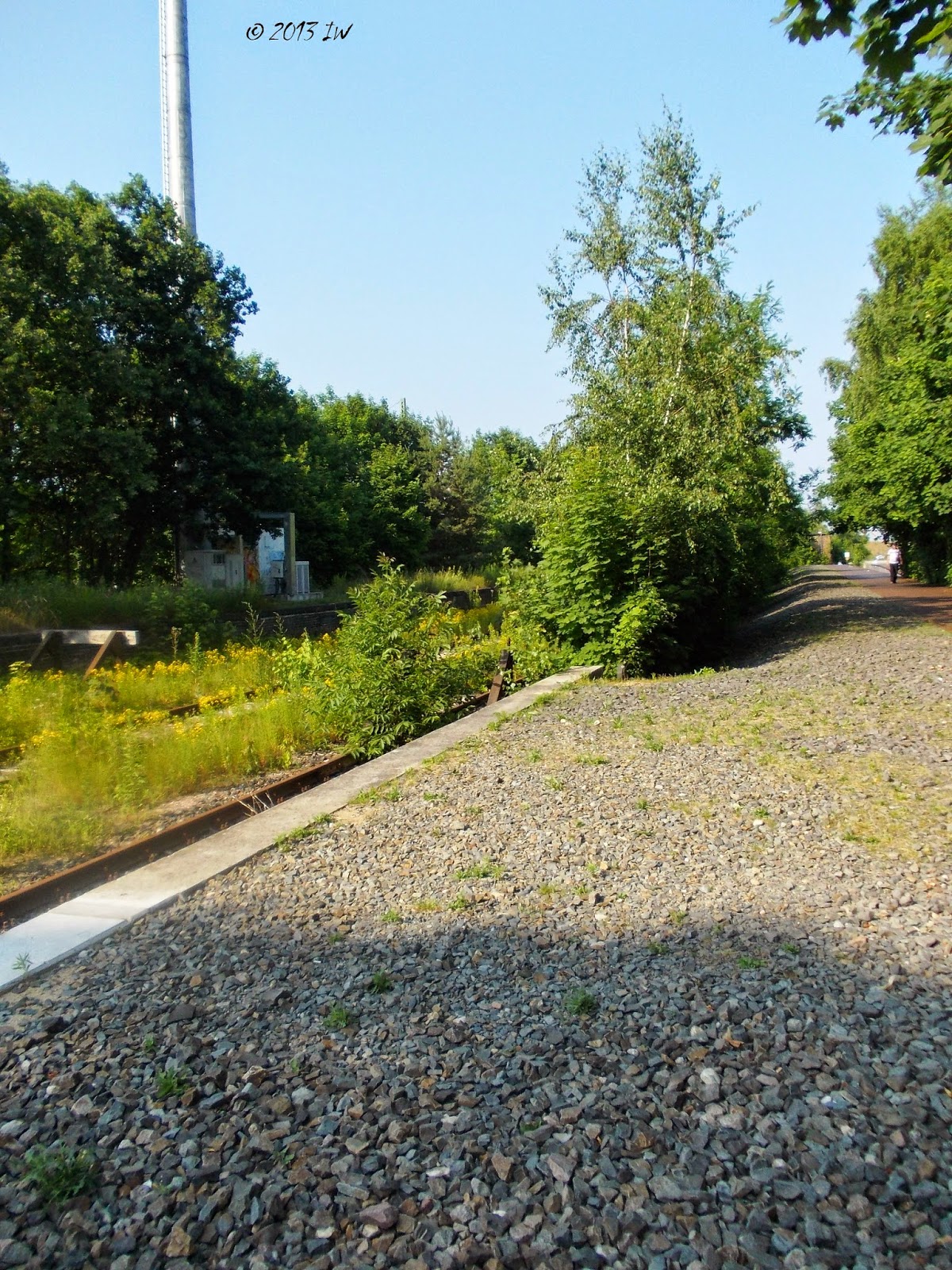
I visited the Gleis 17 from the Berlin Grunewald station the last August. It was a very sunny beautiful day and the noble houses from the area were breathing a majestic peace. The station was first opened in 1879 and bore different names till the current one. The entrance has the shape of a castle and was finished in 1899. 
Various arrows and historical references are leading the visitor to the Gleis/Platform 17, one of the many stations from the Berlin network where the trains are coming and going every 15 minutes almost. It was a certain ambiance of normality that I'm afraid to think it used to be during the terrible times too. Some were taking the train to Berlin, others to death.
From 18 October 1941 till beginning of March 1945, from this station left 183 trains with Jews deported to, first, Litzmannstadt and Warsaw and from 1942 on, to Auschwitz and Theresienstadt. The number of the victims that went through this station is of around 55,000 persons. 
Nowadays, the line is not used being changed into a memorial in the memory of the person deported with the Deutsche Reichsbahn. The inheritors of the then German rail company, Deutsche Bahn, contributed to the establishment of a memorial officially inaugurated on 27 January 1998. At this date the Auschwitz and Birkenau concentration camps were liberated. 
The platform is separated into 183 steel plates, with details of the trains that left the station. It includes the date, the destination and the number of deportees. 
Stones in the memory of the victims, according to the Jewish tradition, are set on various places near the platform. Regularly, reunions in the memory of the victims are held, and most Israeli delegations visiting Berlin include Gleis 17 as part of their program. 
Remembrance has an important role in the Jewish tradition. The victims should be remembered individually and their name kept in the book of life. 
I spent there probably more than one hour, walking slowly and quietly the platform, putting one stone in one corner. No one around, only my silent steps on the steel. There is a lot of sadness and depressive feeling about the human condition. But there is also hatikva/hope, that such atrocities are not possible nowadays as we do have our state to protect and safe us from all evils.