Showing posts with label Zionism. Show all posts

Sunday, 1 March 2026

Zionism. An emotional state by Derek J. Penslar


There are many different ways to approach a movement like Zionism and the focus on emotional aspects is clearly one of them. But what type of national-ism/-oriented movement isn´t emotional? Similarly with a religious awakening, a nationalism requests more emotiona connection than rational choice. In moderate dosis it can magnify the individual, offering them a place within the larger community, with at least one function to perform: being counted towards the identity group.

Zionism, at least in terms of theoretical origin, can be placed under the same category of national revival occuring in the 19th century. Canadian-American historian Derek J. Penslar is analyzing it as ´an emotional state´, which may be a very interesting take.

Is Zionism different than any other national mainstream movements? It answers a different national aspiration and clearly is based on a different narrative than, let´s say French nationalism. And although the book has a solid factual historical background, it lacks the deeper connection, including emotional, which makes Zionism slightly different also from the historical point of view. Across centuries, no one prayed to return to Germany or France, but the idea of Zionism pre-existed the 19th century.

The author quotes from Bava Batra 158B: ´the air of Eretz Israel creates wisdom´. I´ve heard a variant of this very often and it shows a thought that goes, including emotionally, beyond the current debate confronting antisemitism and anti-Zionism or the state of Israel in general. Such references would have offer a much realistic overview of a movement that, clearly, is the subject of more emotional interest than any other in the world. Understanding the ´why´ is still something that needs to be answered.

Disclaimer: Book offered by the publisher in exchange for an honest review

Tuesday, 26 July 2016

Yom Yerushalaim in Jerusalem

"There is no better place to celebrate Yom Yerushalaim than Jerusalem", my friend from Tel Aviv told me, a sound of jealousy in her voice. Indeed, I was wondering myself of my luck, of finally being in Jerusalem on this occasion. With a limited time and not in the mood to follow the official celebrations path - concerts and public gatherings in various parks, I decided to just go out in the central area and watch the people.

From noon on, groups of young people with Israeli flags started to enter the city, mostly from Gush Etzion and Shomron, singing and dancing in the street. The spirit of joy from the 28 Iyar in 1967 when after thousands of years, the holy city of Jerusalem was united again was in the air.

For some religious communities, Yom Yerushalaim is considered even more important than the Yom HaAtzmaut, with the Hallel prayer recited and day-long celebrations organised. This year, despite the heat, the joy embraced the streets and the groups of youngsters were joined by stand-byers of all ages and degree of religious observance. Such moments show the unity despite the many differences. Indeed, I was very lucky to spend this very special day in the very special city.  

Saturday, 7 September 2013

'Come to Israel...'

"Come to Israel, come and see the splendor of a desirable land, the splendor of the Carmel and of the Sharno, the splendor of the pleasant and beautiful azure skies, the magnificience of the clear, pure, and temperate air that reigns in its majesty and glory, even in Tevet. Delight and rejoice in this desirable, fair and pleasing land. A land of life, a land whose air is the wellspring of the spirit. How beautiful and graceful she is!

Come to Israel, come and see 'and your heart shall rejoice, and your bones shall flourish like grass' (Isaiah 66:14). Come and see how our beloved and precious nation like an eagle renews its youth, how she begins to stretch her bones, aching and shattered from wandering and bitter exile; some and see how she accustoms herself to standing erect as a date palm. Come and feel how our national invigorates its spirit by remembering its strength and majesty, by remembering its grandeur and glory at every turn. Come and delight in memories better than good wine, that exalt the soul and increase wisdom, memories of kings and princes, memories of heroes and prophets, memories of glory and strength, greatness and majesty. Come to the Land of Israel - here you will behold the vision of all this, here you will know that you are alive, living a life worthy of the name, in the land of life".

from Rav A.Y.Kook, Selected Letters, translated and annotated by Tzvi Feldman, Ma'aliot Publications of Yeshiva Birkat Moshe, Ma'aleh Adumim, Israel, 1976, pp. 239-240

Friday, 24 February 2012

János Rónai, the brave Zionist from Hungary


I was always surprised by the variants of Hungarian-breed Judaism, and most specifically but their strong Hungarian patriotism that prevented many to see the terrible plans the rest of the population was preparing for them. I have the same curiosity for the way of thinking of the Satmar Hasidic group but also for the Modern-Reform orientations.

Of course, we do not have to forget that Herzl is of Hungarian origin, for example. In my search for understing Hungarian Zionism and Hungarian Jews in general, I discovered János Rónai, who set the basis of the Zion Society in Hungary. 

I should continue the search and the process of understanding. 

Photo: The tomb of Herzl on Mount Herzl, Jerusalem

Wednesday, 18 January 2012

Kyrkyzstan, why not? But Israel...

I work on Sundays and for me this day of the week is one of the busiest - take into consideration also the difficuties of coping with the post-Shabbes readjustment. But still, I reserve always one hour or two for reading some travel, funny articles, as a source of inspiration for my lazy writing. 

Last Sunday, I've found this article about Jerusalem, in the New York Times. The author is enthusiastically expressing his feeling about keeping himself on the road - nice, I said, I love this too. And he outlined: "As a Jew, especially one who travels constantly, I was expected at least to have the Jewish state on my radar, if not to be planning a pilgrimage in the very near future." Even Iran or Montenegro are looking more appealing to him. And he goes on and on, mentioning again how secular he is, and visits Jerusalem and is happy to find human people with whom he can talk. Anyway, in order to keep himself on the line, he is first visiting some non-Jewish places and he's very happy to recommend it. (His message: You know, I am not as bad). I didn't find the piece an amazing article well written, but was not surprise at all by the words - and the medium. I've read previously many bad articles spotting overrated places, but as they don't pay too much for their contributions at the travel section (you may be happy with a $25 for freelancing staff), I'd kept the observations to myself. Plus, at the end, the author looks as changing his mind and this may be a good beginning. And, mission accomplished: he went to Jerusalam, maybe he will return and why not, he will decide to change his life.

Yesterday, David Harris replied to the piece in The Huffington Post, criticizing the content of the article and the choice of the author.

I do not want to defend anyone and actually I am reading daily so much crap and self-denial and misinterpretations that nothing may surprise me. What it is obvious in many of these positions is the lack of education and understanding of Judaism. Many people introducing themselves as "Secular" and "intellectuals" never had the opportunity to meet people with high education, able to share their knowledge and get people closer to the Torah. The fault is not only on one side.

I am reading right now another interesting book of Rabbi Jonathan Sacks about Jewish continuity. Shoah and the galut put at hard trial our belief and knowledge. We stop being Jews by choice or by the force of the events. But, it doesn't mean that resuming our position to criticize those who are different may absolve our responsibility. We should do our best to have them on our side, with their past, differences and points of view. 


Wednesday, 16 November 2011

Strange times

I didn't read too many news lately, but as usual, when it happens I am overwhelmed by various kind of information. This time there were bad and worrying news, but not surprising in many ways. And at the end, it may be an optimistic conclusion as well.

I started my journey reading about the hate crimes in Brooklyn. Brooklyn, one of my favorite place on earth, where I will ever think with affection. How it is possible to be the scenery of such unthinkable actions? Couple of month ago, when we welcomed my American friends from Brooklyn in Europe, I envied their easiness to wear a kippah in Europe, and reminded how natural is there to freely express your identity. But, it doesn't mean is risk-free...

Maybe we'd forgot - or never knew about - the anti-Semitism of the earlier 20th century America, when Jews were running the pogroms and the Nazis - and weren't allowed to enter the country - and the other outbursts of extreme behavior in the 60s - the red left never was Jewish-friendly, by the way (maybe you ask yourself what about Occupy WS movement? I fully recommend to get rid of any hopes). For many of my friends, Brooklyn is safe, welcoming and more Jewish than any other places in the world. You can buy kosher, go to shuls and speak in Yiddish or Hebrew. But, overall, it's nothing but another artificial paradise of the galut where we aren't protected at all against violence and anti-Semitic aggression.

I continued my media wondering reading a lot about Hungary and Central Europe and realizing how far the far right went in one of the countries whose intellectuals I will always appreciate. Europe never been a safe and welcoming place for Jews and the latest official welcome of far right parties into the European Parliament and the daily political life of Europe didn't surprise me (Italy included). As an observation, many of those far-right parties are extremely worried about the fate of poor Palestinians, as their friends from Occupy WS.

9 November 2011 was the day celebrating the 73rd anniversary of Kristallnacht and the German media dedicated several media coverage, including a report regarding the anti-Semitic support within the population. But shortly after, more worrisome were the news that neo-Nazi cells operated and murdered for years across the country, including with the support of some representatives of the police. There were some arrests and some "calls" for creating a database on extremists, but it's never enough for considering the danger is gone.

And, if you listen to me, the danger was never gone. Anywhere. But since 1948, we have our place to go and live!


Enhanced by Zemanta

Wednesday, 19 October 2011

Different versions of Zionism

David Ben Gurion, Israel's Prime Minister and ...Image via Wikipedia//David ben Gurion, the "founding father"


An interesting article, by Dr. Offer Shiff, on the different interpretations of Zionism- and frictions - between David ben Gurion and Abba Hillel Silver, before but mostly after the creation of the state of Israel. A good lecture outlining the identity discussions and eventual controversies that set the terms of the dialogue between the state of Israel and its diaspora, mainly the American one.
Enhanced by Zemanta

Thursday, 1 September 2011

Shlomit is born

The news about the families moving to the newly created Shlomit community, less than one kilometer from the border with Egypt made my day. And this quote of the community secretary: "The army should be the one concerned about safety – that's its duty; our duty is to establish a vibrant community".

This was my lesson learned for today, part of my daily study during Elul and one of the reasons I love this country and its people. People who aren't afraid and who don't give up fight because they know the price of giving up fighting.

The original form of the name Shlomit is Salomé, derived from Shalom - peace.


Sunday, 19 December 2010

A cup of Wissotzky tea

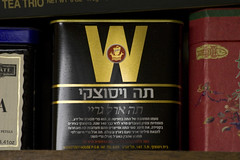
Wissotzky Earl Grey tea tinImage by wesleyt via Flickr
November 1st, at the first Israeli Tea Party gathering, participants were carrying the W tea bags, as part of the country's brand. But, what it is in a cup of tea ?

Currently, the leading producer and exporter of tea in Israel, Wissotzky Tea was founded in 1849 in Russia.

The history

The company was created by Klonimos Wolf Wissotzky, a young Jew living in Moscow, who studied Torah and sent money to Palestine for the cause of Zionism. He expanded the plantations in Ceylon and India. After he died, in 1904, his heritors opened a branch in America, for attracting the Russian immigration there and further expanded to London, Poland and Italy. The Russian Revolution closed the offices of the company. Its first tea plant production in Israel was created in 1936, by Shimon Zidler.

Currently, the company's tea production plant is located in the industrial area in the Galilee and it is the largest tea manufactory in Israel.

In 2005, after 80 years of absence, the company reopened its offices in Moscow.

It continue to be considered a serious and very much appreciated brand, with an important share of the market. Here is an old ad, witnessing the spirit of the time.

My favorites? The jasmine and caramel sorts…Five o'clock tea time!

Enhanced by Zemanta