Thursday, 13 January 2022

Be Strong and of Good Courage


The Israeli leadership portrayed in Be Strong and of Good Courage by Dennis Ross - career diplomat with long experience in the Middle East and the Israeli-Palestinian conflict - and David Makovsky depends at a very great extent of the historical context of the founding of the state of Israel. David Ben-Gurion, Menachem Begin, Yitzak Rabin, Ariel Sharon are usually considered the founding fathers and do represent a certain generation. It is a generation that had to operate under enormous pressure and against a conundrum of inimities and challenges, both internally and externally.

The book follows the historical thread and presents various leadership styles and encounters. While maintaining the historical and geopolitical frame, it displays a variety of arguments explaining one decision or another. Each of the leaders described in the book do have their individual leadership style, mostly inspired by the underground and military experiences - particularly Rabin and Sharon. Given the extraordinary circumstances, judging them through ´normal´/peacetime criteria does not make justice to their times. Knowing more about the context, including the diplomatic unspoken background Ross was largely familiar with, elucidates it.

At the end of the book, I was almost tempted to share nostalgic feeling while comparing ´them´ with ´they´, but finally I realized that it is a very big mistake and in fact, the ´average´ politicians of nowadays are a good sign that no one needs warriors in politics and times turned into a more quiet mood. I suppose that the truth is somewhere in the middle of all this.

Be Strong and of Good Courage do shares a lot of details that may help explaining the many missed opportunities of the ´peace process´, but also the various coordinates that allowed the ´settler movement´ to become such a strong voice within the Israeli politics. Some of the reasons may be, actually, of a very practical nature. The different takes on the relationship with the US, from the very beginning until nowadays is important in the context of Israel´s own state- and national awareness.

Although I much appreciated the well documented narrative, and the interesting political stories brought to life, I was largely disappointed by the writing style. Writing about politics and the Middle East, although it retrains the creative capacity of the writer due to the very complex issues that do not allow too much imaginative tropes, it does not mean that it should be bland and literarily unattractive. More than once I had the feeling that I was just offered some disparate notes on events and characters, that were nissing the thread of a real story.

Rating: 3 stars

Friday, 24 December 2021

Three Graphic Novels with a Jewish Topic

I love the language of the graphic novels as suited to convene a variety of topics, including history and identity and religion. Three topics matching perfectly when it comes to Jewish identity. In the last months I´ve read a couple of graphic novels with Jewish topics that I am happy to further recommend.

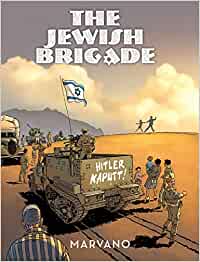
The Jewish Brigade by Marvano


This book is the second from the series created by the Belgian cartoonish Marvano. Based on true facts - Jewish soldiers hunting former Nazis in Europe at the end of the war - it recreates the ambiance of incertainty and human confusion at the end of the second World War. In few words and many inspired visual representations, there are a lot of stories told in just a couple of pages: how Jews just escaping the camps were killed by their non-Jewish neighbours, the meeting between the Russian Cold War interests and the ex-Nazis, the ways in which former Nazis escaped Europe and their punishment. Enough history and context to make you curious to find out more about it, especially if not familiar with the intricacies of those times.

Disclaimer: Book offered by the publisher in exchange for an honest review

Herzl by Camille de Toledo, illustrated by Alexander Pavlenko


Herzl written by Camille de Toledo and illustrated by Alexander Pavlenko is a story within the story, where a simple human story meets the history in the making. Ilya is a Jew who escaped the pogroms and antisemitism of Europe at a time when Herzl acknowledged the neeed for the Jews to have their own homeland. The drama of the little Ilya is the best argument in favor of such a political move. The text is elaborated and unusually rich for this genre, and the predominantly black/dark illustrations are adding the emotional dramatism to the story. I´ve read the book in the original French language. 

The duo De Toledo-Pavlenko recently published a book inspired by the stories of Isaac Babel which I hope to read it soon.

Jerusalem, Ein Familienporträt by Boaz Yakin, illustrated by Nick Bertozzi


Jerusalem. A Family Portrait - I´ve read it in the German version. Ein Familienporträt - is the result of collaboration between the screenwriter and producer Boaz Yakin and illustrator Nick Bertozzi. Its focus is the story of the Halaby family - originally from Aleppo - living in Jerusalem before and during the creation of the state. The story not only dares to explore a very delicate historical period of time, but reveals so many details that one can rarely find in a ´serious´ history book, such as the story of the Communist Party in ´Palestine´.

Those three books are not only relevant from the purely Jewish history point of view, but there are also important as a way in which historical information can be treated and transmitted through literary/visual support. 

Orthodoxed. A Film by and about Berel Solomon


With so many books and testimonies around the web about leaving Orthodox Judaism - in its manifolds and various representations, I often complained that more testimonies about Jews returning to their origins is essential for balancing the facts. Being an Orthodox Jew - Hassidisch, Litvisch etc. - has only a way out and no one wants to go it? In my opinion, it is a false premise, as personally I known many more people who are actually returning to faith, a phenomenon very common among people in their 30s and 40s, in Israel and abroad. There are people who mostly grew up with any or a very limited religious education who in the middle of their life, found themselves lost and in need of guidance. They started alone or as a family, by keeping kosher and Shabbes and learn Torah and create religious families. Without relying on serious data, I may assume that this is a phenomenon predominant among Judaism, as my non-Jewish friends I´ve questioned about similar moves among Muslim or Christian denomination are rather unique and are mostly the result of religious conversions, particularly when it comes to young people.

Last night I was finally offered the chance to see a challenge to the predominant narrative about Jews living the fold, as I watched Orthodoxed - available to watch for free on YouTube - by and about Berel Solomon. Berel Solomon grow up in a culturally Jewish family in Toronto, where, according to his own account, they ate pork chops on the Friday evening Shabbes table. He went to Jewish school and Jewish camps but without a proper religious education. Soon, he become part of a dysfunctional group, got involved in drug trafficking and then got into the nigh club business. He had the mind for business and even launched his own reality show. Until the pressure of his ´empty´ life was too heavy as a burden and he collapsed. 

´Looking for the truth´ he first reached to a Breslov Hassid and ended up - where many baal teshuva end - by Chabad. Diplomatically, he does not mention the group too often, although there is a flash-picture of their 7th Rebbe and he prayed to the ohel in NYC. His rhetoric suits very much the usual Chabadnik enthusted by the return to traditional values and I may say that he sounds a bit too aggressive and show-offish for my taste. After all, the return to religion does not happen overnight and no matter how much one would love to come back to traditional values, technically it is impossible as one needs time to go through the long process of understanding the complex rules of kosher and of Shabbes, among others. But there is a lot of enthusiasm for burning up the stages and starting to catch up with the time of ´unkosher´ life. 

Berel Solomon is now training in Jewish business leadership, and has a religious family. His parents were a bit shocked by his choices - although they seemed not so worried as he was a drug dealer and nightclub entertainer - but nevertheless they got used with his beard, and kapota and kippah. 

Despite my reservations towards any kind of loud declarations of faith, I am glad that a film like Orthodoxed exists and despites its imperfections and shortcomings, it offers a different take on being religious and Jewish in the modern world.


Thursday, 16 December 2021

Impossible Exodus: Iraqi Jews in Israel


Between 1950 and 1951, 123,000 Jews from Iraq moved to Israel, particularly under the pressure of antisemitic turn of events. For the next decade at least, most of them were faced with a different reality that that they might have imagined before: far from being the country of ´milk and honey´, Israel was a pragmatic new state, coping with serious economic and social difficulties, looking for cheap labor force and with a relatively low tolerance towards cultural and social differences. 

Impossible Exodus: Iraqi Jews in Israel is the last volume of a trilogy written by Orit Bashkin featuring the Jewish community in and from Iraq. Very well documented both in terms of history, culture and direct contact with the Iraqi Jews themselves, the book opens up new perspective while countering triumphalistic approaches. ´The Iraqi-Jewish experence in Israel challenges the notion that Israel served as a melting pot for various global Jewish communities´.

There is a lot of material to discuss about in the book. From the extensive description of the conditions suffered by the newly arrived from Iraq, until the disdain unempathic displayed by the Askenazi establishment and the more or less random acts of protest again the measures took, the reader is offered a very detailed insight into the topic. Interestingly for me was the information regarding the connections of Iraqi Jews with the Communist Party in Israel. 

By taking a variety of perspectives - social, political, economic, cultural, anthropologic - the reader is offer a very complex landscape, which far from making conclusions, it re-writes an episode of histoy of both Israel and Jewish communities. It critically treats the data while offering possible explanations of the rift that exists - although at a very low level - between ´European´ and non-European Jews. 

However, the rift is not so black-and-white and rather has to do with specific social discrepancies, as, for instance, within the camps where the Iraqi Jews spent as long as seven years, they met not only other ´Mizrahim´/´Oriental´ Jews, but also Jews coming from Romania or other Eastern European countries. 

Personally, I would have love more comparative approach between, on one hand, the Iraqi Jews in Israel, and the Jews from Yemen or Syria or Egypt, among others. There are a couple of mentions in this respect, but it gives the impression of a special case faced by the Iraqi Jews when, in fact, it was typical for other communities as well.

Nevertheless, Impossible Exodus: Iraqi Jews in Israel is a noteworthy contribution to the current Israel story. By revealing less known and less pleasant episodes of the recent history, it only makes the Israel story easier to understand. 


Tuesday, 14 December 2021

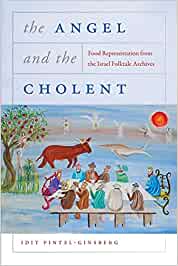
The Angel and the Cholent


Jewish identity and food are connected not only through the limitations and complexities of the rules of kashrut, but through the meanings beyond the immediate food connection. In The Angel and the Cholent, a collection of 30 folktales by Idit Pintel-Ginsberg there is a story about a Jewish woman from Libya who converted in order to join his Muslim husband. The smell of hamin reminds her of the life she left behind and gave her strength to return to her parents.

The tales reunited in the volume are compiled by the Israel Folktale Archives (IFA) named in honor of Dov Noy, at the University of Haifa. Since 2017, IFA´s collection was included in UNESCO´s Memory of the World program. The selection was made out of 180 tales whose plots relate to food. The stories do cover a vast geographical area: from Eastern Europe and Russia, to Morocoo, Libya or Iraq. There is also one story by a Muslim storyteller from Israel. 

The collection is diverse also from the point of view of the characters featured: from the rabbi and the pauper, to the wife and the mother. The story may not be equal in terms of their originality - there is a variant of the ´Love like salt´ story - but for me, the most important part was the commentary, the way in which the specific story was contextualized from the geographical, historical and religious-traditional point of view. In this way, various elements of the text are outlined, compared and explained. 

An important element of The Angel of the Cholent is its particular reading(s) of the food stories: as gender dynamic, as a marker of the interaction with other religious and ethnic groups, as an intricate social system, as a historical mirror of various evolutions within the majority as well. The critical feedback can be further use in other anthropological discoveries centered on food in other cultures and religions as well.

The ubicuity of food in our everyday life is a nourishment for the belly but equally nurtures the soul and the mind in its very personal special Jewish way.


Saturday, 11 December 2021

Unashamedly Jewish


I may confess that my first encounter with Barbara Honigmann´s writing was not an outstanding experience. It may be that I was not prepared - mentally and linguistically - or just it was not a good book. It happens to everyone - both readers and writers.

My second meeting with this German Jewish author and translator living  in France is in fact a collection of discourses held on the occasion of being awarded literary prizes and public appearances, where elements of personal biography, particularly related to her Jewish identity are omnipresent. Written in German, they are inspiringly connecting European Jewish biographies - like Proust and Kafka´s - with personal literary experiences and her own Jewish journey. 

On one side, there are the intellectual references and the arguments for a critique, literary or philosophically. On the other side, there are her own personal/subjective encounters with her own Jewishness - that she assumes ´unashamedly´/unverschämt - as growing up in a secular Jewish family that decided to return from Exile after the war in the Soviet-occupied communist Germany. Some of the few whose family histories did not include Nazis. 

Honigmann writes about different kind of Jews. Jews like Heine or Proust or Edith Stein. Obviosuly, about Kafka too.  ´Western´ Jews that preferred to abandon their identity for joining the majorities, nevertheless Jews. Sometimes, there are the stories themselves that matter. Another time, the intellectual histories.

I may acknowledge that right now, I will not hesitate to start reading another book by Honigmann, particularly for the authentic GDR-Jewish stories, that keep interesting me and whose reliability through personal memoirs is at a certain extent problematic - for reasons that maybe will be able to explain one time.

Friday, 10 December 2021

The War on Women

´Feminism is starting to have its day in Israel, and on a certain level, this is invigorating´.


 There is a war on women in Israel and Elana Maryles Sztokman is documenting its major fronts. 

Women are sent on the back of the buses, women faces are erased from the public space and publications, women voices are cut shortly. Women bodies are under control either it has to do with conversions, dress code, divorce or fertility. There are modesty patrols in the religious neighbourhoods, not only in Israel, but in other religious neighbourhoods around the world as well, such as in the USA or London. There is erasure of women´s faces from Holocaust artifacts - ´a new low in the world of religious misogyny´. 

Although the situation emerged in the 1990s, only in the last five years there is more awareness about the extent of the problem. Most of the turns do not have anything to do with the religious law - for instance, in the case of women voices, the prohibition is for men to hear it, not for the women to stop singing - and in the rest, there are completely out of context rulings. 

The War on Women in Israel documents all those situations, in the smallest details, but also offers insights about the turn that was taken among the women themselves, including the religious ones. There is more pressure against the establishment - religious, state´s - towards reclaiming a safe and respectful space. This is the only way to keep the radicalism in check over and over again. 

Democracy and individual freedoms are not to be taken for granted. Critical voices are needed to maintain the awareness about the need of any power - laic, religious etc. - to respect women. The fact that more and more women refuse the second-class condition they were assigned by men, gives hope. But it is not enough. Never will it be enough.