Showing posts with label Jewish life Germany. Show all posts

Tuesday, 4 November 2025

Books featuring Jewish life in Germany

I´ve recently read two books in German featuring Jewish authors and public figures that may show the diversity as well as the particularities of being Jewish in Germany.


München-based author Dana von Suffrin collected 16 stories by Jewish authors who are sharing either their experiences or a literary work inspired by their identity. Among them, Eva Manasse, Maxim Biller, Zelda Biller, Adriana Altaras, Linda Rachel Sabiers or Lena Gorelik. Given the literary representation it largely set the ground for a discussion about Jewish literature in German language, that could be a source of both debate and dissent, but interesting nevertheless.


The other collection, edited by Andrea von Treuenfeld, is essentially aimed at offering a voice to young Jews in Germany, sharing their experience, their encounter with antisemitism and the diversity of their life and identity experiences.

This was by far my favorite book, because it shows the future of Jewish life as well as the topics of actuality that may be generated of the different relationships to identity. The authors do come from different ways of life: were born in Germany or in Israel, or they have Israeli parents or are patrilinear Jews or are second generation of ´contingent´ Jews, discovered religion later in life or are keeping the traditions no matter of their halachic background. 

This book is equally interesting for researchers and historians aimed at understanding the Jewish identity in Germany in the 21st century as it offers many new directions of study and analysis.

Sunday, 22 September 2024

Traces of Jewish Life in Ulm, Germany


Travel across Germany allows me always not only to get to learn more about the country, but also to identitfy traces of Jewish life and memory. While in Ulm, I had the chance to discover more details about the tormented WWII history. 

A permanent exhibition an Einstein Haus/Ulmer Volkshochschule, on Kornhausplatz is dedicated to explaining historical episodes of the resistance against Nazi regime.


As for now, I do not have enough historical information to offer a critical outlook to the exhibition as such, but as expected, it features extensively Hans&Sophie Scholl, born here. 


There are also featured another members of the White Rose - the name of the most important resistance movement, at least in this part of Germany - as well as testimonies of Jewish citizens of Ulm. Take them with a grain of salt, but there are many details that deserve a further research.


As in many other German cities, what once was the Jewish quarter was clearly named - Jewish street, or yard. Judenhof in Ulm used to be the centr of local Jewish life from the late Middle Ages onwards. In 1353 a synagogue used to serve the community here. The name served usually to create clear boundaries between Jewish and non-Jewish residents and very often limited the freedom of movements of Jews living there.


As all over Germany, Jewish life got a new impetus in the 1990s, with the arrival of Jewish from former Soviet Union. The community increased considerably in the decade onwards, prompting the need for a bigger religious and community meeting point. Right now, the members count around 450-500, mostly Russian-speakers.

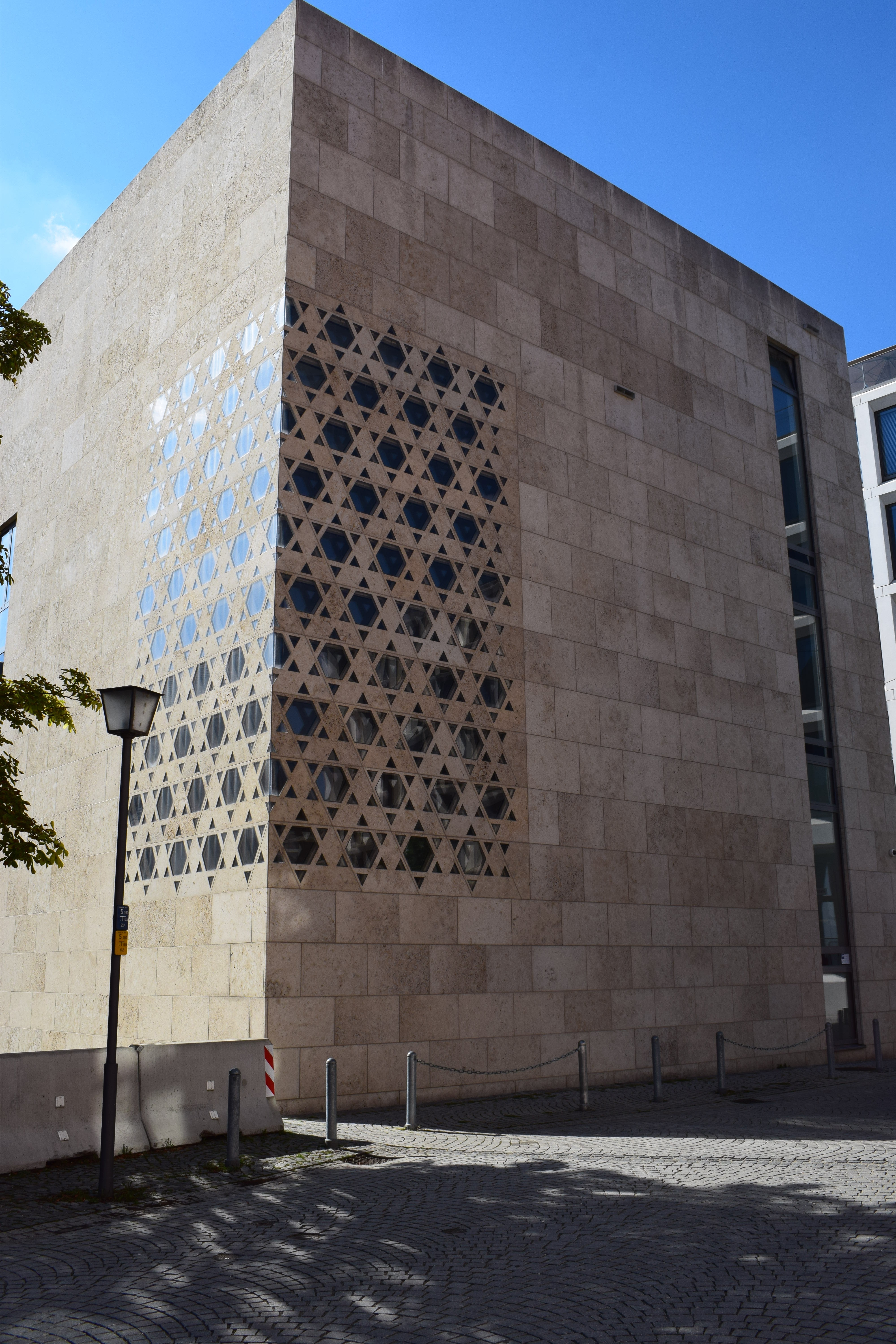
The new synagogue, a cube marked on sides with windows outlined by Stars of David, was inaugurated in 2012, 70 years after the Kristalnacht pogrom. 

It is situated on Weinhof 2 where the 19th century once stood, and is currently following the Chabad orientation. Due to the lack of time, during my visit I was not able to visit the synagogue, but according to the general descriptions of the location, it hosts a community center, a mikwa, a nursery and various educational programmes for children.


Sunday, 28 August 2022

The Case for Avital Gerstetter

The recent case of the first German woman Cantor Avital Gerstetter, fired by the Judische Gemeinde after writing an article in Welt criticizing Jewish conversions, although generously spread salt on the wounds of the problematic German identity of Jewish communities, still does not deal with the system disfunctionalities that made possible this situation.

Shortly, Gerstetter, born in West Berlin to an Israeli mother and a German - Jewish convert father - mentioned, among others, how the big number of Jewish conversions, some of them Germans with a brown family past, is altering the structure and in the end, the ´Jewishness´ of the everyday practice, including the regular synagogue service itself.

There are a lot of nuances regarding the motives of conversions, that Gerstetter noticed, and there are also individuals differently changed and challenged by their new identity. There are many people who are converting for the sake of a spouse, for having Jewish children, although shortly after the conversion they may give up any trace of practice. They are many belonging to the ´contingent Jews´, those who emigrated from the Soviet Union, with a Jewish father, who may want to convert according to the Jewish Orthodoxy. Some used to celebrate their whole life Jewish holidays and are familiar with the Jewish values therefore the conversion is just an official confirmation of their belonging.

However, there are situations when, unfortunately, situations when exhaustive knowledge about Jewish practice does not help to build the community spirit that connects Jews no matter their background, orientation and level of kashrut. There are those situations when someone who knows very into depth the rules of kashrut or tzniut may make you feel like a second class Jewish citizen because displaying 1 mm more of collarbone that they learned about during the giur classes. That patronizing attitude that, ´puah, they call themselves Jews but look at them, enjoying their plate full of seafood!´/not fasting on Yom Kippur, never coming to the Shabbes service, driving on Shabbes etc.etc.

Reminding someone where is he/she coming from in terms of original religious practice may not be allowed, but what about keeping in mind that it is wrong to make distinctions between Jews, humiliate someone in public, doing lashon hara etc.?

Who are those people learning with for their giur classes? Who are the persons in charge with their giur? What about the rabbis responsible for their giur?

And what about the trauma of the persecutions and the relationship with the state of Israel as the ultimate place of refuge for a persecuted Jew? 

In some cases may be that people who went through the years of the conversion process themselves supported the new converts. Before the accused article was published leading to her abrupt redundancy, Gerstetter used to sing in the synagogue in Oranienburger Straße whose rabbi herself is a convert, born in a Protestant family. Another convert actively ´converting´ other people, whose case made less waves that the remarks by Gerstetter, Walter Homolka is accused of being part of a network of sexual abuse created by his husband. 

Some may ask why Gerstetter haven´t addressed those issues in the Jewish media that used to generously host Homolka´s achievements? Maybe some of the answers are already stated in the article for the smart and informed readers to figure out by themselves.

In the end, what was not (yet) frontally touched upon is the cause of this problem, mainly a system - not necessarily ´liberal´ or ´reform´-supported - that for very non-religious related reasons allows some conversions instead of others. It´s largely unclear how far this discussion will go, but maybe it was about time to happen, even just for the sake of the historical mentions.

(Hopefully) to be continued...

Moses Mendelssohn: ´We Dreamed of Nothing but Enlightenment´

There is a bitter irony that struck me when I visited the very well documented interactive exhibition dedicated to Moses Mendelssohn at the Jewish Museum in Berlin: Although his whole life he pledged the cause of a liberal Judaism for the sake of diminishing persecutions and antisemitism, for the cause of the integration into the mainstream German society, Nazi actually hated and demonized Moses Mendelssohn. His Jewish Enlightment process, that lead that his children even converted to Judaism being eventually burried in a Christian cemetery while bearing very heimishe names, failed from the point of view of the clear aim endeavoured: to take upon Jews the stigma of being targeted for their religion and religiosity.

The exhibition We Dreamed of Nothing but Enlightment/Wir Träumten von Nichts als Aufklärung, hosted by the Jewish Museum in Berlin, until the 11st of September is however an important journey into the intellectual roots of Mendelssohn, his life benchmarks as well as the complex context of his times (including the economic development of Prussia, requiring qualified and skillful workforce which lead to allow more Jews to be part of the larger society). This was my first visit at the museum under the new direction, and although I grasp that there is a relatively similar (liberal) orientation, at least in the case of this exhibition, it pays more attention to the historical facts and less to the ideological background.

Mendelssohn lifestory and intellectual statements can be read in many ways and mine is just one of them. Well integrated Jews are not safer from antisemitism than the visible self-aware Jews. It may offer a temporary invisibility and illusory safety but a full acknowledgment of being the ´part´ of the majority will never happen. The fate of the Jews from the Soviet Union who gave up every bit of their identity to be Soviet, but ended up being marked as Jews in their passports is another example.

But without knowledge it is impossible to make right choices and the exhibition at the Jewish Museum in Berlin offer enough food for thought for a (sad) meditation of the tragical ending of the Haskala Jews.

Disclaimer: I visited the exhibition free as a journalist but the opinions, as usual, are my own.

Saturday, 11 December 2021

Unashamedly Jewish


I may confess that my first encounter with Barbara Honigmann´s writing was not an outstanding experience. It may be that I was not prepared - mentally and linguistically - or just it was not a good book. It happens to everyone - both readers and writers.

My second meeting with this German Jewish author and translator living  in France is in fact a collection of discourses held on the occasion of being awarded literary prizes and public appearances, where elements of personal biography, particularly related to her Jewish identity are omnipresent. Written in German, they are inspiringly connecting European Jewish biographies - like Proust and Kafka´s - with personal literary experiences and her own Jewish journey. 

On one side, there are the intellectual references and the arguments for a critique, literary or philosophically. On the other side, there are her own personal/subjective encounters with her own Jewishness - that she assumes ´unashamedly´/unverschämt - as growing up in a secular Jewish family that decided to return from Exile after the war in the Soviet-occupied communist Germany. Some of the few whose family histories did not include Nazis. 

Honigmann writes about different kind of Jews. Jews like Heine or Proust or Edith Stein. Obviosuly, about Kafka too.  ´Western´ Jews that preferred to abandon their identity for joining the majorities, nevertheless Jews. Sometimes, there are the stories themselves that matter. Another time, the intellectual histories.

I may acknowledge that right now, I will not hesitate to start reading another book by Honigmann, particularly for the authentic GDR-Jewish stories, that keep interesting me and whose reliability through personal memoirs is at a certain extent problematic - for reasons that maybe will be able to explain one time.

Monday, 17 May 2021

Feeling a Stranger in your Own Country


Yascha Mounk was born in Germany in a culturally Jewish family originary from Poland. The official Polish antisemitism within the Communist Party at the end of the 1950s, forced his family to leave Poland and spread all over the world. Belonging to a post-war generation born Jewish but raised Communist and Polish, his family set in Germany, besides the heavy weight of the recent past, because they wanted a professional future. As many immigrants in Germany, they learned the language and contributed to the larger German society.

Yascha Mounk was born here, speaks German with an accent and is vaguely - if ever - involved in the institutional Jewish life. From the legal point of view, Germany is indeed his country, but a country where he does not feel at home and never did. Nowadays an American citizen, he lives and teaches political sciences in New York City.

Stranger in my Own Country belongs to a recent trend of memoirs written by young Jews living in Germany who are brutally coming at terms with their identity, which can also mean rejecting dramatically the society that never wanted them. 

There are a couple of aspects involved by this process.

On one side, is the nauseating philosemitism which is as pathetic as lacking any substance. It´s a mental automatism, a tic, which in fact does not say anything - good - about how the Germans really feel officially about Jews. Usually expressed in the presence of someone declaring his or her Jewish identity, this attitude does not mean anything but a political statement, empty of a practical meaning. It is just a reflex, not a constant state of mind, and its clearer reflection is the attitude towards refugees. ´In fact, while ordinary Germans now have a multifaceted contradictory attitude towards Jews, many of them express hostility against other kinds of immigrants and foreigners with larger integration issue´. 

On the other side, there is the frontal antisemitism which never actually left - Europe, or Germany and what was latest heard on the streets of Berlin, London or Milan, to name only a few is one of the many proofs in this respect. 

Caught between those extreme attitude, Mounk, as many other Jews living here, born or only immigrants, could not feel at home. Do not have any real reason to consider Germany their home. The wall between they and them and the others and in the end, between humans as such, are becoming higher and higher. A self protection against each other.

The book explains the post-WWII German history - from the West Germany perspective - through facts and historical details. The slow development of the Jewish communities in Germany are explained in the same time with the different incidents and the shift in the field of the mentalities, particularly acknowledging the past in all its complexity and especially context. ´A younger generation of intellectuals, in short, has become willing to talk about the German victims of WWII without feeling the need to put their ancestors´ suffering into context´. A kind of YOLO interpretation of history which irony put aside, is wrong in its simplicity. 

Stranger in my own country is the unhappy ending for an identity search. Actually an identity which is refused for all the wrong reasons. But we are living in a fluid world and identities can be replaced, embelished and re-created. I am glad that in the last ten years so many memoirs written by young German Jews were written. Although the tone is sad and disappointed, those testimonies can create a space for open discussion and, who knows, maybe a medium- and long-term change at the level of mentalities.

Sunday, 3 November 2019

Traces of Jewish Life in Coppenbrügge, Niedersachsen

There are not too many stories about the Jewish life in Coppenbrügge, a small village situated near Hannover and Hameln, in Niedersachsen, Germany. The community was always small, with around 50 Jews living here at the beginning of the 19th century. 
The presence of Jews here is first mentioned in 1630. For the holidays and the Shabbat, the services were offered as far as Hameln, made famous by Brothers Grimm Pied Pipper of Hamelin.


The few Jewish families living here were active in small businesses, such as the Levy family, which owned a textile factory. Oskar Levy was member in the local hunting and war veterans associations, from whom he was dismissed shortly after the Nazi come to power. 
But the Nazi were not having enough humiliating and killing innocent people, they had their feud with the dead Jews too, as they destroyed the local cemetery where 60 people were laid to rest. The cemetery was open since 1787, for the Jews living in the communities of Coppenbrügge, Brünninghausen and Hohnsen.


After the war, the plot that used to be a cemetery was purchased by a private person and was returned back to the Jewish community only in 1988. There are no information about Jews living now an open Jewish life in Coppenbrügge. The area of the former cemetery is marked with a fence, with a modest memorial for the Jews murdered.
An informative billboard has an outline of the circumstances that lead to the destruction of the Jewish life in Coppenbrügge, mentioning the name of the former Jewish residents murdered: Erich Levy, Lieschen Levy, Oskar Levy, Ruth Levy, Ernst Rothstein, Bertha Spiegel. May their memory be a blessing and the name of their murderers for ever erased!

Friday, 26 July 2019

Traces of Jewish Life in Bayreuth

With a community of around 500 people, the Jewish life in Bayreuth is aimed at getting a new impetus with the opening of a Jewish center the next year. Situated opposite the synagogue, considered the oldest still in use in Germany, the center will include a kosher café, rooms for Talmud Torah classes and other spaces for events.
It is unclear who will give the hechsher - the stamp attesting the products are kosher - or who will teach the Torah classes. Most of the community is nowadays made of Russian-speaking Jews originally from the former Soviet Union.
The synagogue
The history of the local synagogue is connected for all this goods and bads with the UNESCO-listed Margravial Opera House. During the Kristallnacht pogrom, it was not put on fire only because it was a high probability that the Opera with which is sharing a common wall, will be affected. At the end of the war, when the Allies were throwing the remaining bombs on the way out of Germany, it was the round of the synagogue to save the Opera, which was not bombed in order to spare the synagogue. 

The community center
As everywhere in Germany, and in Europe in general, the life of Jews in Bayreuth was never been easy. The first proof of Jewish life is dating back in the 13th century. Various persecutions and pogroms ceased their presence between the 16th and 18th century. Under the protection of Magrave Friedrich, they were allowded to return. Their main representative at the time was Moses Seckel, the count banker and count supplier. The community grew up slowly, with 389 persons registered in 1792 and 530 in 1837. The intensive anti-Semitism, manifested both in the everyday life and at a highly intellectual level - see Wagner's works  - reduced significantly the Jewish presence in Bayreuth. It continued to decrease constantly in the years of National-Socialism, with only 80 Jews living here in 1938. Most of them were killed during deporations, with only a couple of them surviving, mostly due to their marriage with Christian spouses. 
Walking tours aimed to highlight the Jewish life are organised via the local tourism office, featuring former Jewish properties and streets with Jewish histories, as well as places of memories, where the Jews were gathered and sent to death. 

Tuesday, 25 June 2019

New Book About Jewish Life in Germany

Understanding the Jewish life in Germany, beyond the usual approach regarding the 'contingent people' (Jews from the Russian-speaking lands that were allowed to move to Germany in the early 1990s) is a work in process. 
The arrival of Jews from the former Soviet Union territory was a challenge both for the very small group of local Jews and for the country in general, after decades of absence of a proper Jewish life. It is a lot to be said and written about what happened after all those years and at what extent the religious and cultural identity of the local communities were challenged and changed following this interaction.
In the collective volume of 'Weil ich hier leben will', the authors involved at various extents with the Ernst Ludwig Ehrlich Studienwerk (ELES) are sharing their experiences, wishes and expectations of a new Jewish life in Germany. Although most of the writers do have a direct experience mostly with the intricacies of the everyday Jewish life and community organisation in Berlin, other parts of the country are also covered, although at a very limited extent. 
For someone relatively knowledgeable of those aspects, the volume is not bringing too many insights and even the less about practical solutions, but it outlines in a common effort ideas and suggestions that are 'in the air' for a long time. Such as how to re-redefine the Jewish identity otherwise than in relationship with Shoah, how to increase the level of democracy within the organisational structures of the community - a very complicated and almost impossible mission under the current conditions in my opinion - the role of the Jewish education and how to improve it (as the schools are the direct responsibility of the aforementioned community, the education is the collateral victim of the lack of vision), what role to assign to the Israeli, non-European Jews that settled in Germany, especially in Berlin in the last years. And last but not least, the permanence of anti-semitism in its different manifestations.
The discussion for each and every one of those topics requires volumes and weeks of discussions, not necessarily leading to solutions. Sometimes solutions are not necessarily what one should look for, as opportunities and new possibilities might arise. It is important to seize the momentum and raise the voice, but would always be better to dare to speak your mind when necessarily - like in the case of the debate regarding the advice of a German official to the Jews to wear or not the kippa - outside the narrow limits of the community.
The clear, outstanding Jewish voices are needed as part of the democractic representation in this country, and this volume gives an idea about the current intellectual leadership. It was an interesting reading overall, although there are so many corrections to be done and approaches that are specific to the religious and cultural background of the authors only.

Saturday, 1 December 2018

Winternähe - About Jewish Identity in the German Lands

When it comes to Jewish identity in Germany, I've often read about a lot of topics, all interested but not necessarily relevant for my interests. Many young promising writers lately published their memoirs or novels, in German, about their experiences of being Russian Jewish or mostly from the former communist countries and facing a completely new country with its rules, new language and local communities reluctant to welcome to warmheartly the new comers. 
However, I've been always curious about the experience of local Jews of growing up and living in Germany, not only after the war but especially in the last decades of the 1980s and beginning of the 1990s. I personally know one person that might have some stories to tell but I completely abhor so I better look finding for honest and interesting people. 
I've first heard and seen Mirna Funk a couple of years ago, at a discussion at the Jewish Museum in Berlin dedicated to Israeli-German relations, literature and identity that although it was a bit too leftist in essence, brought interesting topics expressed by young writers and intellectuals. Her book, Winternähe, was not ready yet but the dialogue I've witnessed then made me curious enough to buy the book shortly after publication. 
I will not enter now into the - very important though - halachic debate about how is a Jew, and how the Jews in Germany define themselves. The book has also many autobiographical insertions, at least as I take into account the various public statements by the author herself. The character of the book, Lola grew up in the former communist Germany, with a Jewish father who run away from her and his country as far as from Australia. Her German mother wasn't too family bound either so she lived with her paternal grandparents. In the new, democratic, reunited Germany she is making a life of her own, trying to define herself, in a different way than other people - both Jews and non-Jews - want to define her. She is genuine, a bit chaotic, financially independent to run away from Berlin to Israel - during the latest war - and then to Thailand. She needs to settle to a herself she is not aware how to find it, where to find it and how to clearly define in a readable way for the other people - noth Jews and non-Jews - too. Her ideas and her context are sometimes highly stereotypical, but this is the feeling I've had often when I've tried to delve more into the local Jewish approach. When you go beyond the overall accepted culture of rememberance there is nothing clear to expect and most probably anything good either when it comes to Jewish perception and identity. 
Besides the actuality of the topics raised I also liked the style - I've read the book in the original German language - and the character construction. I only wish I'll discover more genuine German authors writing about as many relevant Jewish questions and issues as Mirna Funk.

Rating: 4 stars

Tuesday, 22 August 2017

Traces of Jewish life in Karlsruhe, Germany

I had a very intensive time in Karlsruhe at the beginning of this year, therefore I hardly was able to go off the beaten path and focus exclusively on the Jewish history of this big industrial city in the Western part of Germany. However, as usual fate was on my side and without too much effort was able to notice some fragments of Jewish history just on my way from a meeting with the local history and culture to another.
For instance, on Karlstraße 11, where nowadays there is a restaurant, it used to be the bank L. Homburger, belonging to one of the oldest families in Karlsruhe. The art nouveau influenced building was planned by the architects Robert Curjel and Karl Moser. After 1938, the bank was liquidated and took away by the state.
Another memorial remembers the synagogue destroyed in 1938, together with many other Jewish institutions. The Jews started to establish in Karlsruhe at the beginning of the 18th century. In 1725, here it was a synagogue, a mikve, a cemetery, and infirmary. After the partial emancipation decrees, here was established in 1809 the seat of the Central Council of Jews in Baden. From 1820s on, Jews were allowed to be work in the field of law and medicine. 
Stolpersteine in the memory of murdered Jews are visible all over the city: on Stephaniestraße, Rheinstraße...In October 22, 1940, 893 Jews were deported to Gurs, France. Others were sent to death between 1942-1945 to Izbica, Auschwitz or Theresienstadt. In 1945, there were 90 Jews left in Karlsruhe. Nowadays, there are less than 1,000 Jews here, served by a Chabad House and a synagogue, mostly originary from the former Soviet Union. 

Saturday, 12 August 2017

Traces of Jewish Life in Görlitz, Germany

Call it the traveller's luck: You spontaneously decide to go to Görlitz and this is exactly the day when there is the open day visit of the main historical monuments in the colourful, Hollywood-loved town. This is how I had the chance to visit the Art Nouveau Synagogue on Otto-Müller Straße, that during my previous visit I've only seen from outside. 
From outside, the massive stoned synagogue looks like many others I've seen in Germany and Eastern Europe, typical constructions for the beginning of the 20th century. It looks like a temple, but it is rather a Greek one it reminds of, instead of the Temple from Jerusalem. The synagogue in Görlitz was inaugurated in March 11, 1911, being the few in Germany not damaged during WWII. I particularly loved the metal-lace intricacies near the main door, an interesting Moorish detail. 
Inside, the details are impressive and carefully chosen with golden inserts into black marble. The lightning also plays an important role in creating a special ambiance and amplifying the space. When we arrived, there were preparations for a concert, as the synagogue nowadays is used as a cultural space rather than a religious institution.
The ceiling offers a fascinating combination between the usual decorative elements of Art Nouveau and typical Biblical motives, such as the lions.
It also has a space for the choir, the typical element of a Reform synagogue, but this space can also be used as a women's section. Around me, other visitors were coming and going in a hurry, snapping pictures before heading up to the new open monument. I wanted to stay a bit more, trying to imagine how it was when the synagogue was ready to welcome the guests coming to pray for Shabbat or holidays.
This synagogue in Görlitz, a town where the presence of Jews is documented since the 13th century, is one of the many, and apparently not the most frequented, as shortly after the opening it seems that there were problems to gather the miniyan - the 10 men needed to pray. Most of the Jews living here were merchants, laywers or doctors, and traces of Jewish life still can be seen in many places around the town, including a cemetery, a mikveh - ritual bath - and houses that used to belong to Jews. 

Friday, 31 March 2017

Who was Gerda Taro?

A small square in the German city of Stuttgart bears since November 2008 the name of the forgotten first war photographer woman Gerda Taro. Taro was also the first woman photographer killed in mission, as she died at 27 years old in 1937 while on assignment covering the Spanish Civil War. The square, situated at the intersection of Ecke Hohenheimer and Alexanderstraße has 9 rotten-looking rectangles where the letters of her name are inscribed in metal on one side, with extensive information and photographs about her on the other side.
Gerda Taro was born Gerta Pohorylle in Stuttgart in a family of Galitian (Polish) Jews that emigrated to Germany. She attended boarding school in Switzerland and shortly after the National-Socialists arrived to power, she got involved in anti-establishment protests and was shortly imprisoned in Leipzig. After this incident, she decided to move to Paris leaving Germany for good. Most of her family will perish during Shoah and she will never meet them again. In Paris, she met a Hungarian Jew, Endre Friedmann, who later took the name of Robert Capa (capa means 'shark' in Hungarian), with whom she got sentimentally and professionally involved. She changed her name to Taro, inspired by the Japanese avantgarde sculptor and painter Taro Okamoto.
She soon got involved with the activities of the French Communists and decided to continue her search for authenticity in Spain, fighting with her camera to catch on film the moments of the Spanish Civil War. She became friend with Hemingway, George Orwell and the future post-war German chancellor Willy Brandt. Taro was working as what much later was called 'embedded' member of the media corp, journalists working and traveling together with one of the 'armies' of the conflict. She was wounded while on a car caming back from an assignment and died later, on the day of her 27 years anniversary. 
Her funeral was organised by the French Communist party in the famous Pere Lachaise Cemetery in Paris and a monument for her grave was commissioned to Alberto Giacometti. 
Many of her works were kept by Capa and therefore there are not too many specific works left. Her presence into the world was rarely noticed and mentioned despite her pioneering work and artistic achievements. 

Friday, 24 February 2017

Traces of Jewish life in Ettlingen, Baden-Würtemberg

Every time I travel somewhere in Germany - and in Europe - I discover traces of Jewish life. In most cases, there are stories about a life that used to be and the past in general. But learning about the past is always a good opportunity to think about the future. 
The last week, I visited the small locality of Ettlingen, situated 5 minutes away by train from Karlsruhe, in the Western part of Germany, close to the border to France.
During WWII, many of the Jews murdered in this part of the country were sent to Gur concentration camp in France. Ettlingen has a relatively small Jewish community, with origins as far as the beginning of the 14th century. The Black Death persecutions and pogroms between 1348-1349 when Jews were accused and killed for an imaginary fault of spreading this epidemics - instead of thinking more logically at the precarious hygienic conditions most part of the population lived in, decimated the community. The Jews returned in Ettlingen in the 17th century, with most of them used to live on Färbergasse - Dyers alley - that was also named Jüdengasse - Jewish alley. With the number increasing, a synagogue was built on Alberstr. in 1849, that was further replaced by a biggest one in Pforzheimstr. According to local statistics, in 1910, there were 75 Jews living in Ettlingen. 
During Kristallnacht, this synagogue was destroyed and the deportation of Jews started. In 1933, there were 48 Jews living here, the number increasing to 79 at the end of the decade. Most of them were sent to death during WWII, Stolpersteine being installed in the recent years to remember the fate of the former Jewish residents. The ones featured in the picture are situated on Rheinstrasse, on the way to the central train station. 

Source of the information: The Encyclopedia of Jewish Life before and after the Holocaust, A-J, ed. by Shmuel Spector, Geoffrey Wigoder

Thursday, 9 February 2017

Traces of Jewish life in Ludgwislust, Germany

Ludwigslust is a small town in the German district of Mecklenburg Vorpommern, in the Northern part of the country. It is mostly famous for the baroque castle, called the Versailles of the North, for its golden stucco and massive decorations, most of them made out using a special revolutionary technique at the time - 18th century - of papier mache. 
The Jewish life here was rather discrete, without significant mentions of the city as an active center. Being close to Hamburg and the big trade center, most probably Jewish families established here searching for a quiet place far away from the urban centers. Nowadays, the city has a Jewish cemetery. Documents of missionary centers mention a high number of baptism done among the local Jews. Jewish citizens of Ludwigslust were mostly reform. Near Ludwigslust, a locality where the Jewish presence is mentioned is Grabow.
On Kanalstrasse, at no. 10, I noticed a Stolpersteine, remembering the inhabitant of the house, whose fate remained unknown. His properties were seized by new owners. Tourist information documents mention the existence of several other Stolpersteine on various streets in the city. 
Besides the castle, there is a dark side of Ludwigslust, not well known. Towards the end of WWII, in its close vicinity of the city the Wöbbelin camp was created, as a subcamp of a Neungamme concentration camp. Here were brought prisoners from all over the country whom the SS evacuated from the other camps to prevent the liberation. Around 5,000 inmates were found by the 82nd Airbone Division who liberated the camp May 2, 1945. Funeral services for the inmates - both Jewish and Christians - were made, where the inhabitants of Ludgwislust were brought to in order to witness the horrors made.
In the city it was also a munition factory where Jews were sent to work too.
Probably a comprehensive history of Jews in Ludwigslust remains to be written, but my short visit there revealed equally some important and tragic facts. 

Friday, 27 January 2017

#Weremember: Maria Forescu

Photo credit: Wikipedia
Today is the International Holocaust Remembrance Day, another occasion to remember every of the 6 million innocent people murdered only because they were Jewish. A sad moment in the history of humanity which took place less than a century ago. The date commemorates the liberation of the Auschwitz concentration camp, by the Russian troops.
Hopefully, there were survivors who were strong enough to share with us the stories of the horrible lack of humanity humans can be capable of. Most of the people who were sent to the camps didn't survive though and it is our duty to remember them, because our memories of them keep them alive. 
One of the many who were sent to death and didn't come back was the actress and singer Maria Forescu, whose full story is relatively less known. I first read about her during a recent visit at the German Film Museum in Potsdamer Platz, Berlin, where her activities and short details about her life, mostly undocumented, are mentioned. 
She was born in Czernowitz, nowadays Ukraine, at the time part of the Austro-Hungarian Empire, in 1875, as Maria Füllenbaum. She changed her family name into one sounding Romanian in order to avoid the obvious anti-Semitic intolerance at the time. She attended a boarding school in Paris, studied music and singing as well as drama at the Prague Conservatory. She secured a position at the Viennese Carl Theater as an operetta singer. She was on tours all over the world, including the Theatre of the West in Berlin or the famous Metropolitan. Since 1915, she decided to leave the singing career, moved to Berlin and dedicate all her energies and talent to the film, playing in various movies famous at the time, including Zwischen Nacht und Morgen or Danton, both launched in 1931. In total, she acted in around 160 films, only few of them archived. She was married with Harry Piel, an actor himself together with whom she appeared in many movies.
In 1932, her career was shortly cut by the racial laws of the Nazis. She decided to stay in Berlin, ending up completely isolated and expelled from the main professional organisations. After a short time during which she found refuge together with other Jews in Motzstrasse in the Wilmersdorfer borough of Berlin, she was sent to death, probably Buchenwald concentration camp where she died at the end of 1943.

Wednesday, 18 January 2017

Wo bist Du, Motek?

For more or less clear reasons, I avoided this book for quite a long time, as I had a bad thought that in fact it is a book about fantastic Israeli life in Berlin, far away of that...and this...and that...About how beautiful and free and attractive Germany is compared to the realities back home. Nothing bad with the freedom of choosing your own country, but expat exhibitionism in this case may reach some levels close to the kitsch. So, again, I avoided the book.
But at the end of the last year I changed my mind and ordered a copy from the local library. The book is available only in the German version and it is a good and quality writing. More than a careful account of adventures in Berlin - living in this city is an adventure anyway - the book is the story of connecting with the German roots, reading old family diaries and tracing down less known personal histories. After the dark nostalgic episodes of the lecture of the family stories, the 'balagan' of the daily life and journalistic requests from Israel are welcomed encounters. From hysterical laughing to tears of regret and inter-religious passions, this book is an interesting read, outlining episodes of Jewish history in Germany. It is worth reading if interested to know the old and new Germany and its Jewish histories. 

Wednesday, 28 December 2016

Traces of Jewish life in Naumburg (Saale), Germany

A picturesque city, with many colourful houses spread around the old city area, Naumburg (Saale) also used to host a small Jewish community, first historically recognized in 1350. 
Close to the central square - markt - the Jewish street - Jüdengasse - was partially rebuilt in the last years and nowadays is part of the usual touristic tours regularly offered to the tourists from all over Germany visiting what is considered one of the most beautiful cities in the center of the country.
Nowadays, there is no significant Jewish presence in Naumburg (Saale) the former Jewish history being remembered by two memorial inscriptions: one in the memory of a pogrom that took place in 1494 and the other to remember the Jews killed during Shoah. 
In 1440, the archives mention the presence of 22 Jews in Naumburg (Saale). Unfortunately, even there was a small number, they were considered threatening enough by Elector Johann Friedrich who ordered their dispersion. The synagogue and the ritual bath - mikwaot - were destroyed. 
After the incident, in the last centuries, the Jews came and go, without establishing a constant high number presence. The few that were living here between 1933-1945 were killed in Shoah.
This stone representation of the 1494 events, on one of the walls of the Jüdengasse is an episode that went on repeat very often in Europe, in Germany and abroad. Innocent people that only wanted to live their life, were forced to leave in the middle of the night, with children and leaving everything behind. When were lucky enough to be able to run. Now, there is a state where Jews can go and live, but apparently, this is not good either, because, it seems, this fight and hate is never ending. 

Wednesday, 17 August 2016

Traces of Jewish life in Angermünde

In the region of Brandenburg, close to Berlin, there are many traces of Jewish life and even well settled communities, many of them destroyed during Shoah. The question regarding the choice of Jews to settle in those area has some simple answers: many of them where waiting for an eventual opportunity to make it to Berlin, or they just wanted to take advantage of the relatively tolerant - non-Catholic - ambiance and use the trade routes to Poland and other Central European destinations.
As his part of Germany used to be during the Cold War part of the communist world - the GDR - if a minimal, if any denazification, many of the traces of Jewish life disappeared. The idea of the German communists was that most of the perpetrators were actually in the 'West' therefore the biggest number of victims were on the other German soil. After the reunification, more efforts were directed towards recognizing the victims and traces of Jewish presence in this part of the country, hence the big number of mentions about Jewish life in Brandenburg and elsewhere in the ex-communist realm.
During a short weekend visit to Angermünde, on the Pushkinallee, I encounter a mention regarding the former Jewish cemetery in this locality, The Jews established here at the beginning of the 19th century, with 1709 the year of the first Jewish presence. In 1835 it was bought a piece of land that was used as a cemetery until 1936. After the intensification of anti-Semitic attacks, the cemetery was took over by the state and the space used for various destinations, among others as a garage. As in many cases in Brandenburg, Prenzlau for instance, the stones were took away by the locals and used for their own constructions.
There are no Jews or signs of Jewish presence in the nowadays Angermünde, only a short historical mention about their presence here, installed in 1996.

Sunday, 7 February 2016

Jewish Life Berlin: Westhafen Memorial

I was in a big hurry and a bit nervous as I was in a completely new and not friendly looking part of Berlin when I stumbled upon a spectacular monument near the Westhafen S-Bahn train station. A singular presence on the bridge, in the middle of almost nowhere, with unhappy people crossing the bridge. 
I made a short stop, looked around in order to be sure that there are not unusual - yes, this is the word that I wanted to use - people around, get the camera out of the pocket and made 2 short pictures and run away.
As I had found later, this memorial was inaugurated in 1987, for remembering the 30,000 Berlin Jews deported from the nearby Moabit freight depot. After Grünewald, Moabit was the second station for the 180 transports of Jews to death from the German capital city to the camps spread all over the country and the occupied territories. The memorial is located on the Putlitzbrücke that connects Moabit with Wedding. Volkman Haase was a famous sculptor, with many public works sharing a special strength, but this seems to be his only Shoah-related work.
The German railways - then Reichsbahn, today Deutsche Bahn - in the Shoah was concealed long time after the war was over and its atrocities made public.