Thursday, 26 June 2014

Jewish memories in Hamburg: Brandenburger Haus

A Hansa city, with an intensive trade activity, Hamburg also used to have a very rich and sophisticated Jewish community, whose representatives contributed greatly to the well-being of the city and its citizens. The free economic status that supposedly also involved a certain free mind frame. It was not always like this, but at least, for a certain period of time, Jews living in Hamburg had a good time. They invested in the local economy and constructions, their contributions remaining as part of the history of the city. 
During a short visit to the city of Hamburg, I discovered close to the Gansemarkt, the imposing Brandenburgerhaus. It has 4 stores and bay-windows, a typical architectural element from Liverpool, in England. This 'kontorhaus' - tradesman house, usually used as offices for businesses - was built following the plans of Johannes Wald.
The house belonged to Isidor Hirschfeld that wanted to build the house for his wife, born Brandenburger. Isidor, together with his brother Benno, had before the war a successful fashion owner based in Hamburg, with offices in Hannover, Bremen and Leipzig. Isidor died in 1937, but Benno shortly before the end of the war, at Buchenwald. 

Tuesday, 10 June 2014

Memories of Jewish life in Schöneberg, Berlin

In the Western part of Berlin, Schöneberg is one of the areas where used to live many Jewish intellectuals, among which Albert Einstein, that used to live on Haberlandstrasse 8, Gisele Freund, Leo Baeck on Fritz Elsasstrasse 15 or Erich Fromm, on Bayerischer Platz 1. Marcel Reich-Ranicki, the leading literary critic of German literature also lived here for a while, and in his memory, a local school is bearing his name.
Aiming to remember the terrible times, an artistic project of Renata Stih and Frieder Schnock is aimed to raise awareness about the absurdity of the racist legislation at the time. Near the street lamps, on the main streets from the Bayerische Viertel, where Jews used to live, small billboards were placed with the texts of the interdictions the Jews were victims thereof. 
Jews were not allowed to go to school, own dogs or visit the doctors. Even though, later in the project, various mentions were added aimed to specify the context where those decisions were taken, reading all those messages on the light of the day in 2014, doesn't sound very pleasant.
The 80 signs are doubled signed: on one side there is a fragment of the German Nuremberg law and on the other side, there is a graphic description of the interdiction. 
As the signs are written in German, the target of the live exhibition is the German speaking population, but I suppose that after a while, those living around got used with the signs ending up by completely ignoring them. 
This exhibition is part of the larger project 'Places of Remembrance', aimed to outline the lost Jewish heritage of Berlin and can be considered as one of the most significant in the Western part of the city.
In the Schöneberg area used to live around 16,000 Jews, out of which 6,000 were deported from the Munchenerstrasse. At no. 37, there used to be a synagogue and Jewish school, mostly destroyed first during Kristallnacht and after by the bombings. The Orthodox synagogue was opened in 1909, answering the spiritual needs of the growing Jewish population. 
Schöneberg used to be called the 'Jewish Switzerland', but nowadays, there are only the Stolpersteine and the various memory projects that reminds about the past. This is how things are in this part of the world. 

Jewish memories in Berlin: Wittenbergplatz

After going out through the exit of the Wittenbergplatz U-Bahn Station in Berlin, after admiring the old adds and the modernist architecture of the station, the traveler will arrive close to the Ku'damm main shopping attraction: the historical KaDeWe retail center. Before that, near the main entrance, a list of places of infamous resonance is mentioned, a reminder of how the Jews were took over in the trains of death in the very center of the German capital city. The list of names was inaugurated there in 1967.
During the anti-Semitic attacks from the 1930s, the area near this station was often the scenery of boycott and vandalism of the Jewish shops. On Ku'damm and Tauentzienstrasse it used to be a high concentration of Jewish shops and businesses. One of the main representative was the KaDeWe, opened in 1907 by the Jewish businessman Adolf Jandorf and later sold to the Jewish family Tietz. The Jews themselves did not give up and openly protested against the situation, without too much chances of changing the overall mood of the population. 

Monday, 9 June 2014

There are different kinds of Torah teachers

Shavuos is one of the best times of the year to think about teachers and ways of teaching Torah. This year, I was not too tired, so I spent the whole night taking part to different shiurim, focused on catching up with the style of the teacher as well. 
First, it was the rebbetzen, speaking passionately about the story of Ruth, discussing, asking and answering questions, using her notes for bringing more ideas, but generally enjoying the dialogue rather than the monologue, translating the story of Ruth into our daily life. As I always had serious struggles to really go into the deep sense of this megillah, I had enough food for thought for the next days. And energy to keep up with the learning for the rest of the night.
After, I moved into a more complicated register, keeping up with the discussion about Shavuos and its signification, but through the reading of texts in Hebrew with translation, discussion line by line in a systematic way. After a while, around 2 o'clock, one might feel tired and exhausted, but between trying to read the proper Hebrew and investigating the sense of a word, the time passed very fast and didn't acknowledged that it's already 4 o'clock. I did learn a lot of new things here as well, even though I cannot openly say that I fully enjoy the intellectual discussion, as it was rather a monologue, with a couple of questions and different short observations from the participants. 
And there are always the very interesting shiurim of the rav, whose style took me a while to understand. He starts explaining a word, and the context, and goes further on with clear analysis looking for the hidden meaning. Everything told with a quiet voice, like counting the seconds before telling something new. We should be cautious yet respectful when talking about Torah.
Three different styles of teaching Torah the same learning. As for me, I never have enough of learning more and discovering new teachers helping me to find more meanings. 

Wednesday, 21 May 2014

Jewish life: Halle (an der Saale) Memorial

Relatively close to the central historical area, but hidden between blocks of houses, there is a small square in Halle (an der Salle) called Jerusalem Square /Jerusalmerplatz with a big arch in its center with a symbolic metal door in the middle, whose lines are united in the 6-star corners of many small Magen David. Although while arriving in the city by bus, I noticed close to the entrance the black stones of a Jewish cemetery, it seemed that the place was either too far away from the center or completely unknown to the locals I'd asked about after, so this was the only Jewish memory I encountered in Halle.
The first official Jewish presence is recorded somewhere in the second half of the 12th century. After the houses of many inhabitants were burned and looted by the locals, the Jewish presence diminished till the 14-15th century, when they returned in relatively bigger numbers. Halle used to be a very important trade knot in the Eastern side of Germany, with many fairs held around the year. 
In 1933, there were 1,100 Jews living here, representing 0.5% of the total population. Comparatively, in 1700, there were only 12 families. On November 10 1938, the synagogue and communal center were demolished, and the small memorial - called 'Judentores'/Jewish door - , where I completely arrived by accident as there were no specific information about it, is in the memory of this tragic incident. In July 1944, there were only 92 Jews living here, and their number decreased since then. 
Here is the place where the tragic events in the life of German Jewry are celebrated. A quiet place, with some green areas, and a bench where to stay and remember those terrible times.  

Tuesday, 20 May 2014

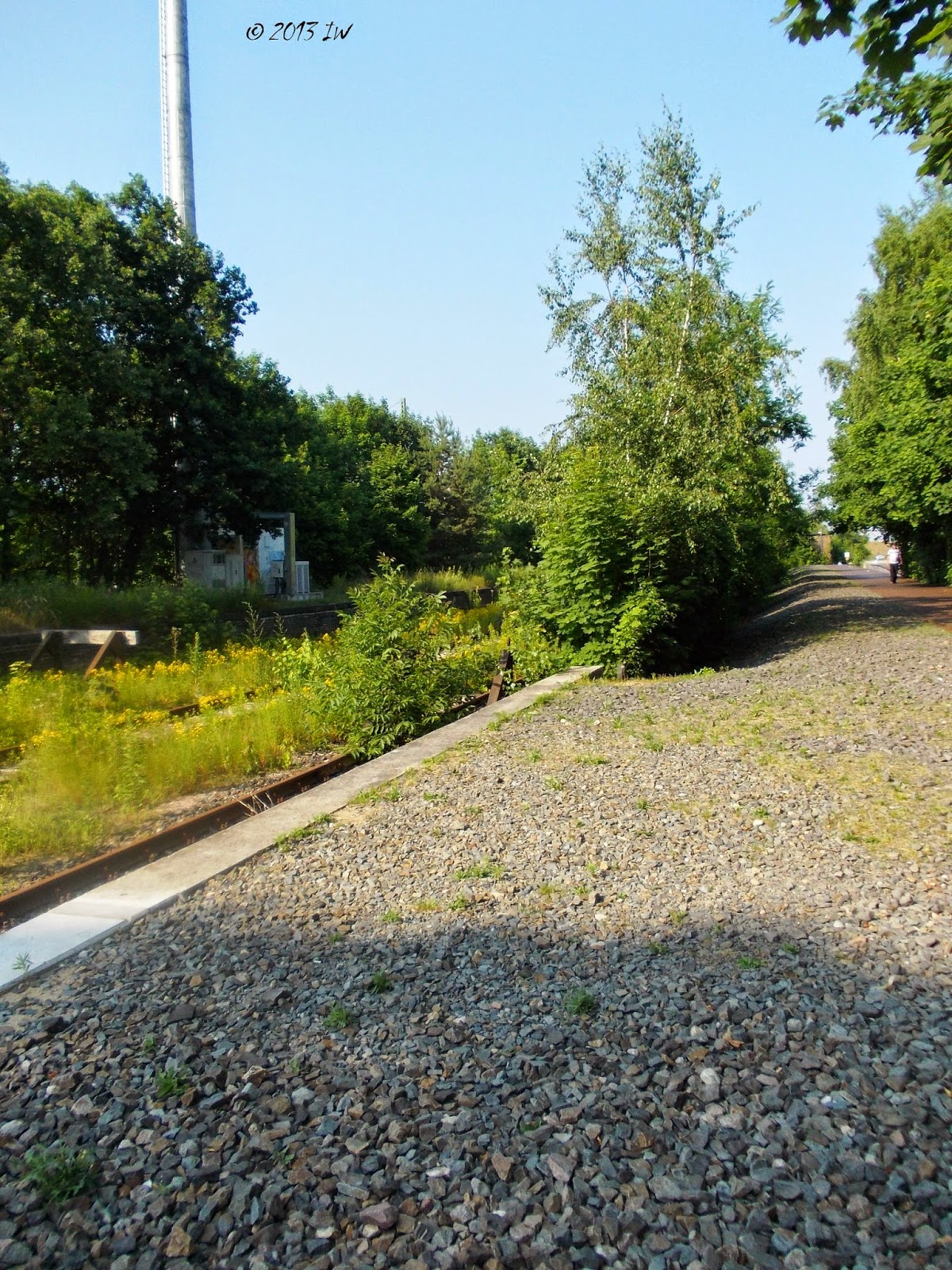
Jewish Memories: Gleis 17 Berlin

I visited the Gleis 17 from the Berlin Grunewald station the last August. It was a very sunny beautiful day and the noble houses from the area were breathing a majestic peace. The station was first opened in 1879 and bore different names till the current one. The entrance has the shape of a castle and was finished in 1899. 
Various arrows and historical references are leading the visitor to the Gleis/Platform 17, one of the many stations from the Berlin network where the trains are coming and going every 15 minutes almost. It was a certain ambiance of normality that I'm afraid to think it used to be during the terrible times too. Some were taking the train to Berlin, others to death.
From 18 October 1941 till beginning of March 1945, from this station left 183 trains with Jews deported to, first, Litzmannstadt and Warsaw and from 1942 on, to Auschwitz and Theresienstadt. The number of the victims that went through this station is of around 55,000 persons. 
Nowadays, the line is not used being changed into a memorial in the memory of the person deported with the Deutsche Reichsbahn. The inheritors of the then German rail company, Deutsche Bahn, contributed to the establishment of a memorial officially inaugurated on 27 January 1998. At this date the Auschwitz and Birkenau concentration camps were liberated. 
The platform is separated into 183 steel plates, with details of the trains that left the station. It includes the date, the destination and the number of deportees. 
Stones in the memory of the victims, according to the Jewish tradition, are set on various places near the platform. Regularly, reunions in the memory of the victims are held, and most Israeli delegations visiting Berlin include Gleis 17 as part of their program. 
Remembrance has an important role in the Jewish tradition. The victims should be remembered individually and their name kept in the book of life. 
I spent there probably more than one hour, walking slowly and quietly the platform, putting one stone in one corner. No one around, only my silent steps on the steel. There is a lot of sadness and depressive feeling about the human condition. But there is also hatikva/hope, that such atrocities are not possible nowadays as we do have our state to protect and safe us from all evils.  

Wednesday, 16 April 2014

Book review: Rivka Guber Signal Fires of Lachish

Pesach is that time of the year when I have time to catch up with reading, and especially after a couple of busy weeks, I finally found the peace for books. Trying to follow the general topic of the holidays, stumbled upon a book by Rivka Guber, a pioneer in the domain of education and absorption policies in the newly created state of Israel.
The signal fires of Lachish is written in the journalist style, rather as a testimony than a literary account of the first years of the state. When you work hard to build a country, who does have time of literature and poetry? The style reminds me of some early Soviety/Russian feature reports, that probably Guber was used with, as she was born in Ukraine and spent some time in the country before moving to Israel. Involved in the creation of the new education system, especially the integration of new Jewish immigrants from all over the world, she mentions several times that she used the pedagogic principles of Makarenko in creating equal opportunities for the Jewish children. 
Even though the book doesn't have high literary or journalistic qualities, it is a valuable testimony of the beginning of the state and not less important, a very intimate account of the sociological and demographic changes underwent by the state of Israel. The issue of the so-called Eastern communities - North Africa, Iran, Yemen, Iraq, Kurdistan area - is presented carefully, without the usual ethnic bias, but with the generous aim to create an integrated society. The first stage of the ingathering of exiles brought together the sophisticated and less religious Askenazim with traditional families from Morocco and Yemen and the meeting wasn't a happy one. Prejudices of old generations against Eastern communities were based of a lack of understanding and contact with those fellow Jews. Some of those prejudices I try to do not hear tomorrow, but I should be thankful for living in a different stage of Jewish history, when I don't feel different of the welcoming Iraqi Jews from whom I am happy to learn every time something new. The educational state policies contributed to bring all of us at the same level of Jewish knowledge and made all of us feel as part of the same community, assuming our differences and histories. Guber's book helped me to understand  - even though I deeply disapprove - the root of the stereotypes and lack of understanding towards the 'Oriental' Jews, and to appreciate the tremendous progress achieved in only in one generation that diminished many of the misunderstandings.
I went more than one jealous of the extraordinary experiences she witnessed, the enthusiasm of building a new country, the discovery of the lost Jews and all the difficulties of the new beginnings. But still, the same difficulties persist and even though the challenges are different, the passions remain.
Especially one story at the end of the book made me think about some recent stories that maybe I will talk more about one day: a family of fresh Polish immigrants, mother and son, were expressing their dissatisfaction with the situation encountered in Israel. They were speaking only Polish and the son was photographer, a job not necessarily sought at the time. Rivka Guber suggests them to try to find out a low level job till they will be able to get a proper training for competing for the job market. They refuse to accept the reality and prefer to complain about the lack of promises in the 'promise land' and threaten with leaving the country. Sounds familiar? At least for me does...
I recommend this book for the sociological information, but also because it shows how fast we were able to move fast forward in such a short time.